
Category: SEO Strategy | Content Marketing | AI Search | Entity SEO
Published: June 27, 2026
Read time: 8 min
Site: TheTechCursor
For years, SEO content strategy meant one thing: find a keyword, create a page, repeat. The goal was to accumulate rankings across a growing list of target terms. It worked — until AI search changed what “being found” actually means.
In 2026, the question is no longer just “do we rank for this keyword?” It is “Does Google’s AI understand our expertise deeply enough to cite us when users ask about this topic?” That is a fundamentally different question — and answering it requires a fundamentally different content strategy.
Topical maps are the answer. Here is how to build one that drives AI search citations, not just keyword rankings.
Table of Contents
- Why Topical Maps Matter More Than Ever in AI Search
- Keywords vs Topics vs Entities — The 2026 Distinction
- What a Topical Map Actually Is
- How AI Search Changed the Rules for Content Clusters
- Building a Topical Map for AI Search Visibility
- Step 1: Define Your Core Entity
- Step 2: Map Your Topic Clusters
- Step 3: Identify Content Gaps Using AI Tools
- Step 4: Build Authority Pages, Not Just Posts
- Step 5: Connect With Semantic Internal Linking
- How Topical Maps Drive AI Citations
- Bottom Line
1. Why Topical Maps Matter More Than Ever in AI Search
AI search systems — Google AI Overviews, AI Mode, ChatGPT, Perplexity — do not retrieve individual pages in response to queries. They retrieve entities, synthesize understanding across multiple sources, and generate answers that cite the sources they consider most authoritative.
To be cited consistently, your brand needs to be recognized as an authoritative entity in your topic area — not just a page that matches a keyword. That distinction is the heart of why topical maps matter in 2026.
As covered in TheTechCursor’s breakdown of Google’s entity understanding patent, AI systems build holistic profiles of brands and businesses by aggregating signals from across the web — your website, third-party mentions, review platforms, and structured data. The depth and coherence of your content coverage is one of the primary signals those systems use to evaluate your topical authority.
A scattered content strategy — jumping between loosely related topics based on keyword opportunity — produces a fragmented entity signal. A coherent topical map produces a concentrated authority signal that AI systems recognize and cite.
2. Keywords vs Topics vs Entities — The 2026 Distinction
Before building a topical map, it helps to understand the three levels of content organization — and how they relate to AI search:
Keywords are the specific phrases users type into search engines. They represent individual user queries — highly specific, tied to a moment of intent. Traditional SEO optimized primarily at this level.
Topics are thematic areas that encompass multiple keywords and related concepts. A topic like “content marketing for SaaS” contains dozens of related keywords, subtopics, and angles. Topics guide content strategy at the cluster level.
Entities are the foundational concepts AI systems use to organize knowledge. They are unique, identifiable concepts — people, places, things, ideas — that exist consistently across different texts and contexts. “Content marketing” is an entity. So is your brand.
In AI search, entities are the organizing principle. When a user asks, “What are the best content marketing strategies for B2B SaaS?” the AI system does not look for pages that contain those exact words. It looks for entities it recognizes as authoritative on content marketing for B2B contexts — and cites the sources most strongly associated with those entities.
Your topical map should be built with entities in mind — not just keywords.
3. What a Topical Map Actually Is
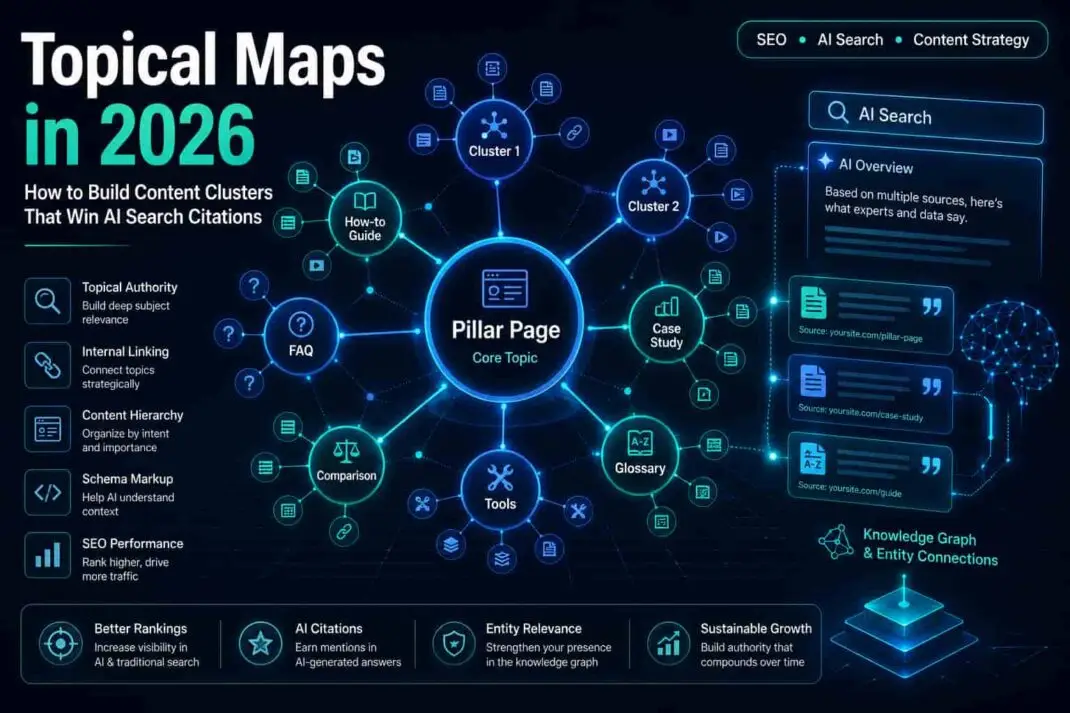
A topical map is a structured visualization of your content strategy — showing how your core subject matter connects to related subtopics, specific articles, and the entities that link them together.
Think of it as a hub-and-spoke diagram:
- The hub — your core entity or primary expertise area
- Primary spokes — major topic clusters that define your expertise
- Secondary spokes — specific subtopics within each cluster
- Content pieces — individual articles, guides, or pages covering each subtopic
- Entity connections — the semantic relationships linking your content together
For example, TheTechCursor’s topical map might look like:
Hub: Digital Marketing and AI Search Primary clusters: SEO Strategy, Google Ads, AI Tools, Content Marketing, Tech News Within SEO Strategy: Entity SEO, Content Pruning, Query Fan-Out, Topical Authority, Link Building, Technical SEO Within each subtopic: Specific articles targeting that subtopic comprehensively
The goal is not to cover every possible topic. It is to cover your specific expertise area more completely and coherently than any competitor, creating a content footprint that AI systems recognize as the authoritative source for your niche.
4. How AI Search Changed the Rules for Content Clusters
Traditional content cluster advice focused on creating a pillar page with supporting articles linking back to it. The goal was to link equity distribution and topical signal concentration. It was primarily about internal linking architecture.
AI search has changed the requirements in three important ways:
Comprehensiveness beats breadth. AI systems evaluate whether your content collectively covers a topic from multiple angles — not just whether you have a page for each keyword. A comprehensive pillar page that addresses the full information space of a topic is more valuable than ten thin pages targeting individual keyword variations.
Query fan-out rewards depth. As covered in TheTechCursor’s query fan-out article, AI systems generate multiple related sub-queries for each user question. Your content cluster needs to address not just the primary query but the full range of sub-queries — implied questions, follow-up questions, comparisons, and specifications — that AI systems generate from your core topics.
Entity relationships matter as much as internal links. The traditional cluster strategy emphasized linking. AI search emphasizes semantic coherence — whether your content collectively signals a consistent, coherent expertise in a specific entity space. Schema markup, consistent terminology, and clear entity relationships across your content contribute to this signal.
5. Building a Topical Map for AI Search Visibility
Here is a practical, step-by-step process for building a topical map specifically optimized for AI search citations.
6. Step 1: Define Your Core Entity
Start by identifying the primary entity your brand or website represents. This is the concept at the center of your topical map — the thing AI systems should associate with your brand above all others.
Be specific. “Digital marketing” is too broad for a new or mid-sized site to claim authority over. “AI search optimization for B2B SaaS companies” is a specific enough entity to own.
Questions to define your core entity:
- What specific problem does your brand solve?
- Who specifically do you serve?
- What would you want AI systems to cite you for most?
- Where do you have genuine expertise that competitors lack?
The more specifically you can define your core entity, the more coherent your topical map — and the stronger your authority signal will be in that specific space.
7. Step 2: Map Your Topic Clusters
With your core entity defined, identify the major topic clusters that make up your expertise area. These are the primary spokes of your topical map — the broad thematic areas that collectively define your subject matter.
For each primary cluster, identify:
- The main subtopics within it — the secondary spokes
- The specific questions your audience has about each subtopic
- The content you already have covering each area
- The gaps where coverage is thin or missing entirely
Tools useful for this mapping process:
- Google’s People Also Ask boxes reveal the sub-questions AI systems commonly generate around your topics
- Answer the Public or similar tools — surface question patterns around each entity
- Your existing Search Console data shows what queries you already rank for and what adjacent topics generate impressions
- Competitor site audits using
site:competitor.com— reveals the cluster structure of competitor content
8. Step 3: Identify Content Gaps Using AI Tools
Once your topical map is drafted, identify where your coverage is incomplete relative to what AI systems expect to find in your expertise area.
The query fan-out test: For each of your core topics, run that topic as a prompt through Google AI Mode, ChatGPT, or Perplexity. Review the response — what subtopics does it cover? What sources does it cite? Where is your brand absent from the response?
The subtopics covered in AI responses represent the query fan-out your content needs to address. If AI systems consistently cover aspects of your topic that your content does not address, those are your priority content gaps.
The entity coverage test: Using Google search operators (site:yourdomain.com intext:"entity name"), check whether your site addresses all the key entities associated with your core topic. Missing entity coverage weakens your topical authority signal.
The competitor gap test: Identify which competitor pages appear most frequently in AI citations for your target topics. Analyze their content structure — what do they cover that you do not? What depth of treatment do they provide that your content lacks?
9. Step 4: Build Authority Pages, Not Just Posts
In AI search, comprehensive “authority pages” — content-rich pages that address a topic across multiple angles and sub-questions — consistently outperform collections of thin posts targeting individual keywords.
An authority page on “content pruning for AI SEO” should address:
- What content pruning is and why it matters
- How AI search changed the requirements for content pruning
- A step-by-step process for identifying pruning candidates
- Specific metrics to evaluate
- What to do with pruned content — remove, redirect, consolidate
- Post-pruning actions to maximize impact
- A real case study with outcomes
This single comprehensive page addresses the full range of sub-queries AI systems generate around the topic — making it far more likely to be cited than five thin posts each targeting one aspect of the topic.
Furthermore, schema markup on authority pages significantly strengthens entity signals. Article schema with clear author attribution, mentions schema linking to related entities, and FAQ schema for common questions all help AI systems parse and cite your content accurately.
10. Step 5: Connect With Semantic Internal Linking
Internal linking in the AI search era is about semantic relationships — not just link equity transfer. When you link from one piece of content to another, the anchor text and surrounding context signal to AI systems how those pieces of content relate to each other within your entity space.
Best practices for semantic internal linking in 2026:
Use descriptive, entity-rich anchor text. Link to “content pruning for AI SEO” rather than “this guide” or “click here.” The anchor text signals the semantic relationship between pages.
Link from primary topics to subtopics and back. A hub page on “AI search visibility” should link to every cluster article that covers a specific aspect of AI visibility — and each of those articles should link back to the hub.
Connect related entities across clusters. When your content on “query fan-out” is relevant to your content on “topical maps,” link between them — not just within each cluster. Cross-cluster connections strengthen the overall coherence of your entity network.
Update older content to link to newer authority pages. Every time you publish a new comprehensive resource, identify existing content that covers related entities and add internal links to the new resource.
11. How Topical Maps Drive AI Citations
The connection between a well-built topical map and AI citation probability is direct and measurable. When AI systems evaluate which sources to cite for a given topic, they assess:
- Coverage depth — does this source address the topic comprehensively across multiple angles?
- Entity consistency — does this source consistently discuss the same entities across multiple pieces of content?
- Authority signals — do third-party sources reference this site when discussing this topic?
- Content freshness — is this source actively maintaining and updating its coverage?
A coherent topical map systematically strengthens all four signals simultaneously. Every piece of content you add to a well-structured cluster deepens your coverage, reinforces your entity consistency, gives third-party sources more to reference, and demonstrates active maintenance of your expertise area.
This is why brands with strong topical maps consistently appear in AI citations even for queries that do not exactly match their content — AI systems recognize their entity authority and cite them across the full range of related queries their expertise encompasses.
12. Bottom Line
Topical maps are not new — but their importance has increased dramatically as AI search has become the primary discovery mechanism for a growing share of user queries.
The brands that build coherent, comprehensive topical maps — covering their core entity deeply, addressing the full query fan-out space their topics generate, and connecting everything through semantic internal linking — are the ones consistently appearing in AI-generated answers.
The brands chasing individual keyword opportunities without a topical structure are building content that may rank temporarily but will struggle to generate the entity authority that drives AI citation probability over time.
Build the map first. Then fill it in systematically. The citations will follow.
Pingback: How Knix Beats H&M and Victoria's Secret in AI Search — The Vertical Authority Playbook for DTC Brands - The Tech Cursor