
Category: SEO Tools | AI SEO | Digital Marketing
Published: July 7, 2026
Read time: 7 min
Site: TheTechCursor
With 87% of Americans now reading AI-generated summaries rather than clicking through to websites, the tools that powered SEO success two years ago are no longer sufficient on their own. They have not become useless — but they have become incomplete.
Generative AI and automation are reshaping what SEO professionals need to track, analyze, and optimize. The teams moving fastest are not abandoning their existing tools. They are adding a new layer on top — LLMs, APIs, lightweight scripts, and notebook workflows that handle what legacy tools were never designed for.
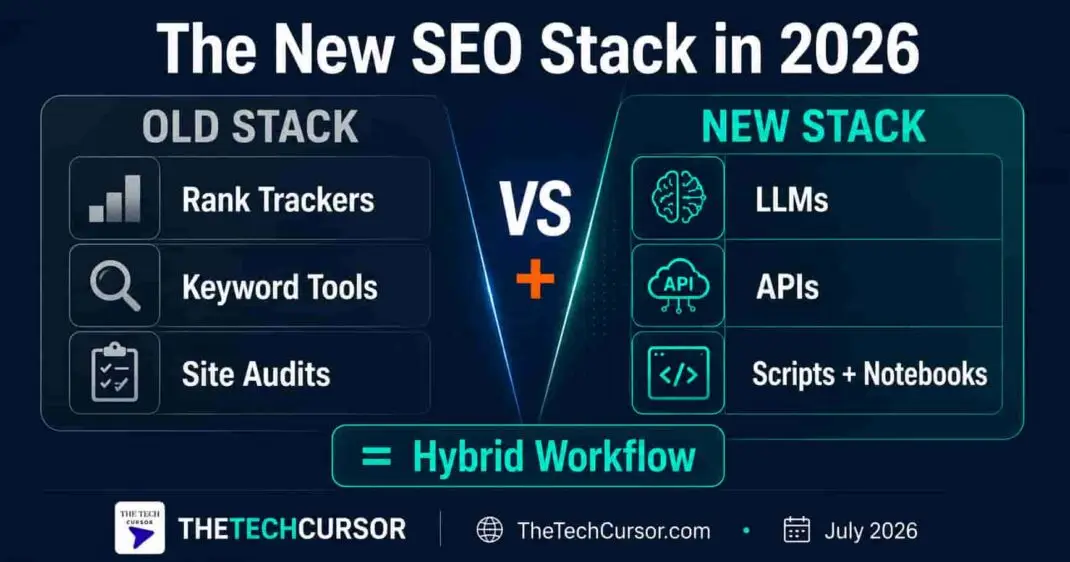
Here is a clear-eyed comparison of what is in the old stack, where it falls short, what belongs in the new stack, and how to combine them into a hybrid workflow that works in 2026.
Table of Contents
- Why Your Current SEO Stack Is Incomplete
- What the Old SEO Stack Looks Like
- Where the Old Stack Falls Short in 2026
- What the New SEO Stack Looks Like
- Tool 1: LLMs as SEO Analysts
- Tool 2: APIs — Beyond CSV Exports
- Tool 3: Lightweight Scripts
- Tool 4: Notebooks and Local Workflows
- Building a Hybrid Workflow — Old + New Together
- Bottom Line
1. Why Your Current SEO Stack Is Incomplete
Between the first and second half of 2025, LLM referral traffic to websites grew by 80%. Conversion rates from LLM referrals reached 18% — significantly higher than most organic search benchmarks. Yet LLM referrals still account for less than 2% of total traffic for most sites.
That combination — high conversion quality, low current volume, rapid growth — is exactly the signal that warrants early investment in understanding and optimizing for AI search visibility. The brands doing that work now will have a measurable advantage as LLM referral volume continues to scale.
The problem is that most existing SEO tools were built for a different environment. They measure what traditional search engines surface. They do not measure what AI systems recommend, cite, or synthesize — and those are increasingly different things.
2. What the Old SEO Stack Looks Like
Most SEO teams operate with some variation of this core toolset:
Rank trackers — Monitor keyword positions in search results. Add target keywords, watch SERP positions, use ranking improvements as a proxy for traffic potential.
Keyword research tools — Identify search volume, difficulty, and intent for target queries. Help build content calendars around what people are searching for.
Site audit tools — Crawl websites to identify technical issues: broken links, redirect chains, missing metadata, slow pages, thin content, and indexing problems.
These tools remain relevant. Google’s SEO fundamentals still apply to AI search — as covered extensively across TheTechCursor’s AI search series, the same crawlability, indexability, and content quality signals that drive traditional rankings also influence AI search visibility. However, these tools were not designed to answer the questions that matter most in 2026.
3. Where the Old Stack Falls Short in 2026
Rank trackers miss the new SERP reality. Rankings have fragmented dramatically. SEOs now need to track AI Overviews, local packs, shopping carousels, and featured snippets — not just blue link positions. Furthermore, a keyword that drove substantial traffic through a traditional ranking may now generate zero clicks because an AI Overview resolves the query without any click-through. The ranking still shows up. The traffic does not arrive. Rank trackers measure the former but cannot account for the latter.
Keyword tools reflect a world that is changing rapidly. A keyword with 10,000 monthly searches last month does not guarantee the same volume this month — and even stable volume does not guarantee click-through opportunity if an AI Overview resolves the query in the SERP. The opportunity has changed even when the volume has not.
Site audit tools lack brand mention and AI visibility tracking. Technical audit tools are excellent at identifying crawlability and on-page issues. However, brand mentions across the web — Reddit discussions, editorial reviews, community forums, third-party citations — are among the most important signals for inclusion in LLM recommendations. Most site audit tools do not track these signals at all. Your site can be technically perfect and still be invisible in AI-generated answers.
4. What the New SEO Stack Looks Like
The new SEO stack does not replace the old one — it extends it. Four categories of tools belong in every serious SEO team’s workflow in 2026:
- LLMs — for analysis, content evaluation, and research at scale
- APIs — for direct data access beyond dashboard exports
- Lightweight scripts — for custom automation without enterprise tool dependency
- Notebooks and local workflows — for consistent, documented, shared data processing
5. Tool 1: LLMs as SEO Analysts
LLMs — ChatGPT, Claude, Gemini — are the most significant addition to the SEO toolkit in years. Used correctly, they compress tasks that previously took hours or days into minutes.
Practical SEO applications for LLMs:
ChatGPT + Google Search Console integration: Connect ChatGPT directly to your GSC data to automate SEO analysis — identifying patterns in query performance, flagging pages with high impressions but low CTR, and surfacing content opportunities from your existing search data.
Claude for content and metadata work: Claude handles large-scale content audits, metadata refinement, and copy editing with consistent quality across high volumes. As covered in TheTechCursor’s guide to training Claude with your brand voice, Claude can be configured to maintain specific tone and formatting standards across all outputs.
Gemini for technical and competitive research. Gemini is particularly effective for schema markup generation, competitive site comparison, and identifying technical issues — especially when combined with its multimodal capabilities for analyzing page layouts and visual elements.
The critical constraint: Keep human oversight in place. LLMs improve performance — they do not replace the judgment required to evaluate that performance. Use them to handle volume; apply your expertise to decisions.
6. Tool 2: APIs — Beyond CSV Exports
The old workflow: log into Google Search Console, export a CSV, open it in Excel, and analyze manually. It worked — but it was slow, created data silos, and made cross-source analysis laborious.
APIs change this equation entirely. By connecting directly to data sources, you get real-time access to the exact data you need, in the format you need it, without the export-import cycle.
Key APIs for modern SEO workflows:
- Google Search Console API — direct access to query performance, page metrics, and index coverage data
- Google Analytics 4 API — programmatic access to traffic, engagement, and conversion data
- Google PageSpeed Insights API — automated Core Web Vitals monitoring across your full URL set
The barrier to using APIs has dropped significantly. LLMs can now help you authenticate requests, parse JSON responses, and structure data outputs — making API access realistic for SEO professionals without a development background.
7. Tool 3: Lightweight Scripts
Python scripts are now accessible to any SEO professional with basic skill — and tools like Claude Code make creating custom scripts significantly more approachable for those without a coding background.
What lightweight scripts can do:
A well-designed 100-line Python script can handle work that previously required manual effort across multiple tools:
- Pull your top pages from the Google Search Console API
- Compare title tags against character limits and keyword targets
- Flag pages where 30-day performance has changed significantly
- Generate a structured CSV output ready for editorial review
The key advantage over vendor tools: scripts are transparent, customizable, and immediate. You do not wait for a SaaS vendor to add a feature. You build exactly what you need for your specific situation — and you can see and share the exact logic behind it.
Furthermore, scripts can combine data from multiple sources in ways that no single tool can replicate — merging GSC query data with crawl data with GA4 engagement metrics into a single prioritized action list.
8. Tool 4: Notebooks and Local Workflows
Most SEO teams have data scattered across multiple places: shared folders, Google Sheets, Notion documents, tool exports, client dashboards. Pulling a coherent analysis from fragmented sources requires manual effort that compounds over time and creates inconsistency.
Notebooks — tools like Jupyter Notebook or similar environments — address this by creating a single, documented, shareable space where data flows in from multiple sources, scripts process it, and LLMs interpret the output.
The workflow pattern:
- A script pulls data from GSC, GA4, and a crawl tool simultaneously
- An API surfaces real-time signals alongside historical data
- An LLM makes sense of the combined data and surfaces priority actions
- Output goes into the Notebook in a consistent, documented format
- The team works from a single shared view rather than individual exports
The core benefit: consistent data formats, shared access, and documented logic that persists across team members and projects. New team members inherit the workflow — not a pile of unlabeled spreadsheets.
9. Building a Hybrid Workflow — Old + New Together
The most effective approach combines both stacks into a hybrid workflow that handles tasks which previously took weeks in a fraction of the time.
A practical hybrid workflow example:
- Crawl the site with a traditional audit tool (Screaming Frog, Sitebulb, or similar)
- Run a Python script that processes the crawl output and joins it with GSC data
- Script flags pages where impressions are high but click-through rate is low — identifying AI Overview impact
- Send flagged pages to an LLM to evaluate title tags against search intent and AI recommendation potential
- LLM output goes into a Notebook for editorial review and action tracking
- Approved changes become a change log with documented rationale and expected outcomes
This workflow handles tasks that enterprise teams previously found overwhelming. The combination of crawl data, API-sourced performance data, and LLM analysis in a single documented workflow makes large-scale technical content optimization genuinely manageable.
The principle behind the hybrid approach: use traditional tools for what they do best — comprehensive crawling, established ranking signals, proven technical diagnostics. Use the new stack for what legacy tools cannot do — AI visibility signals, large-scale content analysis, cross-source data synthesis, and custom automation.
10. Bottom Line
Your old SEO stack is not obsolete. Your rank tracker still tells you something useful. Your site audit tool still identifies real technical issues. Your keyword research tool still reveals search demand.
However, it is incomplete — and the gap is growing as AI search visibility becomes an increasingly important driver of qualified traffic.
The SEO teams moving fastest in 2026 are not starting over. They are adding LLMs for analysis at scale, APIs for direct data access, lightweight scripts for custom automation, and notebook workflows for data consistency — layered on top of the fundamentals that have always mattered.
Build the new stack. Keep the old one. Connect them into hybrid workflows that give you the signal coverage, speed, and scale that neither can provide alone.
Pingback: Topic Clusters for SEO and AI Search in 2026 - The Tech Cursor