
Category: SEO | Content Strategy | Google Search Quality
Read time: 8 min
Site: TheTechCursor
Google has published an official self-assessment checklist for content quality — 14 questions that site owners and content creators can use to evaluate whether their content meets Google’s quality standards.
This checklist is not new. However, it has taken on new importance in 2026 as AI Overviews, AI Mode, and multiple core updates have all applied the same underlying quality evaluation framework. Understanding Google’s exact criteria — in Google’s own words — is one of the most direct ways to improve both traditional search rankings and AI search visibility simultaneously.
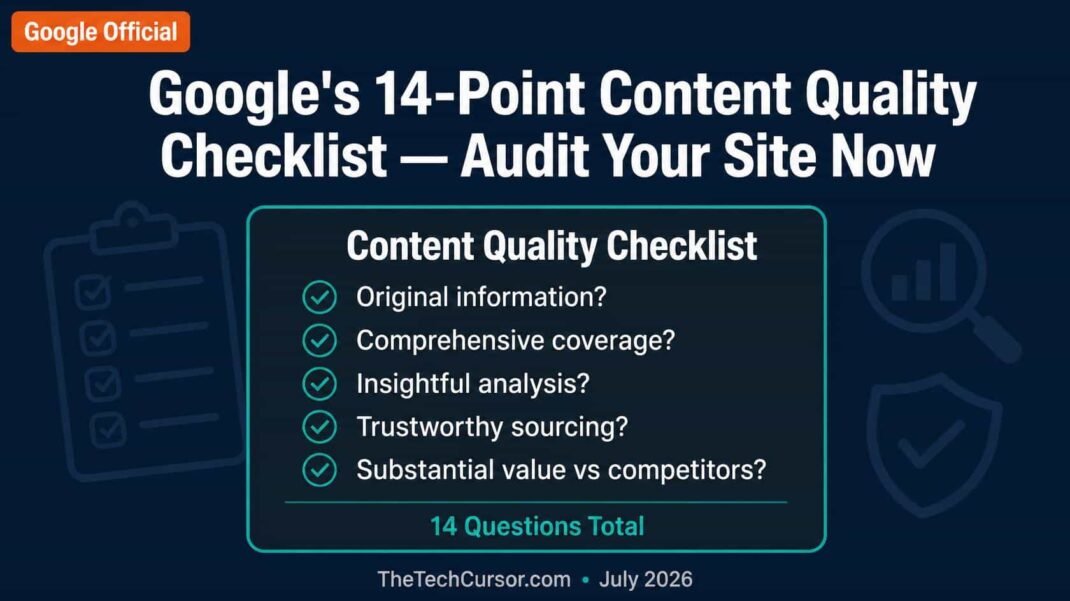
Here is the full checklist, how to use it as a practical audit tool, and what it means for AI search specifically.
Table of Contents
- Why This Checklist Matters More Than Ever
- The 14 Questions — Google’s Full List
- How to Use This as an Audit Framework
- Section 1: Content and Quality Questions (Q1-Q8)
- Section 2: Expertise Questions (Q9-Q11)
- Section 3: Presentation and Production (Q12-Q14)
- Content Problem vs Link Problem — How to Tell the Difference
- Applying the Checklist to AI Search Visibility
- Bottom Line
1. Why This Checklist Matters More Than Ever
Google’s helpful content system and its core ranking systems use the same quality signals that these 14 questions address. Content that would score well against this checklist is content that Google’s AI systems are designed to surface — whether in traditional search results, featured snippets, or AI Overviews.
Furthermore, as covered in TheTechCursor’s E-E-A-T 2026 article, the same signals that determine content quality for traditional rankings also feed into Google’s entity understanding — the holistic profile of your brand that AI systems use when deciding whether to cite you in generated responses.
Running this checklist against your most important pages is not just a traditional SEO exercise. It is an AI visibility audit.
2. The 14 Questions — Google’s Full List
Google organizes its content quality self-assessment into three categories. Here are all 14 questions exactly as Google frames them:
Content and Quality Questions:
- Does the content provide original information, reporting, research, or analysis?
- Does the content provide a substantial, complete, or comprehensive description of the topic?
- Does the content provide insightful analysis or interesting information that is beyond the obvious?
- If the content draws on other sources, does it avoid simply copying or rewriting those sources and instead provide substantial additional value and originality?
- Does the main heading or page title provide a descriptive, helpful summary of the content?
- Is this the sort of page you would want to bookmark, share with a friend, or recommend?
- Would you expect to see this content in or referenced by a printed magazine, encyclopedia, or book?
- Does the content have any spelling or stylistic issues?
Expertise Questions: 9. Is the content produced well, or does it appear sloppy or hastily produced? 10. Is the content mass-produced by or outsourced to a large number of creators, or spread across a large network of sites, so that individual pages or sites do not get as much attention or care? 11. Does the content present information in a way that makes you want to trust it — such as clear sourcing, evidence of the expertise involved, background on the author or the site that publishes it?
Presentation and Production Questions: 12. Does the content have an excessive amount of ads that distract from or interfere with the main content? 13. Does the content display well for mobile devices when viewed on them? 14. Does the content provide substantial value when compared with other pages in search results?
3. How to Use This as an Audit Framework
The most effective way to use this checklist is not to evaluate your site globally — it is to run it against specific pages systematically.
Step 1: Select your audit candidates. Identify the pages that matter most to your business — highest traffic, highest commercial intent, or highest competitive priority. Additionally, identify pages where traffic has declined recently. These are your priority audit candidates.
Step 2: Score each question honestly. For each of the 14 questions, score the page: Yes (meets the standard), Partially (meets it inconsistently or incompletely), or No (does not meet it). Be honest. The exercise is only useful if the scoring reflects reality rather than optimism.
Step 3: Identify patterns. Look for questions where multiple pages score Partially or No. Patterns indicate systemic issues — not just individual page problems. Systemic issues require content strategy changes, not just individual page fixes.
Step 4: Prioritize by impact. Not all 14 questions carry equal weight. Questions 1, 3, 4, and 14 — originality, insightful analysis, substantial additional value, and comparative value — are the ones most directly connected to core ranking performance and AI citation probability. Prioritize fixes that address these first.
4. Section 1: Content and Quality Questions (Q1-Q8)
Q1: Does the content provide original information, reporting, research, or analysis?
This is the foundational question. Content that restates what is already widely available online fails here — regardless of how well-written or well-structured it is. Original research, proprietary data, first-hand experience, and genuine analysis that adds something not already available elsewhere are what “yes” looks like.
Q2: Does the content provide a substantial, complete, or comprehensive description of the topic?
Thin coverage of broad topics fails this question. A 500-word overview of a complex topic that readers can find better covered in dozens of other places does not score well. Depth and comprehensiveness within a focused scope are what Google rewards — not length for its own sake.
Q3: Does the content provide insightful analysis or interesting information beyond the obvious?
This question targets the most common failure mode of AI-assisted content: producing technically accurate but intellectually inert summaries of established knowledge. “Insightful analysis” means the content offers a perspective, conclusion, or framing that a reader could not easily find by searching elsewhere.
Q4: If drawing on other sources, does it avoid simply rewriting them?
Content that aggregates or paraphrases existing sources without adding genuine value fails here. Synthesis that produces new understanding, identifies contradictions, or applies existing information to a novel context passes. Simple rewrites do not.
Q5: Does the main heading or page title provide a descriptive, helpful summary?
Clickbait titles that overpromise or misrepresent content fail this question. Descriptive, accurate titles that give readers a clear picture of what they will find pass.
Q6: Is this the sort of page you would want to bookmark, share with a friend, or recommend?
This is Google’s most human-centred question — and one of the most useful for honest self-assessment. If you would not share or bookmark the page yourself, it is unlikely to meet the standard.
Q7: Would you expect to see this content referenced by a printed magazine, encyclopedia, or book?
This question sets a high bar for factual accuracy, sourcing quality, and informational substance. Content that would embarrass a reputable editor fails this standard.
Q8: Does the content have any spelling or stylistic issues?
This is the most mechanical of the 14 questions — but it matters because surface errors signal hasty production, which correlates with lower content investment overall.
5. Section 2: Expertise Questions (Q9-Q11)
Q9: Is the content produced well, or does it appear sloppy or hastily produced?
Production quality signals investment — and investment signals that the content was created to serve readers, not to fill a content calendar. Sloppy production — inconsistent formatting, missing images, broken internal links, incomplete information — fails this question.
Q10: Is the content mass-produced or spread across a large network of sites without individual attention?
This question directly targets content farm patterns — large volumes of similar content produced at scale without individual editorial attention. Each page should feel like it received specific care, not like it was generated from a template.
Q11: Does the content present information in a way that makes you trust it?
Clear sourcing, named authors with verifiable credentials, transparent publisher information, and accurate factual claims all contribute to trustworthiness. As covered in TheTechCursor’s E-E-A-T 2026 guide, this aligns directly with the Trust component of Google’s quality framework.
6. Section 3: Presentation and Production (Q12-Q14)
Q12: Does the content have an excessive amount of ads that distract from or interfere with the main content?
Interstitial ads, auto-playing video ads, and ad placements that obscure content before the user has had a chance to read it all fail this question. The standard is “no ads” — it is “ads that do not interfere with the primary content experience.”
Q13: Does the content display well for mobile devices?
With the majority of searches now happening on mobile, this is a baseline technical requirement. Responsive design, readable text sizes, accessible navigation, and fast loading on mobile connections are all components of a yes answer here.
Q14: Does the content provide substantial value when compared with other pages in search results?
This is the comparative question — and in some ways the most important one. A page can score well on all 13 preceding questions and still fail here if every competitor page is equally good or better. Genuine differentiation — a unique angle, exclusive data, more comprehensive coverage, or a more useful format — is what “substantial value compared to other pages” requires.
7. Content Problem vs Link Problem — How to Tell the Difference
One of the most valuable applications of this checklist is diagnosing why pages are underperforming. However, a content quality audit only reveals content problems — not link problems. Knowing which you are dealing with changes your remediation approach entirely.
Signs of a content problem:
- Pages score Partially or No on multiple questions in the checklist
- Competitor pages covering the same topic score better against the checklist
- User engagement metrics are poor — high bounce rate, short session duration, low return visit rate
- Pages have never ranked well despite existing for a long time
Signs of a link problem:
- Pages score well against the checklist — they are genuinely good content
- User engagement is strong when traffic does arrive
- The page targets a competitive keyword where established sites with strong link profiles dominate
- Comparable pages on competitor sites with stronger domain authority outrank you despite similar content quality
Content problems require content improvements. Link problems require authority building — through earning backlinks, improving topical authority across the site, and building the third-party citation signals covered in TheTechCursor’s link intent and topic-specific authority articles.
Applying content fixes to a link problem — or link building to a content problem — wastes time and budget.
8. Applying the Checklist to AI Search Visibility
The 14 questions are framed around traditional search quality. However, they apply equally to AI search visibility — and in some cases with greater weight.
Q1 (originality) and Q3 (insightful analysis) are particularly important for AI citation. As covered in TheTechCursor’s content repurposing and AI visibility guides, AI systems favour content that contains something they cannot generate themselves — proprietary data, first-hand experience, expert analysis. Content that fails Q1 and Q3 is unlikely to be cited in AI responses because the AI already has access to the same information from the same sources you are drawing on.
Q11 (trustworthiness signals) feeds directly into entity understanding. Named authors, clear sourcing, and verifiable credentials are not just trust signals for human readers — they are entity signals that AI systems use to evaluate and represent your brand, as covered in TheTechCursor’s entity SEO and Google patent articles.
Q14 (comparative value) is the AI equivalent of the citation worthiness question. An AI system generating a response about your topic has access to every source on the web. The reason to cite your specific page — over hundreds of others covering similar ground — is that your page provides something the others do not. That is what Q14 is testing.
9. Bottom Line
Google’s 14-question content quality checklist is one of the most direct tools available for understanding what Google’s ranking systems actually evaluate. Running it honestly against your highest-priority pages will surface problems that keyword analysis and technical audits cannot find.
Moreover, in 2026, this checklist is not just a traditional SEO tool. It is an AI visibility audit — because the same quality signals that drive Google Search rankings also drive AI Overview citations, entity understanding, and AI search recommendation probability.
Print it out. Run it against your ten most important pages. Score every question honestly. Then fix the patterns you find — starting with Q1, Q3, Q4, and Q14.
The checklist is simple. Following it honestly is harder. Doing so consistently is what separates the sites that win in AI search from those that disappear from it.
Pingback: Why Your Content Briefs Are Failing — And How Audience Situations Fix Them - The Tech Cursor
Pingback: Content Marketing Hits 12-Year Low — AI Isn't Why - The Tech Cursor
Pingback: Keyword Seed Selection for International SEO: Complete Guide - The Tech Cursor