
Category: Google Algorithm | SEO | Spam Update
Read time: 4 min
Site: TheTechCursor
Table of Contents
- What Google Just Released
- 2026 Google Update Timeline — Where This Fits
- What This Update Targets
- How August Differs From the June Spam Update
- Who Should Be Concerned
- What to Check Right Now
- Bottom Line
Update — August 21, 2026: The August 2026 Spam Update has completed rolling out. Google confirmed the rollout finished on August 21, 2026 at 4:50 am ET — taking just 2.5 days to complete. Google noted this is a “normal spam” update with nothing specifically new outside of running it again. If your site was not impacted, you are good to go — at least for now.
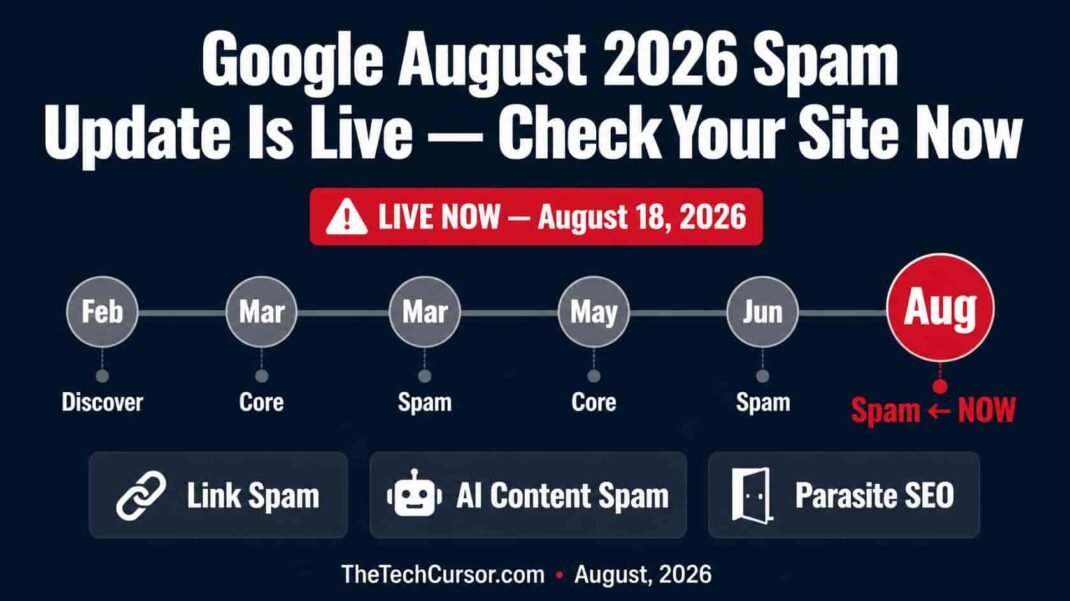
Google has released its second spam update of 2026. The August 2026 Spam Update began rolling out today — following the June 2026 Spam Update covered in TheTechCursor’s earlier article — and continues Google’s pattern of more frequent, targeted enforcement actions against manipulative search practices.
As with previous spam updates, Google confirmed the rollout applies globally and to all languages.
1. What Google Just Released
Google confirmed the release of the August 2026 Spam Update on August 18, 2026. The update follows the same structure as previous spam updates — a targeted enforcement action against sites violating Google’s spam policies, separate from the broader quality recalibration of a core update.
The rollout is expected to take a few days to complete. During that window, sites using manipulative techniques may begin seeing ranking changes — though full impact assessment typically requires waiting until the rollout is confirmed complete.
2. 2026 Google Update Timeline — Where This Fits
August’s spam update is the sixth confirmed Google algorithm update of 2026:
| Month | Update Type |
|---|---|
| February 2026 | Google Discover Core Update |
| March 2026 | March 2026 Core Update |
| March 2026 | March 2026 Spam Update |
| May 2026 | May 2026 Core Update (completed June 2) |
| June 2026 | June 2026 Spam Update |
| August 2026 | August 2026 Spam Update ← Live now |
Two spam updates in a single calendar year — in June and now in August — signal that Google is accelerating its spam enforcement cadence. Historically, spam updates occurred once or twice annually. Two within three months suggests either a growing volume of spam requiring enforcement or an increasingly capable SpamBrain system that can identify and action violations more rapidly.
3. What This Update Targets
Spam updates target sites violating Google’s spam policies — not general quality issues, which are addressed by core updates. Common spam techniques that spam updates enforce against include:
Link spam: Buying, selling, or artificially generating backlinks to manipulate PageRank. As covered in TheTechCursor’s article on why traditional link building no longer works for AI search, manipulative link schemes carry increasing risk as both traditional spam detection and AI search systems become more sophisticated at identifying manufactured authority signals.
AI-generated spam content: Low-quality, mass-produced AI content created purely for ranking manipulation without genuine editorial value. The line Google draws is between AI-assisted content with genuine editorial oversight and AI-generated content produced at scale purely to fill pages with keyword-relevant text.
Cloaking: Showing different content to Google than to users — a classic spam technique that remains a violation regardless of how it is implemented.
Doorway pages: Pages created purely to rank for specific queries and then redirect users elsewhere, with no genuine standalone value.
Hidden text or links: Content or links visible to crawlers but not to users — another classic technique that SpamBrain has become increasingly effective at detecting.
Parasite SEO: Using high-authority third-party domains to publish content designed to rank for queries unrelated to the host site’s core topic — a technique that has seen growing enforcement in recent spam updates.
4. How August Differs From the June Spam Update
Two spam updates within three months raise a natural question: what is the August update targeting that June did not already address?
While Google has not published specific targeting details for the August update, several patterns typically distinguish consecutive spam updates:
Model improvements: SpamBrain — Google’s AI-powered spam detection system — receives ongoing improvements. An August update may reflect improved detection capabilities for spam patterns that June’s model caught less reliably.
Emerging spam patterns: The SEO community often responds to enforcement actions by adapting tactics. New spam patterns that emerged after June may be specifically addressed in August.
Geographic or language-specific targeting: Some spam updates focus enforcement on specific markets or languages where particular techniques are concentrated.
Scale and backlog: Google processes an enormous volume of web content. Some sites flagged by SpamBrain’s continuous monitoring may be actioned in batches — the August update may be addressing a queue of violations identified since June.
5. Who Should Be Concerned
As with all spam updates, sites not using manipulative techniques should not be affected. The update is enforcement, not quality recalibration.
Higher risk if you have:
- Participated in link buying, link exchanges, or paid placement schemes — regardless of how they were framed (as “sponsored content,” “native advertising,” or “partnership placements”)
- Published large volumes of AI-generated content without genuine editorial oversight or original value
- Used programmatic or templated page generation to target large volumes of keyword variations with thin content
- Engaged in any form of cloaking — including JavaScript cloaking or geo-targeting used to show different content to Google
- Published content on high-authority domains that is unrelated to those domains’ core topics (parasite SEO)
Lower risk if you have:
- Earned links through genuine content quality and outreach
- Used AI as an editorial assistance tool with human oversight and genuine value-add
- Built content strategy around topical authority and user need rather than keyword manipulation
- Maintained consistent, accurate content across all technical and user-facing surfaces
6. What to Check Right Now
Monitor your Search Console data: Over the next 3-5 days, watch for significant changes in impressions, clicks, and average position — particularly for pages that rely heavily on link equity from external sources. A sudden drop in ranking for specific pages correlates more clearly with spam enforcement than a gradual decline.
Check for manual actions: Navigate to Manual Actions in Google Search Console. Spam enforcement can arrive as either an algorithmic action (through SpamBrain) or a manual action from a Google reviewer. Manual actions appear explicitly in Search Console — algorithmic ones do not.
Audit your link profile: Review your backlink profile using Ahrefs, Semrush, or Google Search Console’s links report. Identify any links from sites that match spam patterns — irrelevant niches, multiple unrelated clients linked from the same page, no organic traffic, heavily monetised with paid placements.
Review your AI content policy: If your team has been using AI for content production, audit whether that content includes genuine editorial value — original analysis, first-hand expertise, or information that adds something beyond what is already available. Content that fails this test is increasingly at risk from spam enforcement as SpamBrain’s AI content detection capabilities improve.
7. Bottom Line
The August 2026 Spam Update is Google’s second spam enforcement action of 2026 — following June’s update just two months ago. The accelerating cadence signals growing spam enforcement capability and intent.
If your site relies on genuine content quality and earned authority, you have nothing to fear. If your site has accumulated links through manipulative means or produced AI content at scale without genuine editorial oversight, the August update represents increasing risk.
Monitor your Search Console data over the next few days. Check for manual actions. And if you see unexplained ranking drops after the rollout completes, review your practices against Google’s spam policies before concluding.