
Category: International SEO | E-E-A-T | AI Search | Digital Marketing
Read time: 8 min
Table of Contents
- The Assumption That Is Costing Global Brands AI Visibility
- How AI Flattens 40 Markets Into One Impression
- The Credential Recognition Problem — The Japanese Architect Example
- Source of Truth vs Domain Authority — Two Different Claims
- What Authority Translation Actually Means
- How to Make Local Credentials Machine-Recognizable
- The Informational Gain Requirement for International Content
- Entity Connections — The Technical Layer of Authority Translation
- What International SEO Teams Need to Change Right Now
- Bottom Line
International SEO has always operated on an assumption that authority travels. Build expertise in one market, translate and localize the content, and that authority extends naturally into other markets.
< cite index=”34-1″>While a brand’s reputation and authority do travel, international SEOs have already learned that they don’t travel for free. Link building taught the same lesson years ago: a page didn’t rank in Mexico because the brand had strong links in the US. It ranked because it earned links from local-market sites carrying local trust. Authority accrued market by market, evidenced locally, not inherited from headquarters. The same is turning out to be true of experience and expertise signals for AI.</cite>
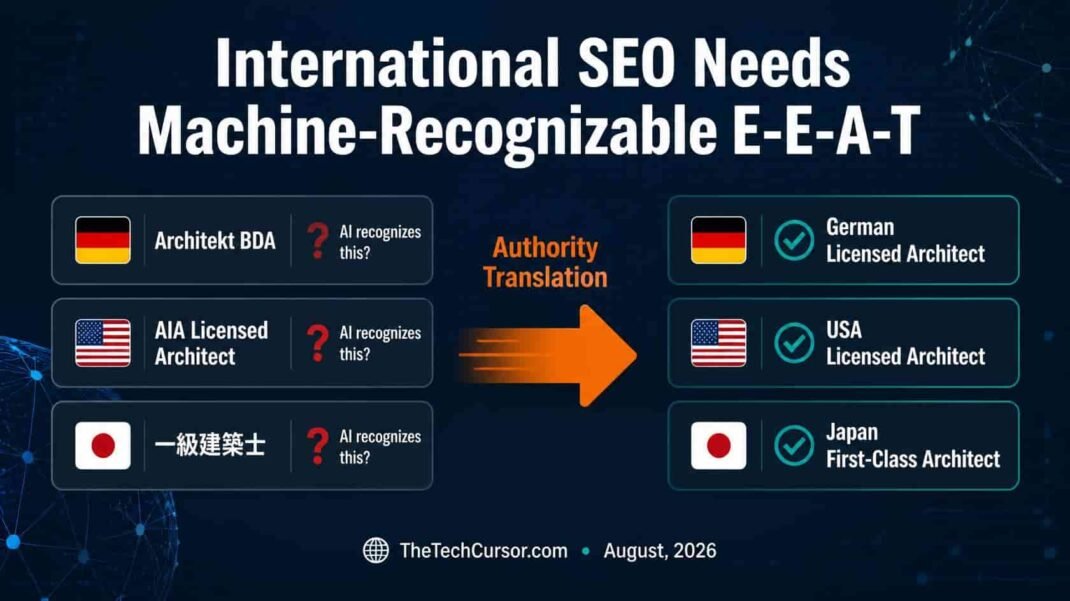
This is the challenge that Motoko Hunt — President of AJPR and one of the leading international SEO practitioners in the world — has named and framed in a landmark August 2026 analysis. The concept she introduces is Authority Translation — and it fundamentally changes what international SEO teams need to do in the AI era.
1. The Assumption That Is Costing Global Brands AI Visibility
The assumption that authority automatically transfers across markets was always partially wrong — link building proved that. However, AI search has made it dramatically more wrong, for a reason that goes deeper than link signals.
< cite index=”34-1″>A brand doesn’t get credit for authority it holds elsewhere; it must be evidenced in a form the model can recognize as belonging to that market. The reality is that AI doesn’t inherit authority automatically.</cite>
This distinction matters because it changes where the problem lives. International SEO teams have traditionally focused on making content understandable for local customers and discoverable by search engines. AI introduces a third objective — making expertise recognizable to machines that may not understand what local credentials, professional designations, and institutional affiliations actually represent.
Expertise that is obvious to people within a market may remain invisible to AI systems if it is not expressed in forms those models have learned to interpret.
2. How AI Flattens 40 Markets Into One Impression
Here is the central insight that should concern every global brand with multiple regional websites.
< cite index=”34-1″>Picture a global brand with 40 regional websites, each one built the “right” way. Each site is localized into the market’s language, staffed with local writers, reviewed by local experts, and full of market-specific examples and terminology. By every traditional SEO standard, this is textbook international E-E-A-T.</cite>
A human evaluating this brand market by market would recognize 40 distinct, credible sources with 40 demonstrations of local expertise. However, AI models do not necessarily see it that way.
< cite index=”34-1″>Trained on a mountain of near-identical content across those 40 domains, it can collapse the brand down into a single global representation — one composite impression of who the brand is and what it knows, flattened out of the very content that was supposed to prove local authority in the first place.</cite>
Hunt has tracked this pattern across her projects over years — a phenomenon she names market aggregation bias and canonical amplification. The more consistent and “on brand” the content is across markets, the easier it is for a model to treat 40 sites as one.
< cite index=”34-1″>Instead of recognizing 40 distinct market experiences, the model can end up with one generalized impression of the brand. Localized authority signals, regional terminology, market-specific examples, named local experts, local citations and references are frequently overwhelmed by their own similarity.</cite>
This is a deeply counterintuitive finding. The very practices that make international SEO work for traditional search — consistent brand voice, standardized content frameworks, unified messaging — can actively undermine AI search visibility by making markets indistinguishable to the model.
3. The Credential Recognition Problem — The Japanese Architect Example
The credential recognition problem is where the AI limitation becomes most concrete. Consider three architects:
< cite index=”34-1″>A German architect recognized through Germany’s professional licensing system and the Bund Deutscher Architektinnen und Architekten (BDA). A French architect registered with the Ordre des Architectes. A Japanese architect licensed as a 一級建築士 (First-Class Registered Architect). Each of these represents significant, legitimate expertise. Each follows a completely different cultural and institutional convention for how that expertise gets stated.</cite>
A human evaluator in each of these markets immediately understands what these credentials represent — because they know the professional standing associated with each designation. However, AI models learn from patterns in training data.
< cite index=”34-1″>Most are trained on enormous amounts of English-language content where professional authority is repeatedly described using familiar patterns and credentials. Those patterns become recognizable signals. When the model encounters a Japanese architect whose credential is expressed as 一級建築士, or a German architect identified as Architekt BDA, it isn’t seeing the same familiar pattern.</cite>
The institution gives the credential its authority. Human evaluators understand institutions. AI models recognize patterns. If the pattern connecting a local credential to the concept of professional authority is underrepresented in training data, the credential remains just another unfamiliar phrase — regardless of how significant it is within its local professional context.
< cite index=”34-1″>An architect can present credentials exactly as local regulations and professional bodies require and still fail to communicate expertise to AI. Nothing is wrong with the qualification itself. The model simply never learned that this particular expression represents the same level of professional authority.</cite>
The same pattern applies across every regulated profession: engineers, attorneys, accountants, financial advisers, medical professionals. In every market with its own licensing system, the credential gap exists — and the solution requires the same approach.
4. Source of Truth vs Domain Authority — Two Different Claims
One of the most important conceptual distinctions Hunt introduces separates two things that international SEO teams often conflate.
< cite index=”34-1″>Even genuinely being the source of truth doesn’t guarantee recognition of authority, experience, or knowledge in the subject matter itself. A brand can be the accurate, canonical answer to “what does this company say about itself” and still not read as an authority on the domain it operates in. Source-of-truth status answers who the company is. E-E-A-T is supposed to answer whether the company, or the person representing it, actually knows the subject. Those are two different claims, and AI systems appear to evaluate them separately.</cite>
This separation has significant practical implications. A company’s Wikipedia article, its structured data, and its official website establish entity identity — who the company is. However, this source-of-truth recognition does not automatically translate into domain authority recognition.
Demonstrating genuine topical expertise in each local market requires a different type of evidence — evidence that shows the company and its local representatives actually know the subject they are advising on, in ways that AI systems can recognize as genuine expertise rather than brand presence.
As covered in TheTechCursor’s entity SEO patent breakdown, AI systems build holistic entity profiles that include both identity signals and expertise signals. For international organizations, these two signal types require separate optimization strategies.
5. What Authority Translation Actually Means
< cite index=”34-1″>Localization has traditionally meant translating language, adapting imagery, and making content feel native to a particular market. AI adds another responsibility. We also must translate the evidence behind our expertise. That’s the idea behind what I call Authority Translation. The goal isn’t only to help local customers understand your content but to help AI understand why your organization deserves to be trusted in that market.</cite>
Authority Translation is not about creating new expertise. It is about making existing expertise legible to machines that may not have learned what local credentials and institutional affiliations represent.
< cite index=”34-1″>For many organizations, that doesn’t require rebuilding every regional website. It requires exposing the context that local audiences already take for granted. A credential may be obvious to customers in Germany or Korea, but AI may not know what that credential represents. The same applies to professional associations, regulatory approvals, industry certifications, universities, standards bodies, and other institutions that establish credibility within a market. Rather than assuming those relationships are obvious, organizations increasingly need to make them explicit.</cite>
The operative word is explicit. If a local credential is only listed by name without any contextual explanation of what it represents, the AI may not make the connection. Making it explicit means providing enough surrounding context that even a model without strong representation of that credential’s local significance can understand what it signals.
6. How to Make Local Credentials Machine-Recognizable
Applying Authority Translation in practice requires a different approach to author pages, about pages, and expert content attribution than traditional international SEO has required.
Connect credentials to their institutions explicitly: Rather than listing “Member, Ordre des Architectes,” provide context: “Member of the Ordre des Architectes, the French national regulatory body that licenses all architects practicing in France, with over 30,000 registered members.” This gives AI systems the contextual signal needed to recognize the credential’s significance.
Use Schema markup to encode credential relationships: Person schema allows explicit encoding of credentials, affiliations, and their relationships. The hasCredential and memberOf properties can connect a named expert to the institutions and certifications that establish their authority — providing structured signals that AI systems can parse without relying on training data recognition.
Cross-reference credentials across languages: For credentials that have internationally recognized equivalents, mention both. A Japanese 一級建築士 can be described as “Japan’s First-Class Registered Architect license, equivalent to chartered architect status in the UK or licensed architect status in the US.” The cross-reference helps models trained primarily on English content understand the credential’s significance.
Develop local expert entity presence: As covered in TheTechCursor’s E-E-A-T 2026 guide, named authors with verifiable professional profiles build entity associations that AI systems draw on when evaluating content credibility. For international markets, this means developing local author entity presence — not just bylines, but linked professional profiles, local professional association membership pages, and locally relevant publication records.
7. The Informational Gain Requirement for International Content
Authority Translation requires more than credential explanation — it requires that regional content actually contributes something new.
< cite index=”34-1″>One question I increasingly ask global organizations is whether a regional website contributes anything new or simply repeats what already exists somewhere else. Forty localized product pages may satisfy market presence, but they don’t necessarily provide 40 distinct demonstrations of expertise. Market-specific regulations, customer concerns, examples, case studies, and local expert commentary create informational gain. Those differences help preserve local authority instead of allowing it to disappear into a single global understanding of the brand.</cite>
This is where the market aggregation bias can be actively countered. Genuinely different content — not just translated, but locally specific in ways that reflect actual market differences — gives AI systems evidence that distinct local expertise exists.
Sources of genuine local informational gain:
- Local regulatory context: How does a global product or service interact with local regulations, standards bodies, or compliance requirements? This context is genuinely market-specific and cannot be synthesized from headquarters content.
- Local customer concerns: What concerns do customers in this specific market express? What objections are market-specific? What questions arise that customers in other markets do not ask?
- Local case studies and examples: Real outcomes from real clients in the specific market — with local context, local terminology, and local relevance that headquarters content cannot provide.
- Local expert commentary: Direct quotes, analysis, and perspective from named local experts with explicit credential context — creating the kind of distinct local voice that resists flattening into a global impression.
As covered in TheTechCursor’s content briefs article, audience situation briefs are particularly well-suited to generating this kind of locally specific content — because they start from the specific circumstances, constraints, and concerns of readers in a particular market context.
8. Entity Connections — The Technical Layer of Authority Translation
< cite index=”34-1″>The same principle applies to the relationships between entities. Credentials should connect to the organizations that issue them. Experts should connect to professional associations, publications, universities, certifications, and the topics they are qualified to discuss. Products should connect to the regulations, standards, and market-specific considerations that influence purchasing decisions. None of this creates new expertise. It simply makes existing expertise easier for AI to recognize.</cite>
The technical implementation of these entity connections uses structured data — specifically Schema.org markup that makes relationships between entities explicit and machine-readable.
Key entity relationships for international Authority Translation:
Person → Organization: Named experts connected to their employing organization through worksFor schema.
Person → Credential: Expert credentials connected to the issuing body through hasCredential schema, with credentialCategory and recognizedBy properties providing institutional context.
Person → Publication: Expert contributions connected to publications through author schema, establishing a published record of expertise.
Organization → Certification: Company-level certifications connected to the issuing regulatory or standards body through certification schema.
Organization → Market: Explicit geographic service area and market presence through areaServed schema — helping distinguish market-specific entities from the global parent brand.
These structured connections give AI systems explicit, machine-readable evidence of the credential and authority relationships that human readers in local markets understand implicitly.
9. What International SEO Teams Need to Change Right Now
< cite index=”34-1″>For international SEO teams, this changes what optimization means. For years, we’ve focused on making content understandable for local customers and discoverable by search engines. AI introduces another objective: making expertise recognizable.</cite>
Audit your credential presentation across markets: Review how local expert credentials are presented on author pages and about pages in each regional market. Are they listed by name only — or are they accompanied by enough contextual explanation for a model without strong local training data to understand their significance?
Assess your content differentiation per market: For each regional site, honestly evaluate: does this content contribute genuine local informational gain, or is it primarily translated headquarters content? Where the answer is “primarily translated,” identify the most important local differentiators to develop.
Implement entity connection schema: Audit your structured data across regional properties. Are expert credentials connected to their issuing institutions? Are local certifications connected to the regulatory bodies that issue them? Are named experts connected to the professional associations that validate their authority?
Develop market-specific expert entity presence: Identify the two or three most important subject matter experts for each major market. Build genuine local expert entity presence for each — professional association profiles, locally published articles, speaking engagements, and other signals that establish expertise within the local professional ecosystem.
Monitor AI citation patterns by market: As covered in TheTechCursor’s LLM prompt tracking guide, AI citation monitoring can reveal which markets are generating AI citations and which are not. For international brands, running the same prompt queries in different language markets reveals where Authority Translation is working and where the flattening problem is most severe.
10. Bottom Line
< cite index=”34-1″>International SEO has already learned this lesson once. Strong backlinks earned in one country never guaranteed visibility elsewhere, because authority had to be demonstrated in each market. AI is applying a similar expectation to expertise. Organizations that help AI recognize why their local experts, institutions, and knowledge matter will have a significant advantage over those that assume credibility automatically transfers across markets.</cite>
< cite index=”34-1″>The organizations that succeed won’t necessarily be those with the greatest expertise. They’ll be the ones that make it easiest for AI to recognize that expertise. In the AI era, localization is no longer just about translating language. It’s about translating evidence.</cite>
Authority Translation — the practice of making local credentials, institutional affiliations, and market-specific expertise explicitly legible to AI systems — is the new frontier of international SEO. It requires different questions, different content investments, and different technical implementations than traditional localization.
However, the organizations that address it now will build a durable AI visibility advantage in local markets that competitors relying on headquarters authority and translated content cannot easily replicate.
Translate the language. Translate the evidence. Both are now essential.
Pingback: Keyword Seed Selection for International SEO: Complete Guide - The Tech Cursor