
Read time: 7 min
Table of Contents
- The Numbers — How Bad Is It?
- The Real Culprit — Abandoned Strategies, Not AI
- What the Strongest Performers Are Doing Differently
- The Influencer Collaboration Collapse
- AI Saved Time But Did Not Save Results
- Keyword Research Is Still Working — Fewer Are Doing It
- The Measurement Problem
- What Ann Handley Got Right
- What To Do Now
- Bottom Line
Content marketing just recorded its worst performance in 12 years — and the data makes clear that AI is not to blame.
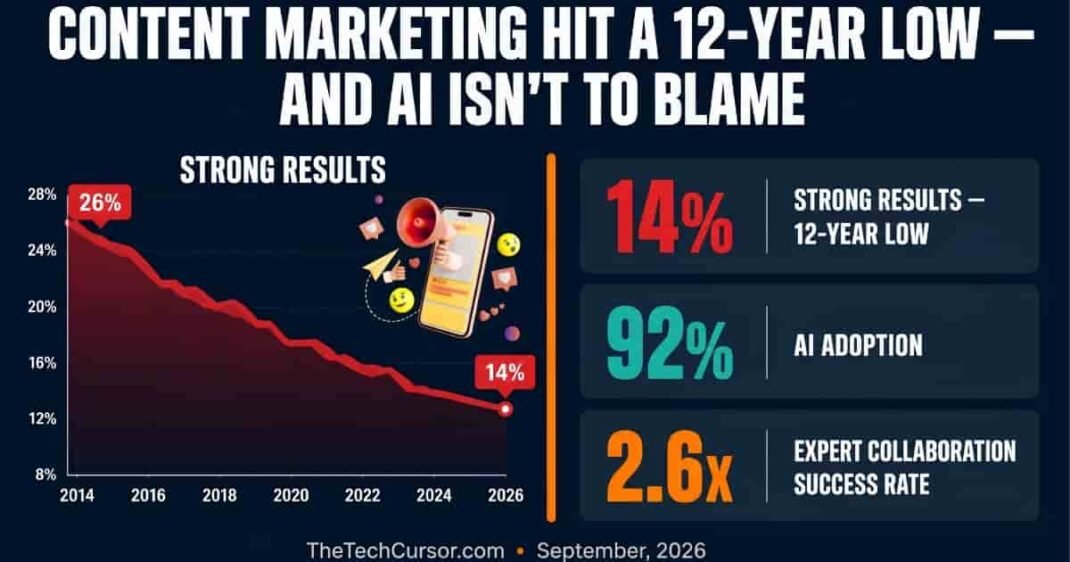
<cite index=”8-1″>Just 14% of marketers said their blogs delivered “strong results” in Orbit Media’s 2026 annual blogging survey of 1,042 content marketers. That is six percentage points below the previous 12-year low and nearly half the 26% reported in 2022.</cite>
The finding is striking on its own. What makes it genuinely alarming is the context: this collapse in content performance happened during a period when AI adoption reached an all-time high. <cite index=”8-1″>AI adoption topped 92% among the marketers surveyed — yet using AI showed no relationship with stronger results.</cite>
The problem is not the tools. The problem is the strategies that marketers abandoned while adopting them.
1. The Numbers — How Bad Is It?
Orbit Media has run its annual blogging survey for over a decade, making it one of the most reliable longitudinal datasets in content marketing. The 2026 results represent a genuine deterioration, not a measurement artefact.
Key findings from the 1,042 marketers surveyed:
- 14% report “strong results” — down from 20% in 2023 and 26% in 2022
- 92.4% have adopted AI tools for content production
- Average blog post time: 3 hours 20 minutes — down from 4+ hours in 2022
- AI saves approximately 50 hours of writing per year per marketer — yet results are declining
The report’s central finding is the divergence between AI adoption and content performance. More marketers are using AI, producing content faster, and getting worse results simultaneously.
<cite index=”8-1″>The decline reflects marketers abandoning tactics historically linked to stronger results, not AI adoption itself, the report concluded.</cite>
2. The Real Culprit — Abandoned Strategies, Not AI
The Orbit Media data identifies a clear pattern: the tactics most closely associated with strong content marketing results have become less common over the past year — even as AI adoption has grown.
The declining tactics include:
- Influencer and expert collaboration
- Original research and proprietary data
- Keyword research before publishing
- Paid content promotion
- Formal human editing
- Consistent use of analytics
Each of these tactics has a documented positive relationship with content marketing results. Each has become less common. The conclusion is straightforward: marketers are using AI to produce content faster while cutting the surrounding practices that make content effective. For a full breakdown of what Google considers quality content, see Google’s 14-point content quality checklist.
This is not an AI problem. It is a strategy problem — one that AI has inadvertently accelerated by making volume easier to produce without making quality easier to achieve.
3. What the Strongest Performers Are Doing Differently
The 14% of marketers reporting strong results are not uniformly different from the rest in every dimension. However, they are consistently more likely to maintain the practices that the broader market has been abandoning.
They still do keyword research. <cite index=”8-1″>Marketers who conducted keyword research were more likely to report strong results, even though fewer respondents said they research keywords before publishing.</cite> The irony is significant: in an era when many marketers have declared keyword research obsolete in the AI search era, the data shows it still predicts content success.
They measure the right things. <cite index=”8-1″>Traffic has become a less meaningful performance metric as AI changes how people discover information online. Instead, marketers who measured qualified leads, deals, and revenue were more likely to report strong results.</cite> Measuring SEO performance rather than business performance is a documented path to misaligned strategy — and the Orbit data confirms this at scale.
They collaborate with experts. The strongest correlation with content success in the survey is expert collaboration — a finding that has significant implications for how content teams should allocate their time and budget.
4. The Influencer Collaboration Collapse
The most striking individual data point in the Orbit survey is the collapse of influencer and expert collaboration as a content practice.
<cite index=”8-1″>Influencer collaboration showed the strongest relationship with success. Marketers who regularly worked with experts were 2.6 times more likely than the benchmark to report strong results. Yet adoption fell from 25% of marketers in 2017 to just 7% this year.</cite>
That is a dramatic decline in the single practice most strongly associated with content success. Furthermore, it is happening at precisely the moment when AI search systems are placing greater weight on named expert authorship and third-party validation — the same signals that expert collaboration builds.
Google’s quality evaluation systems increasingly weight E-E-A-T signals — Experience, Expertise, Authoritativeness, and Trustworthiness — that expert-authored content naturally demonstrates. Furthermore, AI systems are building brand entity understanding from expert appearances, podcast citations, and editorial collaborations — exactly the kind of content that influencer and expert partnerships produce.
The market is moving away from expert collaboration at the moment when both Google and AI systems are placing more value on it. That gap is a significant strategic opportunity for brands that recognize it.
5. AI Saved Time But Did Not Save Results
The AI data in the Orbit survey deserves careful interpretation — because it is simultaneously encouraging and sobering.
The encouraging part: <cite index=”8-1″>AI did reduce production time. The average blog post now takes 3 hours and 20 minutes to write, down from more than 4 hours in 2022. This saves the typical marketer about 50 hours of writing a year, Orbit estimated.</cite>
Fifty hours per year is a meaningful productivity gain. AI tools are genuinely delivering on the time-saving promise.
The sobering part: Those 50 saved hours have not been reinvested in the surrounding practices that drive results — keyword research, expert collaboration, human editing, analytics review, and paid promotion. Instead, the time savings appear to have been absorbed into producing more content volume at similar or lower investment per piece.
The result is a content ecosystem with more output and worse outcomes. AI made it easier to produce content — and the market responded by producing more of it without improving the strategy behind it.
This is consistent with the pattern observed across multiple AI adoption curves: technology that reduces the cost of production tends to drive volume increases before it drives quality improvements. The content marketing industry appears to be in the volume phase — and the performance data reflects it.
6. Keyword Research Is Still Working — Fewer Are Doing It
One of the most counterintuitive findings in the Orbit survey is the continued positive relationship between keyword research and content success — at a time when many in the industry have suggested that AI search makes keyword research less relevant.
The argument against keyword research typically goes: AI search resolves queries conversationally, drawing on entity understanding rather than keyword matching, so optimizing for specific keywords is becoming obsolete.
The Orbit data suggests this conclusion is premature. Marketers who conduct keyword research are more likely to report strong results — not because keyword research itself drives traffic, but because keyword research is a proxy for audience understanding. It forces content creators to verify that genuine search demand exists for their topic before investing in production.
Keyword research in the AI era looks different from traditional keyword research — it focuses on query patterns and intent clusters rather than individual terms. However, the underlying discipline of verifying audience demand before creating content remains as valuable as ever.
Furthermore, AI search systems ultimately draw on the same underlying signals as traditional search — content that addresses genuine user needs, with depth and specificity that serves those needs better than alternatives. Keyword research helps identify what those needs are.
7. The Measurement Problem
The Orbit survey highlights a measurement shift that is both important and underappreciated: as AI search changes how users discover information, traffic-based content metrics are becoming less reliable indicators of content success.
<cite index=”8-1″>Traffic has become a less meaningful performance metric as AI changes how people discover information online.</cite>
When AI systems answer queries without sending clicks, traffic measurements undercount the actual impact of content visibility. A brand mentioned in an AI Overview generates brand awareness, branded search lift, and eventual direct traffic — none of which appears as an organic session from that specific content piece.
The marketers outperforming their peers in the Orbit survey have adjusted their measurement accordingly. They track qualified leads, pipeline contribution, and revenue — outcomes that capture the full downstream impact of content visibility, regardless of whether that visibility came through a direct click or an AI citation.
For content teams still reporting primarily on sessions and pageviews, this measurement evolution is overdue. The channel is changing. The metrics need to change with it.
8. What Ann Handley Got Right
<cite index=”8-1″>Ann Handley, chief content officer at MarketingProfs, called the findings “a wake-up call.” Marketers need to be “much (MUCH!) more discerning about which effort we remove, and which we keep,” she said.</cite>
Handley’s framing is precise and important. The problem is not that marketers adopted AI. The problem is that they removed proven practices without evaluating whether those practices were driving their results.
The implicit assumption behind cutting keyword research, human editing, and expert collaboration is that these practices were overhead — administrative work that could be eliminated without affecting outcomes. The Orbit data demonstrates that assumption was wrong. These practices were producing the results.
AI is a production tool. It can generate a first draft faster, suggest headline variations, and reduce the mechanical work of content creation. However, it cannot substitute for the strategic judgment of keyword research, the credibility signal of expert collaboration, the quality control of human editing, or the accountability of outcome-based measurement.
The marketers who understand this distinction are the 14% reporting strong results. The rest are producing more content, faster, with less of what makes content work.
9. What To Do Now
The Orbit findings point toward specific, actionable adjustments — not a rejection of AI, but a rebalancing of where time saved by AI is reinvested.
Reinvest AI time savings into keyword research: The 50 hours per year that AI saves in writing time should be partially reinvested in keyword and intent research. Verifying demand before production is the single highest-leverage input to content success — and it requires human judgment that AI cannot fully replace.
Revive expert collaboration: The 2.6x success multiplier from expert collaboration is the strongest signal in the Orbit data. If your content program has reduced expert interviews, contributor pieces, and influencer partnerships in favour of AI-generated content, the performance data is clear about the trade-off you made.
Furthermore, expert collaboration now has dual value: it improves content quality for human readers while building the entity association signals that AI search systems use to evaluate topical authority. Getting your brand’s experts into the content ecosystem — through podcast appearances, expert quotes in editorial coverage, and co-created content — builds AI search visibility in ways that AI-generated content alone cannot.
Shift measurement to business outcomes: Replace traffic and pageview reporting with qualified leads, pipeline attribution, and revenue contribution. This change forces alignment between content investment and business goals — and makes content performance visible in terms that business stakeholders understand and value.
Maintain human editing: AI-generated drafts require human editing — not just for grammar and style, but for accuracy, nuance, and the voice that distinguishes your brand’s perspective from generic AI output. Cutting human editing to save time is cutting the step that most directly determines content quality.
Build original research into your content calendar: Original data and research earn citations from AI systems at significantly higher rates than generic content. Furthermore, original research is the content type that earns natural backlinks, editorial coverage, and expert shares — all of which contribute to the topical authority that drives long-term content performance.
10. Bottom Line
Content marketing’s 12-year low is not a story about AI failing marketers. It is a story about marketers failing their content strategies while adopting AI.
The practices most strongly associated with content success — keyword research, expert collaboration, human editing, original research, outcome-based measurement — did not become less valuable when AI arrived. They became more valuable because they are the things AI cannot replace.
The 14% of marketers reporting strong results are not doing something exotic. They are maintaining the disciplined practices that have always driven content success — while using AI to handle the mechanical work that previously consumed that time.
The lesson from the Orbit data is not to use AI less. It is to use the time AI saves more strategically — reinvesting it in the human judgment, expert relationships, and rigorous measurement that make content work.