
Category: AI | NVIDIA | Personal AI | Tech News
Read time: 6 min
For the past two years, AI has lived in the cloud. You type a prompt, it travels to a data center somewhere, a massive server processes it, and the response comes back to you. Fast — but entirely dependent on an internet connection, a subscription, and a company’s servers staying online.
NVIDIA just announced something that changes that model fundamentally.
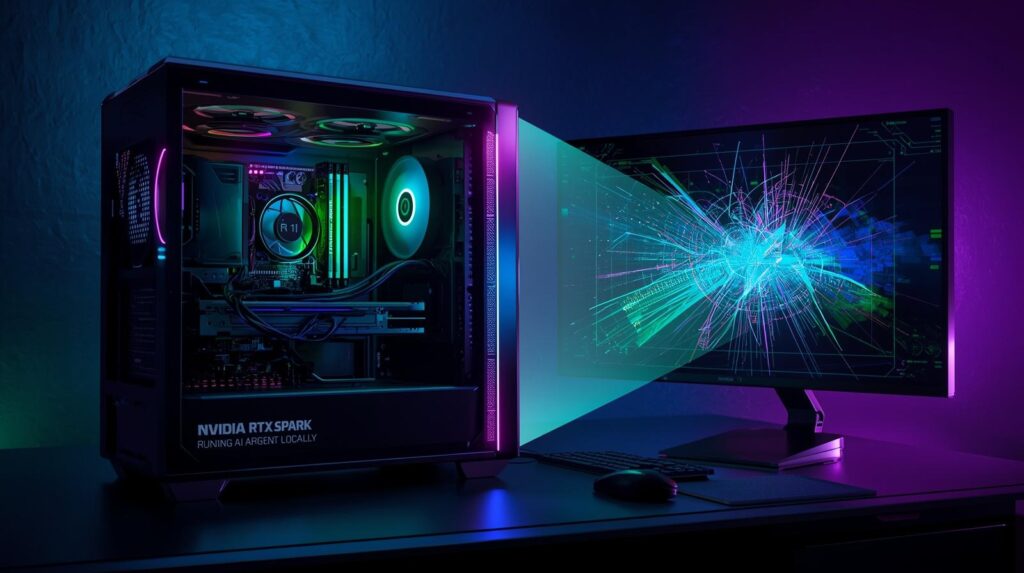
At COMPUTEX 2026, Jensen Huang unveiled NVIDIA RTX Spark — a new class of Windows PC specifically engineered to run AI agents locally, on your own device, without sending your data to any cloud. It is one of the most significant personal computing announcements in years — and most people outside the tech world have barely noticed it.
Here is why it matters.
What Is NVIDIA RTX Spark?
RTX Spark is not just a new laptop chip. It is a complete rethinking of what a personal computer is for.
NVIDIA describes it as moving the PC “from tool to teammate.” The idea is that your laptop or desktop stops being a passive device that executes your commands — and becomes an active AI agent that understands your work, anticipates your needs, and takes actions on your behalf.
Technically, RTX Spark is a superchip that combines two powerful components on a single platform:
- An NVIDIA Blackwell RTX GPU with 6,144 CUDA cores and fifth-generation Tensor Cores with FP4 precision — the same generation of GPU architecture powering the world’s largest AI data centers, shrunk down to fit in a laptop
- A high-performance 20-core NVIDIA Grace CPU connected to the GPU via NVIDIA’s NVLink-C2C chip-to-chip interconnect — a high-speed connection that allows the CPU and GPU to share memory seamlessly
The result: up to 1 petaflop of AI compute and 128GB of unified memory in a device that can be as slim as 14 millimeters and as light as 3 pounds.
What Can It Actually Do?
The honest answer is: run the kinds of AI tasks that currently require a cloud subscription — but entirely on your device.
Local AI agents are the primary use case. An AI agent is not just a chatbot that answers questions. It is an autonomous system that can take actions — browsing the web, writing and executing code, managing files, drafting emails, analyzing documents — all without human input at every step.
Until now, running capable AI agents locally required either a very expensive workstation or a cloud connection. RTX Spark changes that equation for mainstream laptops and compact desktops.
Specific capabilities that RTX Spark enables locally:
- Running large language models on-device — no internet required, no subscription, no data leaving your machine
- 2x faster inference performance on top agentic models via llama.cpp and vLLM compared to previous generation hardware
- Local AI image and video generation — including RTX Video Frame Generation, which can double or quadruple video framerate in real time
- AI-accelerated creative workflows — Adobe is rebuilding Photoshop and Premiere with full GPU acceleration for up to 2x performance on RTX Spark
Why “Local AI” Is a Big Deal
Most people have not thought carefully about where their AI runs. But the distinction between cloud AI and local AI matters enormously — for three reasons:
1. Privacy: When you use cloud-based AI tools, your prompts, documents, and data travel to external servers. For many personal and professional tasks — medical information, legal documents, financial data, private communications — that is a significant privacy concern.
With RTX Spark, your AI runs entirely on your own hardware. Nothing leaves your device unless you choose to send it.
2. Speed and Reliability: Cloud AI depends on your internet connection. Slow connection, server outage, or geographic distance from data centers all introduce latency. Local AI runs at the speed of your hardware — consistently, without network dependency.
3. The cost of AI subscriptions adds up. GPT-4, Claude, Gemini Advanced, Midjourney — the monthly costs for power users across multiple AI tools can easily reach $100 or more per month. Local AI models running on RTX Spark eliminate or significantly reduce these ongoing costs.
Security: Built From the Ground Up
Running autonomous AI agents locally introduces a new security challenge: if an agent can take actions on your device — executing code, accessing files, browsing the web — how do you ensure it cannot be manipulated or compromised?
NVIDIA and Microsoft have partnered to address this directly. NVIDIA OpenShell is coming to Windows, built on top of Microsoft’s new OS security primitives, giving developers a standardized, secure way to deploy autonomous agents safely on Windows devices.
Two of the most popular AI agent projects — Hermes Agent and OpenClaw — are already integrating OpenShell into their upcoming native Windows apps. This is the infrastructure layer that makes local AI agents trustworthy enough for real-world use.
Who Is Building RTX Spark Devices?
RTX Spark laptops and compact desktops will be available this fall from:
ASUS, Dell, HP, Lenovo, Microsoft Surface, MSI — with models from Acer and GIGABYTE to follow.
This is not a niche product from a single manufacturer. Every major PC maker is building around RTX Spark — which signals that the industry sees local AI as the next major computing platform shift, not a side feature.
Devices will come in 14- to 16-inch laptop sizes, featuring precision-machined aluminium chassis and colour-accurate tandem OLED displays with NVIDIA G-SYNC technology.
What This Means for the AI Industry
RTX Spark’s arrival is part of a broader trend that will reshape how AI is consumed and deployed over the next few years.
The current model — where most AI capability lives in a handful of massive cloud providers — creates dependencies, costs, and privacy risks that many users and businesses are increasingly uncomfortable with. Local AI on powerful personal hardware offers an alternative.
For professionals — lawyers, doctors, financial advisors, researchers — local AI means working with sensitive data in AI-powered workflows without cloud exposure.
For creators — designers, video editors, 3D artists — it means AI-accelerated tools that run in real time without subscription fees or internet dependency.
For developers — it means building and testing AI agents on local hardware before deploying to production, with faster iteration cycles and lower costs.
For everyday users — it means AI assistance that is always available, always private, and not contingent on any company’s continued operation or pricing decisions.
The Bigger Picture
Jensen Huang has been talking about the “AI PC” for over two years. RTX Spark is the most concrete realization of that vision yet — a device where AI is not an add-on feature accessed through a browser, but a native capability running at the hardware level.
The announcement also reinforces something important: the AI revolution is not just happening in data centers. It is moving to the edge — to your laptop, your desk, your pocket. The infrastructure is almost ready. The devices are coming this fall.
Whether RTX Spark becomes the defining platform for personal AI or simply the first credible attempt is a question 2026 and 2027 will answer. But the direction is clear — and it points toward a future where powerful AI is as personal, private, and always-available as your own thoughts.