
Read time: 8 min
Fresh data from Semrush, SE Ranking, and seoClarity points to AI Overviews appearing on over 80% of Google searches, up from about 50% in June of last year and roughly 15% the year before. That is a big shift in a very short time, and if you work in SEO, it deserves your attention.
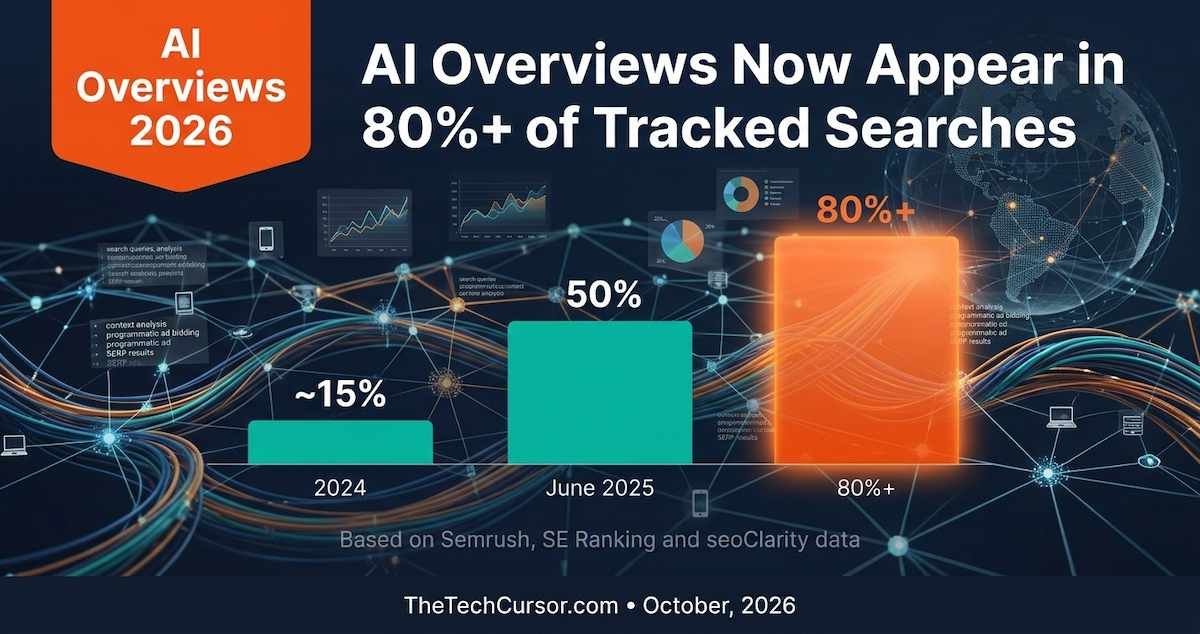
It also deserves a careful read. “80% of searches” is a headline. The underlying studies measure different things, and the gap between them matters for how you plan your next quarter.
1. The Headline Number
Three separate datasets landed within weeks of each other, and they all point in the same direction: Google is showing AI-generated answers far more often than it did a year ago.
Nobody in the industry is truly surprised. Google has spent two years expanding AI Overviews to more query types, and the trend line was clear. What’s new is the scale.
2. Where the 80% Comes From
Here is what each source actually measured.
Semrush. The study tracked 400 US desktop commercial keywords across banking, software, and ecommerce. AI Overviews appeared on 88% of them in August 2026, nearly double the 45.75% recorded in September 2025. Weighted by estimated search volume, coverage reached 97%. The biggest mover was review-style searches: coverage rose from 30% to nearly 90% over the 12 months. And “best X for Y” queries reached over 96% coverage. Google AI Overviews nearly double for commercial keywords: Study +3
SE Ranking. Their data covers brand searches. AI Overviews appear on 82.5% of US brand searches in their dataset. That’s a specific slice, and branded queries are not the whole market.
seoClarity. Their team reports AI Overviews on over 62% of queries, ranging from 55% to 84% depending on industry. That is lower than the other two, which is itself a useful reminder that methodology changes the answer.
3. Why Your Number May Look Different
This is the part many people overlook. If you read “80% of all searches” and tell your client or boss that four out of five Google searches now show an AI Overview, you may be overstating it.
Look at how other panels read the same period. Semrush’s broad panel of over 10 million keywords sat near 16% in late 2025, while Conductor’s enterprise panel showed about 25%. And a fixed panel of 400 keywords is not a prevalence estimate for all searches.
Two more limits are worth knowing. Semrush’s study records whether an AI Overview appeared, not what happened next, so it includes no click, traffic, or conversion data. The volume figures also rest on modelled estimates rather than measured search counts. And geography matters: in Germany, the average in one tracker was 40.4%, against 82.5% for the US.
So the honest summary is this. AI Overviews are now close to standard on commercial, comparison, and branded searches in the US. Across everything people type into Google, the share is lower and depends heavily on who is counting.
4. Why the Jump Happened
A few things appear to be driving it.
Google is moving AI Overviews beyond pure information queries. Commercial searches used to be mostly untouched, and that’s where the growth is now. Semrush noted that brand alternatives and brand-versus-brand searches rose by 34 and 23 points, respectively. x
Google also appears to want an answer on the page for nearly every query. Branded searches are a good example. A person typing a company name used to see that company’s site and little else. Now they often see a summary first.
5. What This Does to Clicks
When more of the page is taken by an answer, fewer people scroll down. SEOClarity’s tracking showed that position 3 click-through fell from 4.88% to 2.47% as AI Overviews pushed results below the fold. Positions 1 and 2 held up better. seoclarity
In real life, this tends to hit sites that depend on mid-page rankings for review, comparison, and “best of” content. Those are the exact formats where Semrush saw coverage climb the fastest. Affiliate publishers and software review sites are the most exposed. If your traffic comes from queries like “best CRM for small teams,” expect pressure.
The flip side: being cited inside the overview is becoming its own form of visibility, even when the click doesn’t follow.
6. What to Do About It
Panic isn’t useful here. These steps are.
Measure your own exposure first. Pull your top 100 queries and check how many trigger an AI Overview. Your number matters more than any industry average.
Keep ranking in the top 20. SEOClarity found that 94% of AI Overviews cite at least one URL from the top 20 organic results. Traditional SEO is still the entry ticket.
Put the answer first. A Surfer analysis from June 2026 found that 38% of AI Overview citations come from the first 100 words of a page, up from 20% a year earlier. Lead with the direct answer, then explain.
Rework your comparison and review pages. Add original testing, real pricing, and clear criteria. Generic roundups give an AI system no reason to cite you over a hundred similar pages.
Track citations, not only rankings. Check whether your brand is named in the overview for your priority queries each month, and watch branded search and conversions alongside clicks.
Use AI SEO tools for the legwork. Tracking tools that flag which of your keywords trigger overviews and who gets cited save real time. Judgment on what to publish stays with you.
7. Frequently Asked Questions
Do AI Overviews really appear on 80% of all Google searches?
Not across all searches. The 80%+ figures come from specific panels: commercial US desktop keywords, branded searches, and tracked industry sets. Broader keyword panels show much lower rates.
Which searches are most affected?
Review, comparison, “best X for Y,” alternatives, and branded queries. Semrush saw all five commercial groups finish above 80% coverage in its sample.
Is ranking still worth the effort?
Yes. Most overviews cite pages from the top 20 results, so ranking remains the foundation for being cited.
Will my organic traffic drop?
It depends on your query mix. Sites relying on comparison and review queries are likely to feel it more than sites targeting local or transactional searches.
Is this the same everywhere?
No. Coverage differs by country. Germany, for instance, showed far lower rates than the US in the tracker above.
How can I check my own exposure?
Run your top queries through a SERP tracker that flags AI Overviews, then calculate the share and compare it to your traffic by query group.
Should I stop writing review content?
No, but make it original. Hands-on testing, real data, and clear verdicts are harder for a summary to replace.
8. Bottom Line
AI Overviews have moved from an occasional feature to something close to the default on commercial and branded US searches. That’s the real story behind the “80%” headline.
Three takeaways. First, treat the numbers as panel-specific, and measure your own queries before drawing conclusions. Second, comparison and review content faces the sharpest change, so strengthen it with original information. Third, aim to be cited, not just ranked.
The trend will likely keep moving, so recheck your exposure every month.
Sources:
- Over 80% of Google Searches Have AI Overviews & Growing, Search Engine Roundtable
- AI Overviews have nearly doubled across five commercial search modifiers, Semrush
- Google AI Overviews nearly double for commercial keywords, Search Engine Land
- Google AI Overviews now hit 88% of tracked commercial keywords, PPC Land
- Google AI Overviews Tracker 2026, Keywords Everywhere
- AI Search Trend Report, seoClarity
Pingback: Paid vs Organic SEO Is Dead — Here's Why AI Is Merging Them Into One System - The Tech Cursor
Pingback: Google Is Restricting Ads From Advertisers It Doesn't Trust — Here's What You Need to Do Now - The Tech Cursor
Pingback: Your Best Software Listicle Is Backfiring — Google AI Overviews Cites You Then Recommends Competitors 69% of the Time - The Tech Cursor
Pingback: Gemini 4 Hydrogen Is Now AI Mode’s Default: AI Visibility - The Tech Cursor
Pingback: Advertisers Cut Google Ads Spend: What the Data Shows - TheTechCursor
Pingback: Google's Content Advice: Replace Generic Listicles With Expertise - TheTechCursor
Pingback: Are AI Overviews Safe for YMYL Topics? What Publishers Do - TheTechCursor