
Read time: 5 min
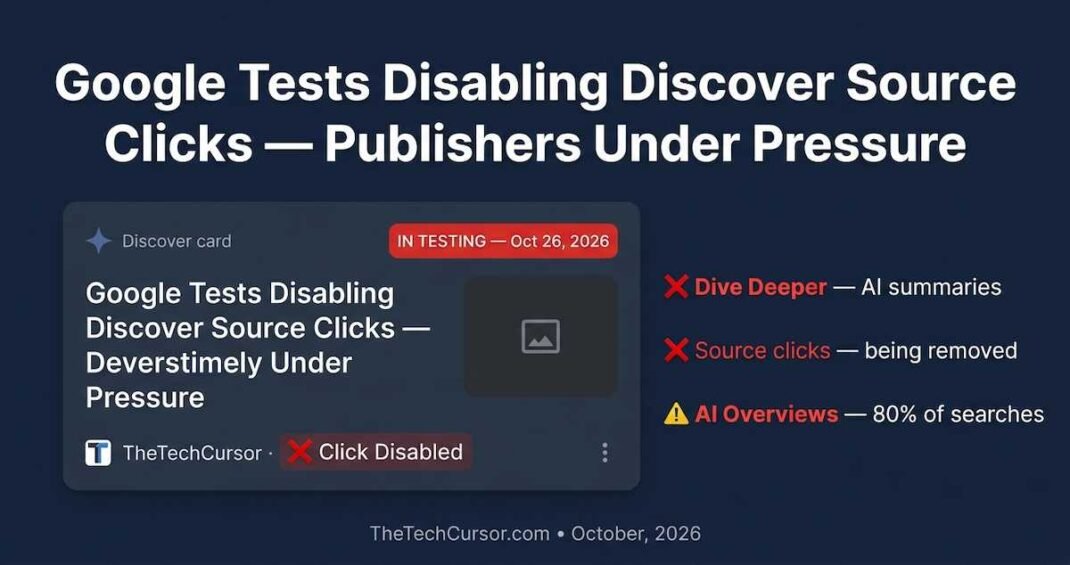
Google is testing the removal of clickable links from the Sources section in Google Discover. The test was spotted on October 26, 2026 and reported by Barry Schwartz. If the test rolls out broadly, users who see a source attribution in Discover will no longer be able to click through to the publisher’s article from that source label.
This is the latest in a pattern of incremental click removal tests across Google’s surfaces. Each test, taken individually, can be framed as a minor UI change. Taken together, they describe a systematic reduction in the click pathways that drive publisher traffic from Google’s products.
1. What Google Is Testing
<cite index=”3-1″>Google Discover is testing disabling clicks in the Sources section.</cite> The Sources section appears within Discover content cards — it is the attribution label that tells the user which publication produced the article they are looking at.
In the current standard experience, that source label is clickable. A user who sees “The Guardian” or “TechCrunch” as the source can tap it to visit the publication’s home page or topic page. In the test variant, that tap does nothing — the source label is present but not linked.
No official explanation from Google has accompanied the test. No timeline has been provided for whether or how it might roll out more broadly.
2. What the Sources Section Is
The Sources section in Discover is separate from the main article card link. When a user sees a Discover card, there are typically two ways to navigate to the publisher:
tapping the article headline or image — which goes directly to the article — and tapping the source label — which typically goes to the publication’s home page or a topic feed.
The test specifically targets the source label click — not the main article link. A user could still tap the article headline to reach the article itself. However, the source label click — which drives direct navigation to publisher home pages and brand exploration — would be removed.
This distinction matters for how publishers experience the impact. Direct article clicks may not change. However, branded navigation — users exploring a publication after discovering it in Discover — would decline. For publishers trying to build Discover as an audience acquisition channel rather than just a single-article traffic source, this is the more damaging of the two click pathways to lose.
3. Why This Is Different From Dive Deeper
The Dive Deeper feature in Discover — covered in September — inserts an AI-generated topic summary that allows users to get the gist of a story without clicking through to any publisher. That feature adds a zero-click option on top of existing publisher links.
The Sources section click removal is structurally different. It does not add a zero-click alternative. It removes an existing click pathway entirely. Users who would have tapped the source label to explore a publication now have one fewer reason to stay engaged with that publication through Discover.
Furthermore, the Dive Deeper test and the Sources click removal test together represent two simultaneous experiments in the same channel — both reducing click opportunities in Discover. The combination is more concerning than either would be individually.
4. The Pattern — Every Click Removal Is a Test Until It Is Not
The history of click reduction tests in Google’s surfaces follows a consistent pattern. A feature is tested quietly. Industry observers spot it. Google declines to comment or provides minimal explanation. The test either rolls back or becomes default behaviour — with no public announcement when it becomes permanent.
AI Overviews followed this pattern. They were tested extensively before becoming the default experience for an expanding percentage of queries. The Wikipedia AI Overviews traffic research estimated approximately 1.2 billion fewer annual referrals to Wikipedia alone from that expansion.
The Dive Deeper feature is currently in testing. No rollout timeline has been confirmed.
The Sources click removal is now also in testing.
Each of these tests is individually small. The pattern they collectively describe is not small. Google is systematically evaluating how much click volume can be removed from its surfaces before user experience or publisher relations deteriorate enough to reverse the experiments.
5. The Publisher Traffic Math
The commercial significance of source label clicks varies by publisher type.
For news publishers and content brands building recurring audiences, the source label click is often more valuable than the individual article click. A user who taps a headline reads one article and leaves. A user who taps the source label and explores the publication may subscribe to a newsletter, bookmark the site, or develop a direct navigation habit. This is the conversion that builds durable audience relationships — and it is exactly the click the test is removing.
<cite index=”3-1″>Over 80% of searches now contain Google AI Overviews</cite> — a figure confirmed by Semrush, SE Ranking, and seoClarity data this week. That number, combined with the ongoing Discover click reduction tests, describes an environment where publisher traffic from Google is declining across both the search and the discovery channels simultaneously.
The Google AI contribution pilot revenue numbers — which showed payments of less than 0.1% of publisher ad revenue — make clear that the financial compensation model Google is piloting does not come close to replacing the traffic value being removed through these tests.
6. What AI Overviews at 80% Means Alongside This
<cite index=”4-1″>AI Overviews now show up for over 80% of Google Searches, that is up from 50% in June of last year and about 15% from the year before that.</cite>
That trajectory — 15% to 50% to 80% in approximately two years — is one of the fastest expansions of any Google search feature on record. At 80% coverage, AI Overviews are no longer a feature affecting a segment of search queries. They are the default experience for the overwhelming majority of Google searches.
The combined picture is stark. In search, AI Overviews absorb intent and reduce clicks across 80% of queries. In Discover, AI-generated summaries are being tested through Dive Deeper. And now, in Discover, clickable source labels are being tested for removal.
None of these developments has produced a corresponding increase in the publisher payments Google is piloting. The State of Search 2027 survey found that 39% of organizations saw traffic decline while conversions held — a finding that provided some comfort about AI search’s business impact. However, that finding was based on data that predates 80% AI Overview coverage and predates the Discover click removal test.
7. What Publishers Can Do
The Sources click removal test is in early stages and may not roll out broadly. However, preparing for a Discover environment with fewer click pathways is prudent regardless of this test’s outcome.
Build direct audience relationships that do not depend on Discover clicks: Newsletter subscribers, podcast listeners, app users, and community members arrive through channels that Google cannot modify. Every audience member converted from passive Discover reader to active direct subscriber is one who remains accessible regardless of how Google’s click architecture evolves. The Invisible PR guide covers how to build this kind of audience through earned media rather than platform dependency.
Invest in Preferred Sources: Google’s October 15 update confirmed that Preferred Sources usage has grown 7x this year. Users who have added a publisher as a Preferred Source have a higher baseline engagement and are more likely to actively seek out that publisher’s content — rather than depending on passive source label taps. Building Preferred Sources followers directly mitigates the impact of source label click removal.
Optimize article cards for direct clicks: Since the test specifically targets source label clicks rather than article headline clicks, publishers can partially offset the impact by optimizing Discover article cards for headline engagement. Compelling, specific headlines and high-quality thumbnails that prompt direct article taps are more valuable than ever in a Discover environment where alternative navigation paths are being removed.
Monitor Discover referral traffic separately: Track Discover traffic as a distinct channel in GA4. If the Sources click removal moves from test to default, the impact will be visible in Discover referral data before it shows up in aggregate traffic figures. Early detection enables faster response.
8. Bottom Line
Google’s test of disabling clicks in Discover’s Sources section is one more data point in a pattern that publishers cannot afford to ignore. The pattern is consistent:
Google is incrementally testing how much click volume can be removed from its surfaces while maintaining the appearance of a publisher-friendly ecosystem.
The correct response is not to assume the test will not roll out. It is to build audience relationships and traffic sources that are structurally independent of how Google configures its click architecture.
The publishers that survive the ongoing reduction in Google-driven clicks will be the ones who treated each individual test as a signal rather than waiting for a definitive announcement. That announcement rarely comes — features simply become defaults, and publishers discover the change in their analytics rather than in a press release.
Action Checklist
- Track Discover traffic separately in GA4 — establish your current source label click baseline now
- Build Preferred Sources following — actively promote “Add as Preferred Source” to your existing audience
- Optimize article thumbnails and headlines for direct card clicks rather than source label navigation
- Accelerate newsletter and direct audience growth — reduce dependency on Google Discover as a primary traffic source
- Monitor the test — check whether the Sources click removal appears in your own Discover experience and report findings