
Read time: 8 min
YMYL stands for Your Money or Your Life. Google uses the label for topics where bad information can hurt people. These include health, finance, and safety. Therefore, the question of whether AI Overviews are safe for these topics matters to both searchers and publishers.
I could not access the specific article that raised this question. Instead, this piece reviews the public evidence and shows what it means for publishers.
What Prompted the Debate
AI Overviews now appear for a large share of Google searches. However, errors in an AI summary can cause more harm on YMYL topics than elsewhere. A wrong movie date is trivial, while a wrong medical range is not.
Several events shaped the debate. First, a newspaper investigation raised health concerns in January 2026. Second, independent researchers have tested accuracy at scale. Meanwhile, new studies show who gets cited on sensitive topics.
What the Guardian Investigation Found
In January 2026, The Guardian published an investigation into AI Overviews for medical searches. It shared AI-generated summaries with health charities, medical experts, and patient groups. Several reviewers said some summaries were misleading or incorrect.
Charities including Pancreatic Cancer UK, British Liver Trust, Marie Curie, and Mind raised concerns. Specifically, they argued that inaccurate summaries could delay people from seeking care.
Google disputed the findings. A spokesperson said many examples were incomplete screenshots. The company also said the summaries linked to well-known, reputable sources and advised people to seek expert advice. Furthermore, Google said it applies higher standards to YMYL topics.
How Common Are AI Overviews on Health Queries
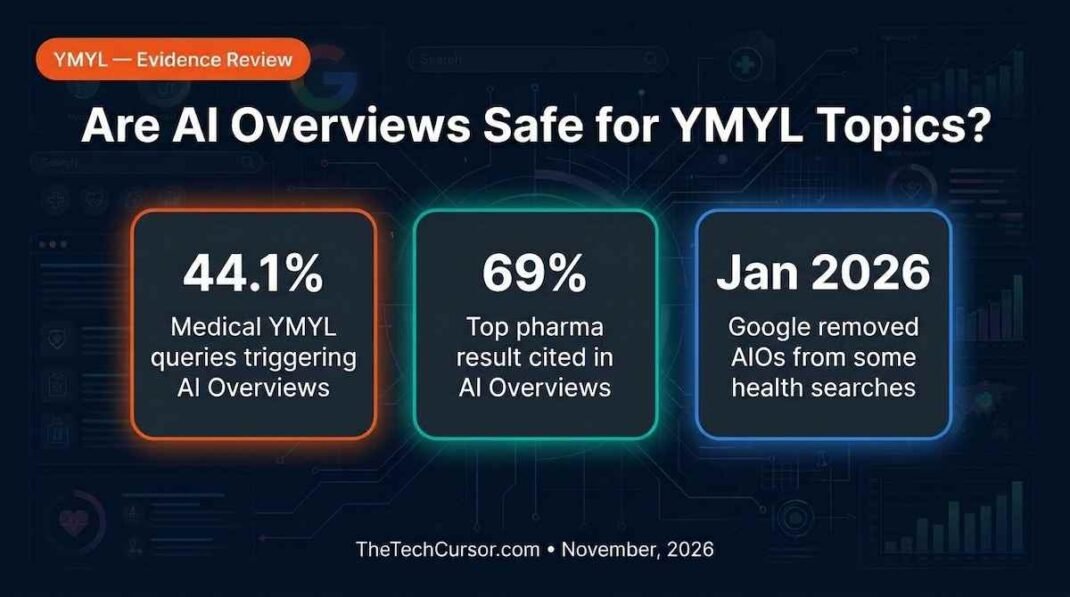
Health is one of the categories where AI Overviews appear most often. An Ahrefs analysis of 146 million search results found that 44.1% of medical YMYL queries triggered an AI Overview. That was the highest rate of any category studied.
This matters because exposure and risk go together. Consequently, a small error rate can still affect many people when the trigger rate is high.
Note that Ahrefs is an SEO software company, and trigger rates change over time. Treat the figure as a snapshot.
What Google Changed
After the investigation, Google removed AI Overviews from some specific health searches. One reported example was a query about the normal range for liver blood tests.
However, the change was narrow. Reports say slightly rephrased versions of the same query could still return a summary. Therefore, the restriction applies to particular searches, not to the whole health category.
Google has also said it applies the highest bar to AI Overview quality for YMYL topics, according to coverage of its Search leadership. Independent researchers also tested this, according to trade coverage of a New York Times report. They found YMYL queries were handled more carefully on average. However, errors still appeared.
New Evidence: Who Gets Cited in Pharma Searches
A November 2026 study looked at AI Overview citations in pharma searches. It found that the top organic result won the AI Overview citation 69% of the time.
The authors offered no firm explanation. Instead, their working idea is that organic ranking weighs YMYL standards more heavily than AI Overview source selection does. In other words, strong organic positions may carry YMYL trust signals into the citations.
In addition, a separate analysis in France found that two of five sites hit after the AI Overviews launch were YMYL sites. One fell from about 80 to about 25 clicks a day. This is a small, specific example, not a general rate.
What This Means for YMYL Publishers
The evidence points in two directions.
First, there is risk. AI Overviews can reduce clicks to YMYL sites, and errors in summaries can damage trust in a topic. Moreover, a brand may be misrepresented without knowing it.
Second, there is opportunity. If organic ranking still shapes who gets cited, trusted YMYL sites keep an edge. One agency claims that Google now favours official medical repositories and academic sources over general health blogs. That claim comes from a vendor, so treat it cautiously.
In short, authority matters. The GEO pillars framework treats credibility as a foundation for visibility.
What YMYL Publishers Should Do
The steps below are analysis, not Google guidance.
- Show real expertise. Name qualified authors and reviewers, and state their credentials. The content quality checklist offers a structured review.
- Cite primary sources. Link to guidelines, studies, and official bodies, and keep references current.
- Update regularly. Outdated medical or financial figures can become harmful, so set a review schedule.
- Monitor AI answers about you. Check what AI systems say about your brand and topics. The AI visibility dashboard guide explains how.
- Fix errors at the source. The Washington Post voter-guide test showed how weak sources can flow into AI answers.
- Keep an evidence trail. Verifiable, human-backed claims are safer, as the evidence house article argues.
What the Evidence Does Not Show
Several limits apply.
First, no source gives a complete accuracy rate for YMYL AI Overviews. Second, the Guardian examples were selected, and Google disputed them. Therefore, they show that errors can occur, not how often.
Third, the studies also differ in date and method. Some are months old, and AI Overviews change often. Also, several sources are vendors or agencies, so verify their figures.
Finally, the 69% pharma finding is a correlation from one study. It does not prove why the citations occur.
Bottom Line
AI Overviews are common on health queries, and journalists and experts have documented errors. Google disputes some findings and has removed summaries from specific searches, though rephrased queries can still trigger them. Strong organic rankings appear to help YMYL sites earn citations.
The Takeaway
For YMYL publishers, trust is the strategy. Therefore, invest in expertise, sourcing, and accuracy, and monitor how AI systems represent your content. Meanwhile, avoid assuming that any single study describes the whole picture.
Sources Reviewed
This article draws on the pages below, reviewed on November 18, 2026. The original article that prompted it was not accessed. Several sources are vendors or agencies, and some are months old. Verify figures before relying on them.
- Link provided for the original article (not accessed)
- PPC Land — Top pharma search result wins Google AI Overview citation 69% of the time
- ALM Corp — Google AI Overviews Health Misinformation: 2026 Guardian Investigation
- AI CERTs — Google AI Overviews Face Scrutiny Over Patient Safety Risks
- Omnia — YMYL in AI Search: How AI Engines Treat High-Stakes Topics
- WebProNews — Google’s AI Overviews Have an Accuracy Problem
- 12AM Agency — Mastering Google AI Overviews (agency blog)
- Wikipedia — AI Overviews