
Category: Digital PR | AI Search | Off-Page SEO | Brand Strategy
Read time: 7 min
Site: TheTechCursor
Traditional PR generates coverage. Traditional link building generates backlinks. Both have been core off-page SEO strategies for years.
However, there is a third category — one that is becoming increasingly important for AI search visibility but that most brands are not yet systematically pursuing. Call it Invisible PR: the accumulation of brand mentions, entity signals, and authority associations that build AI search visibility without necessarily generating a single traditional backlink.
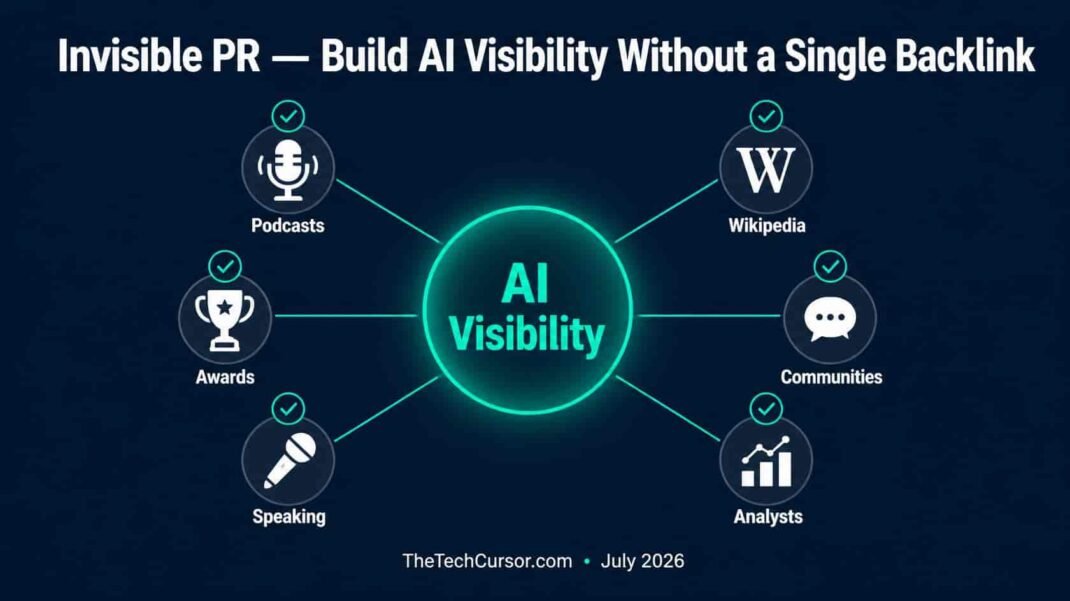
Invisible PR is not a replacement for earned media coverage or legitimate link building. It is the layer beneath them — the ambient brand presence across podcasts, awards, speaking circuits, knowledge bases, and community platforms that AI systems draw on when building their understanding of who your brand is and why it should be recommended.
Table of Contents
- Why “Invisible PR” Is Now an SEO Strategy
- How AI Systems Build Brand Understanding From Non-Link Sources
- Tactic 1: Podcast Appearances
- Tactic 2: Industry Awards and Recognition
- Tactic 3: Speaking Engagements and Conference Presence
- Tactic 4: Wikipedia and Knowledge Graph Presence
- Tactic 5: Strategic Community Participation
- Tactic 6: Analyst and Research Firm Coverage
- How to Measure Invisible PR Impact
- Building an Invisible PR Program
- Bottom Line
1. Why “Invisible PR” Is Now an SEO Strategy
The shift begins with understanding what AI systems actually use when evaluating a brand for citation and recommendation.
Google’s entity understanding system — described in the patent covered in TheTechCursor’s entity SEO article — aggregates information from websites, reviews, maps data, job listings, and other public sources to build a holistic characterization of a brand. OpenAI’s systems draw heavily on Reddit, community forums, and web content encountered during training. Perplexity synthesizes information across web sources with no particular preference for linked versus unlinked mentions.
In other words: a mention that carries no link still registers as a signal in AI training data and retrieval systems. Furthermore, some non-link mentions carry more contextual weight than many traditional backlinks — because they appear in contexts that AI systems specifically trust and weight highly.
The brands that understand this are building presence in these channels deliberately. Those that do not are leaving significant AI visibility on the table.
2. How AI Systems Build Brand Understanding From Non-Link Sources
Before diving into specific tactics, it helps to understand the mechanism.
AI language models are trained on large corpora of web content. That training data includes not just indexed web pages but forum discussions, podcast transcripts, community platforms, Wikipedia articles, and numerous other text sources. When a model encounters your brand name across many of these sources in relevant, positive contexts, it develops confidence about what your brand represents and when it is appropriate to recommend or cite you.
This training-phase influence is different from — and complementary to — the retrieval-phase influence of traditional links and rankings. A brand that has accumulated strong invisible PR signals may appear more confidently in AI responses than a brand with a stronger traditional backlink profile but limited ambient presence.
Furthermore, AI retrieval systems — used in ChatGPT search, Perplexity, and AI Overviews — also draw on non-linked sources in real time. A Reddit thread discussing your brand, a podcast episode where your founder was interviewed, an industry award announcement — all of these can surface as sources in AI-generated responses without any traditional link value attached.
3. Tactic 1: Podcast Appearances
Podcasts have become one of the highest-value invisible PR channels for AI search visibility — for three reasons that are specific to how AI systems work.
First, podcast content is widely transcribed. Most major podcasts publish transcripts, show notes, and episode summaries. These text versions are indexed, crawled, and included in AI training data. A guest appearance on a relevant podcast generates text content mentioning your brand across multiple surfaces: the transcript, the show notes, the podcast platform listing, and often a promotional blog post from the host.
Second, podcast mentions carry contextual authority. When a podcast host introduces you as an expert on a specific topic, and you demonstrate that expertise over the course of an interview, the AI systems that process that transcript encounter a strong contextual signal: this person is an authority on this topic, as validated by a trusted source in the space.
Third, podcast appearances create entity associations. The topics discussed, the other guests mentioned, the companies referenced — all of these create entity associations that help AI systems understand your brand’s positioning and expertise area more precisely.
Priority targeting: Focus on podcasts within your specific topic area that are consistently published, have reasonable audience sizes, and publish detailed show notes or transcripts. A smaller, highly relevant podcast is more valuable for invisible PR than a large general-audience podcast with no topical connection to your brand.
4. Tactic 2: Industry Awards and Recognition
Industry awards generate a specific type of invisible PR signal that is particularly valuable for AI systems: third-party validation from recognized industry sources.
When your brand appears on an industry award list — “Best [Category] Software 2026,” “Top [Industry] Agency,” “Fastest Growing Company” — that mention typically appears across multiple surfaces simultaneously: the awarding organization’s website, press releases, industry publications covering the awards, and social media discussions.
More importantly, award mentions appear in a context that signals credibility and recognition. AI systems that encounter your brand in award contexts develop an association between your brand and positive evaluation by industry peers.
Strategic approach:
- Identify the five to ten most credible awards in your specific industry and category
- Ensure your brand is systematically submitted for consideration each cycle
- When you win or are named a finalist, amplify the mention across your own channels — creating additional indexed references to the recognition
- Focus on awards from organizations that your target audience recognizes, not just any available award
Awards from recognized industry bodies, established media outlets, and well-known analyst firms carry significantly more invisible PR weight than awards from pay-to-play lists or unknown organizers.
5. Tactic 3: Speaking Engagements and Conference Presence
Conference and event content has become an increasingly valuable invisible PR source for AI systems — particularly since most major industry events now publish session recordings, speaker bios, and session summaries online.
How speaking generates invisible PR signals:
A speaking engagement at an industry conference generates brand mentions across: the event’s speaker page, the session recording (often transcribed), post-event recap articles from industry publications, social media coverage from attendees, and the event’s podcast or YouTube channel if applicable.
Furthermore, speaker bio pages specifically serve as entity-building content. A well-crafted speaker bio — mentioning your specific area of expertise, your credentials, your company, and the topic you will be presenting on — creates exactly the kind of rich entity description that AI systems draw on when building brand understanding.
Priority approach:
- Target conferences where your specific audience concentrates — relevance matters more than audience size
- Invest in a detailed, expertise-rich speaker bio rather than a generic professional description
- After speaking, ensure the event publishes and indexes your session — follow up with event organizers if session content is not appearing online
- Repurpose speaking content into blog posts, LinkedIn articles, and other indexed formats to extend the invisible PR footprint of each appearance
6. Tactic 4: Wikipedia and Knowledge Graph Presence
Wikipedia is one of the most consistently cited sources across AI systems — and one of the most underutilized invisible PR opportunities for brands that qualify for inclusion.
Wikipedia does not accept promotional content. However, brands with genuine notability — coverage in multiple independent, reliable sources on topics of general interest — can have legitimate Wikipedia articles or mentions. Furthermore, Wikipedia’s influence on Google’s Knowledge Graph means that a well-sourced Wikipedia presence directly contributes to entity understanding in Google’s AI systems.
Two Wikipedia strategies:
Direct article (for qualifying brands): If your brand has received significant coverage in multiple independent, reliable publications — not just press releases or company-produced content — you may qualify for a Wikipedia article. The article must follow Wikipedia’s neutrality and sourcing standards. If written well and sourced properly, it becomes one of the highest-value invisible PR assets available.
Mention in existing articles: Even without a dedicated article, your brand may be appropriately mentioned in existing Wikipedia articles covering your industry, technology category, or area of expertise. Contributing accurate, well-sourced information to relevant Wikipedia articles — following Wikipedia’s contribution guidelines — builds entity associations without requiring a dedicated brand article.
7. Tactic 5: Strategic Community Participation
As covered in TheTechCursor’s article on AI brand usage vs citation, Reddit accounts for over 67% of uncited URLs that ChatGPT retrieves when generating responses. This makes authentic community presence one of the highest-leverage invisible PR investments available.
What “strategic” means here: Not astroturfing. Not paid posts. As covered in TheTechCursor’s GEO vendor scams article, manufactured community mentions are being recognized and discounted by AI systems — and carry FTC compliance risk.
Strategic community participation means genuine contribution to relevant discussions. When your brand’s actual team members participate authentically in communities relevant to your expertise — answering questions, sharing genuine insights, participating in debates — those contributions create organic brand mentions that AI systems weight as authentic signals.
Priority communities:
- Subreddits directly relevant to your product category or industry
- Slack or Discord communities where your target audience concentrates
- Quora topics in your expertise area
- LinkedIn groups with active, engaged membership in your industry
- Niche forums and community platforms specific to your vertical
Consistency matters more than volume. Regular, genuine participation from named individuals associated with your brand builds a much stronger invisible PR signal than sporadic high-volume posting.
8. Tactic 6: Analyst and Research Firm Coverage
Analyst and research firm coverage — Gartner, Forrester, G2, Capterra, IDC, and their equivalents in various industries — is among the most credible invisible PR available for B2B brands.
Analyst reports are among the most authoritative sources AI systems cite for industry evaluations, vendor comparisons, and market landscape questions. Appearing in a Gartner Magic Quadrant, a Forrester Wave, or an IDC MarketScape is an entity signal of substantial weight — because these are third-party evaluations from recognized authorities, not self-promotional content.
For brands not yet at analyst report scale:
- G2 and Capterra reviews build a comparable invisible PR footprint in software categories — and both platforms are frequently cited by AI systems for software recommendation queries
- Industry-specific research firms often cover a broader range of companies than the major analyst houses
- Contributing data to industry benchmarking studies — even without being the subject of analysis — builds brand mentions in credible research contexts
9. How to Measure Invisible PR Impact
Invisible PR is, by definition, harder to measure than traditional link building. However, several signals provide directional evidence of its effectiveness.
AI citation monitoring: Track how frequently your brand appears in AI responses for your core topic queries over time. As your invisible PR footprint grows, citation frequency should increase — particularly for conversational queries where AI systems draw on the broader web rather than just ranked pages.
Branded search volume: Invisible PR builds brand awareness, which translates to increased branded search over time. As covered in TheTechCursor’s zero-click AI value article, branded search lift is one of the clearest measurable signals of brand awareness growth from non-click channels.
Direct traffic trends: Growing direct traffic — users navigating directly to your site without a search referral — correlates with growing ambient brand awareness. Invisible PR contributes to this even when individual mentions do not generate direct clicks.
Entity footprint audits: Periodically search for your brand name across the platforms where you are building invisible PR presence — podcasts, awards, community platforms, analyst sites. The depth and quality of what surfaces is a directional measure of your invisible PR footprint.
10. Building an Invisible PR Program
An invisible PR program is not a one-time campaign. It is an ongoing investment in ambient brand presence across channels that AI systems weight heavily.
Starting framework:
Month 1-2: Audit your current invisible PR footprint. What does an AI system encounter when it aggregates information about your brand from podcasts, awards, community platforms, Wikipedia, and analyst coverage? Identify the largest gaps.
Month 3-4: Begin systematic podcast outreach. Identify 10-15 relevant podcasts and begin a consistent guest outreach campaign — one pitch per week, targeting shows that publish transcripts and show notes.
Ongoing: Establish a quarterly awards submission calendar. Identify which award cycles are relevant to your category and build submission preparation into your marketing calendar. Furthermore, begin building authentic community presence in two or three priority communities.
Longer-term: As your topic authority and brand recognition grow, pursue analyst coverage and Wikipedia presence — both of which require substantial existing third-party coverage before they are achievable.
11. Bottom Line
Invisible PR is the accumulated ambient brand presence that AI systems draw on when building their understanding of who you are and whether to recommend you. It exists alongside — not instead of — traditional earned media and link building. However, it is increasingly important as AI systems weight a broader range of sources than traditional SEO tools measure.
Podcasts, awards, speaking engagements, Wikipedia presence, community participation, and analyst coverage are not just brand awareness tactics. In 2026, they are AI visibility infrastructure.
The brands building this infrastructure systematically — before their competitors recognize its importance — will have a meaningful advantage in AI search that compounds over time.
Start with one tactic. Build consistently. Measure the signals you can. The invisible PR footprint you build this year will be shaping AI recommendations about your brand for years to come.
Pingback: Link Building in 2027: 15 Ways to Win — and 15 Ways to Fail - The Tech Cursor
Pingback: Global vs Local E-E-A-T: Build Trust Without Confusing AI Search - The Tech Cursor