
Category: AI Search | E-Commerce | Brand Strategy | GEO
Read time: 9 min
Table of Contents
- The Stat That Should Change How Every DTC Brand Thinks About AI Search
- Vertical Authority vs Horizontal Dominance — The Core Concept
- Strategy 1: Engineer a Clear Brand Story With One Consistent Message
- Strategy 2: Build Content That Answers Real Buying-Stage Questions
- Strategy 3: Make Product Pages AI-Readable With Use-Case Language
- Strategy 4: Structure Social Proof as Machine-Readable Signals
- Strategy 5: Run Always-On Creator Campaigns — Not One-Off Spikes
- Strategy 6: Build Third-Party Editorial Coverage in the Right Places
- Where Even a Well-Optimized Brand Can Still Improve
- The Takeaway — AI Visibility Is Engineered, Not Inherited
- Bottom Line
H&M sells period underwear. Uniqlo sells period underwear. Victoria’s Secret sells period underwear.
In 20 buying-stage searches across ChatGPT and Google AI Mode, these global brands appeared a combined two times.
Knix — a direct-to-consumer intimates brand a fraction of their size — appeared 29 times.
<cite index=”35-1″>Visibility in large language models isn’t inherited from massive brand size. It’s engineered through repeated, structured signals. This means DTC brands that understand how LLMs learn can compete with anyone.</cite>
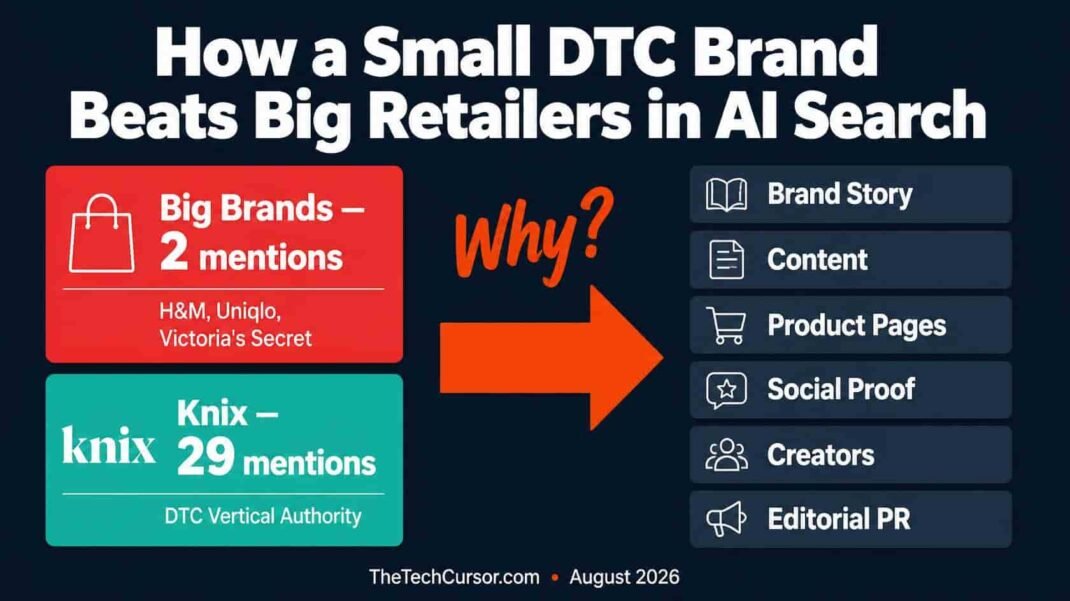
This case study examines exactly how Knix built that AI visibility advantage — and what every DTC brand can take from it.
1. The Stat That Should Change How Every DTC Brand Thinks About AI Search
The 29-to-2 gap is not a coincidence or a measurement anomaly. It is the predictable outcome of a brand that has systematically built the signals AI systems use to evaluate, understand, and recommend products — versus brands that have not.
AI search systems do not reward market share, marketing spend, or household name recognition. They reward the density and consistency of structured signals about what a brand does, who it serves, and why it should be recommended for specific use cases.
This is one of the most significant commercial opportunities available to DTC brands in 2026. The playing field in AI search is not the same playing field as traditional retail distribution or traditional search advertising — where scale, budget, and brand recognition compound into durable advantages. In AI search, the advantage belongs to the brand that has most clearly and consistently communicated what it stands for in the specific spaces where its audience lives and searches.
2. Vertical Authority vs Horizontal Dominance — The Core Concept
<cite index=”35-1″>Large brands are horizontally dominant. They cover a huge range of products, crossing genders, age groups, sizes, and needs. Knix, on the other hand, fits a specific vertical. And they’ve engineered repeated signals that AI reads as authority.</cite>
This distinction is foundational to understanding why Knix wins. H&M, Uniqlo, and Victoria’s Secret are horizontally dominant — they carry enormous product ranges across categories, audiences, and use cases. Their brand signal is broad and diffuse.
Knix is vertically authoritative in a specific niche: leakproof, body-inclusive intimates for women. That specificity makes it easier for AI systems to classify Knix as the authoritative source for a narrow but commercially important set of queries — and to recommend it consistently when those queries arise.
This is a pattern that applies far beyond intimates brands. Any DTC brand competing in a specific niche against larger general retailers has the same structural opportunity: to build deeper, more consistent vertical authority than competitors who are trying to be everything to everyone.
3. Strategy 1: Engineer a Clear Brand Story With One Consistent Message
<cite index=”35-1″>AI doesn’t guess who you are. It reflects what the web repeatedly says about you.</cite>
Knix anchored its entire brand messaging around one consistent idea from the very beginning — before AI search existed. That consistency became an AI visibility asset over time, because AI systems encountered the same brand positioning across every source they indexed: the Knix website, media coverage, influencer content, and community discussions.
The consistency is not accidental. It is intentional repetition of a specific set of associations — body positivity, size inclusivity, postpartum bodies, functional leakproof design — across every channel and every touchpoint.
When someone searches “best age-inclusive lingerie brands” or “body-positive period underwear” in ChatGPT or Google AI Mode, Knix appears because the AI has encountered those exact associations repeatedly across credible sources. The brand story preceded the AI search era and compounded into AI authority over time.
How to apply this:
Define one to three core associations for your brand — what you want to be known for beyond the product category. Not “high quality” or “great value” — specific associations that differentiate you from competitors and resonate with a specific audience.
Then audit every channel: website, product pages, email, social, PR briefs, creator partnerships. Are those associations consistently communicated? If not, close the gaps. AI learns from repetition. Every inconsistency is a missed opportunity to reinforce the signal.
4. Strategy 2: Build Content That Answers Real Buying-Stage Questions
<cite index=”35-1″>AI systems love to quote pages that directly answer real questions.</cite>
Knix’s blog is a direct response to real questions their audience asks before, during, and after purchasing. Topics like “do you ovulate when pregnant,” “how to wash period underwear,” and “what’s the best incontinence underwear” are not chosen arbitrarily. They are reverse-engineered from real conversations — social media comment sections, Reddit threads, and TikTok discussions where their target audience expresses genuine confusion or curiosity.
The mechanism is straightforward: when someone asks ChatGPT or Google AI Mode a question that Knix’s content directly answers, the AI cites Knix’s page. Each citation reinforces Knix’s vertical authority across AI training data and retrieval systems.
Furthermore, this content strategy creates what the original research calls a “network of authoritative, citable content” — each cited post deepening vertical authority across hundreds of related AI queries simultaneously.
How to find your content gaps:
Spend time in the social media comments sections of the top 10-20 accounts in your category. What questions do followers ask repeatedly? What confusion keeps appearing? What comparisons are people making?
Do the same in relevant Reddit communities and YouTube comment sections. These are the unfiltered, authentic questions that AI systems are already being asked — and that your content should be answering before your competitors do.
As covered in TheTechCursor’s guide on topical maps for AI search, a well-structured content cluster that covers a niche comprehensively is one of the strongest AI citation signals available.
5. Strategy 3: Make Product Pages AI-Readable With Use-Case Language
<cite index=”35-1″>AI may be great at understanding context. But it can’t infer what you mean about your products. It relies on what you explicitly say.</cite>
Knix’s product pages are optimized not just for human shoppers but for AI parsing. The navigation uses functional language — “period,” “bladder leaks,” “overnight,” “sweat and discharge” — rather than generic category labels. Product names include descriptive terms like “leakproof,” “high rise,” and “no show.” Product descriptions explicitly state use cases: heavy periods, postpartum recovery, overnight wear.
This explicitness is what enables AI systems to match Knix products to specific, high-intent queries. When someone asks ChatGPT “best leakproof period underwear for 3XL sizes,” Knix appears because its product pages explicitly state the relevant use cases, size performance, and functional attributes — not because the AI inferred it from generic product copy.
How to apply this:
Audit your product page navigation, category headlines, product titles, and first 100 words of product descriptions. Ask honestly: would someone searching “best [product] for [specific use case]” see their exact situation reflected in this copy?
If not, rewrite around explicit use cases. List the top five real-world scenarios your product is used in — not abstract benefits but specific contexts — and make sure every product page makes those contexts explicit.
Furthermore, maintain consistency across all retail platforms where your products appear. <cite index=”35-1″>Semrush data from February 2026 shows Amazon is one of the top sources cited in Google AI Mode answers.</cite> If your Amazon listings are thin or inconsistent with your own site, you are weakening your AI visibility even when your own pages are well-optimized.
6. Strategy 4: Structure Social Proof as Machine-Readable Signals
<cite index=”35-1″>Brands that surface structured credibility signals appear more frequently in AI-generated answers. Backlinko analyzed the top 50 ecommerce brands with medium to high AI visibility scores — and 82% featured awards and certifications on their product pages.</cite>
Structured social proof is not just about converting human shoppers. It is about giving AI systems the consensus signals they need to confidently recommend your brand. When multiple credible sources make the same claim about your product — reviewers praising specific attributes, publications recognizing your brand, certifications validating your credentials — AI systems treat that consensus as evidence of trustworthiness.
Knix structures its social proof specifically for AI parsing. Star ratings broken down by comfort, fit, and support. Review filters allow searches by size purchased and intended use case. Third-party editorial quotes surfaced directly on product pages. Founder endorsements alongside independent media mentions.
This creates what the research calls “structured, reinforced consensus” — the same claims validated from multiple independent directions, in formats that AI systems can extract and cross-reference efficiently.
How to apply this:
Add structured star ratings with category-specific breakdowns to your product pages. Implement AggregateRating schema so AI systems can parse your review data efficiently. Surface editorial recognition on product pages rather than burying it in a press section. Identify your most credible third-party mentions and bring them directly into the product page experience.
As covered in TheTechCursor’s review snippet guidelines article, ensure all reviews are authentic and properly disclosed — fake or undisclosed incentivized reviews now explicitly violate Google’s structured data guidelines and undermine the entity trust signals you are trying to build.
7. Strategy 5: Run Always-On Creator Campaigns — Not One-Off Spikes
<cite index=”35-1″>While one-off influencer posts can create spikes, an always-on approach creates patterns. Knix runs an ongoing ambassador program and long-term partnerships. That builds more distributed mentions over time.</cite>
Semrush data from June 2026 confirms that Instagram, TikTok, and YouTube are among the top 10 sources cited in Google AI Mode answers. This means creator content — which appears natively on these platforms — is directly feeding AI recommendation systems.
The critical distinction Knix has understood is the difference between campaign spikes and consistent patterns. A single wave of influencer posts creates a temporary signal. An ongoing ambassador program with recurring tagged content creates the kind of persistent, distributed mention pattern that AI systems interpret as genuine authority.
When AI encounters Knix mentioned repeatedly across diverse creator content — in different contexts, for different use cases, by different voices — it builds higher confidence in Knix as a recommended brand than if it encountered the same volume of mentions concentrated in a single campaign window.
How to apply this:
Prioritize long-term ambassador relationships over one-off sponsored posts. Brief creators to share real use cases — how they use the product, what problem it solves, who it is for. Natural language context is more valuable to AI systems than promotional messaging.
Then measure your progress by tracking AI mentions over time — not just social engagement metrics. As covered in TheTechCursor’s trending topics AI citations guide, citation monitoring tools can track whether creator activity is translating into AI recommendation improvements.
8. Strategy 6: Build Third-Party Editorial Coverage in the Right Places
<cite index=”35-1″>When reputable publications recommend your product, that’s a credibility signal. AI can then reference those in recommendation-style queries.</cite>
Knix’s appearances in ChatGPT and Google AI Mode for queries like “best leakproof period underwear” are driven substantially by editorial coverage from publications like InStyle and Glamour — sources that AI systems already trust for fashion and personal care recommendations. The editorial coverage creates authoritative, indexable third-party content that describes Knix products in context, discusses specific use cases, makes comparisons, and implies or states recommendations.
This is the 85% insight from TheTechCursor’s earlier five-phase framework article applied in practice: 85% of top-of-funnel B2B brand mentions in AI search come from third-party content. For DTC consumer brands, the percentage may be even higher.
<cite index=”35-1″>Not everyone needs constant Tier 1 placements to win the AI results race. Targeting highly authoritative, niche blogs and editorial sites can have a lasting impact on AI citations because industry experts in your brand’s field are going to be the main storytellers for LLMs.</cite>
How to apply this:
Start by identifying which publications appear in AI responses for your category. Run buying-stage queries like “best [product] for [use case]” in ChatGPT and Google AI Mode. Note which editorial sources appear most frequently as citations. Those are your priority outreach targets.
For smaller DTC brands without access to major national media, niche Substacks, category-specific YouTube reviewers, and specialist bloggers often dominate specific use cases in AI responses. A placement in a highly relevant niche publication may contribute more to AI citation probability than a general mention in a large-audience publication with no topical connection to your category.
9. Where Even a Well-Optimized Brand Can Still Improve
The Knix case study is not a portrait of perfection — it is a portrait of what deliberate vertical authority building looks like in practice. Even a brand winning as clearly as Knix has visible gaps.
Topical authority depth:
<cite index=”35-1″>Knix’s blog content does well in AI search for product-adjacent questions. Where it’s weaker is broader menstrual or women’s health content. Some health-focused posts feel like summaries of existing sources. There’s almost no original, expert-driven content.</cite>
The opportunity identified: partner with OB-GYNs or pelvic floor therapists to co-create content, sponsor small research studies, or publish original survey data. This would move health-related content from “explaining” to “contributing” — a shift that significantly strengthens AI citation probability for health queries.
This applies broadly. Any DTC brand has adjacent topic areas where deeper expert integration would expand AI visibility beyond the immediate product category into the broader conversation their audience cares about.
Community presence:
<cite index=”35-1″>There are active discussions about Knix across Reddit — including subreddits like r/PeriodUnderwear. But there’s little visible brand participation. That’s a missed opportunity.</cite>
Reddit remains one of the top 10 sources for both ChatGPT and Google AI Mode responses. As covered in TheTechCursor’s article on why traditional link building no longer works for AI search, community presence is AI search infrastructure — not a nice-to-have. Authentic brand participation in relevant communities shapes how AI systems understand brand sentiment, objections, and reputation.
10. The Takeaway — AI Visibility Is Engineered, Not Inherited
<cite index=”35-1″>LLMs learn from repetition, clarity, and consistency. That’s vertical authority.</cite>
The Knix case study demonstrates something that is both encouraging for smaller brands and clarifying for larger ones: AI search visibility does not flow automatically from brand size, advertising spend, or market share. It flows from the quality, consistency, and distribution of structured signals across the web.
A DTC brand that has clearly defined what it stands for, published genuine content that answers real buying-stage questions, made its product pages explicitly use-case oriented, structured its social proof for AI parsing, maintained consistent creator partnerships, and earned editorial coverage in the right publications — that brand can outperform a global retailer in AI recommendation systems for its specific vertical.
The six strategies Knix demonstrates are not proprietary or exclusive to well-funded brands. They are available to any DTC brand willing to engineer its vertical authority systematically rather than relying on scale to compensate for unclear signalling.
11. Bottom Line
Knix’s 29-to-2 AI mention advantage over global retail brands is not luck. It is the compounded result of years of consistent vertical authority building — clear brand messaging, genuine content that answers real questions, explicit use-case product language, structured social proof, always-on creator relationships, and targeted editorial coverage.
Every DTC brand competing against larger general retailers has access to the same structural advantage Knix has exploited. The brands that recognize and act on it now will compound AI visibility advantages that become progressively harder for larger, less-focused competitors to overcome.
Start with the audit Knix’s success implies: run 10 to 15 buying-stage queries in ChatGPT and Google AI Mode for your category. Track which brands appear and how often. If your brand is absent where Knix-like competitors are present, the gap tells you exactly where to focus first.
AI visibility is engineered. The engineering starts with a decision to take it seriously.
Pingback: What Makes a Good Listicle? New Research on 3,000 Pages Reveals the Signals That Actually Matter - The Tech Cursor