
Read time: 9 min
Table of Contents
- Why This Data Is Different
- Trend 1: Google Search Is Still Growing for Product Queries
- Trend 2: Traditional SEO Is Still a Top Revenue Driver
- Trend 3: AI Overviews Are Expanding Into Shopping Results
- Trend 4: AI Mode Has Minimal Real Adoption
- Trend 5: AI Assistant Adoption Is Slowing Down
- Trend 6: AI Traffic Is Still Small — But Converts Better
- Trend 7: Organic Google Shopping Converts 60% Better
- Trend 8: Agentic Commerce Is Still Mostly Hype
- What These Trends Mean for Your Ecommerce Strategy
- Bottom Line
Every few months, a new headline declares that Google Search is dying and AI has taken over. The ecommerce brands making smart strategy decisions are not reading headlines. They are reading data.
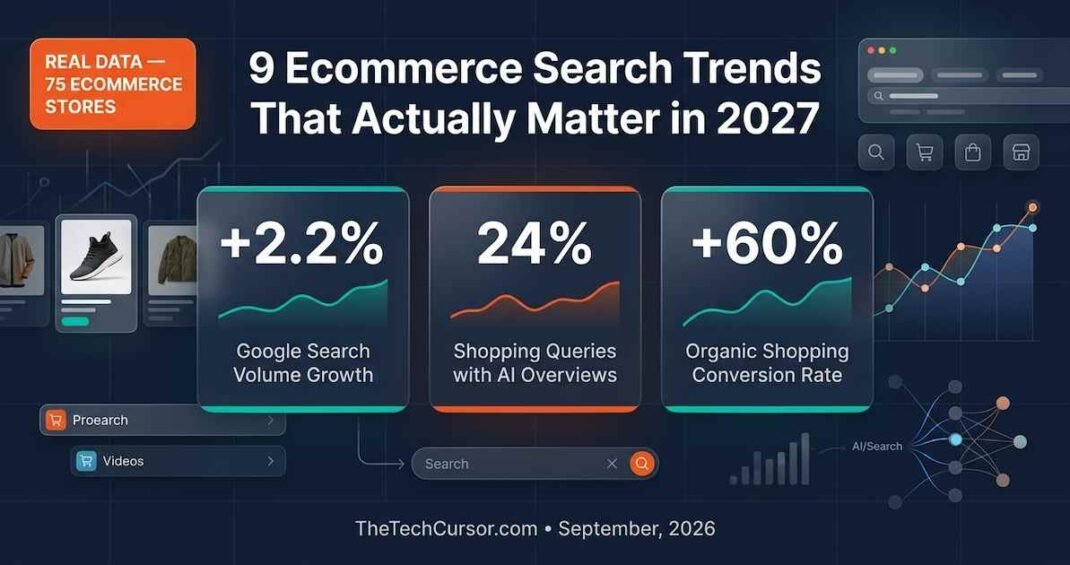
Jeff Oxford, founder of Visibility Labs, analyzed 2,000 transactional product keywords and pulled Google Analytics data from a panel of 75 ecommerce stores — brands generating between $1 million and $20 million in annual revenue. The findings challenge several widely-held assumptions about what is actually happening in ecommerce search right now.
Here are the nine trends that actually matter — with the data to back them up.
1. Why This Data Is Different
Most ecommerce search trend articles are based on industry surveys, expert opinions, or anecdotal reports. This analysis is different in two ways.
First, it uses actual search volume data from 2,000 transactional keywords — the kind buyers submit when they are ready to purchase, not just browsing. Terms like “protein powder,” “air fryer,” “weighted blanket,” and “microwave oven.”
Second, it pulls from a panel of 75 real ecommerce stores with actual Google Analytics and Google Search Console data — showing real traffic and revenue attribution across channels, not modelled estimates.
That combination produces findings that are meaningfully more reliable than most trend reports. Where the data contradicts popular narratives, the data wins.
2. Trend 1: Google Search Is Still Growing for Product Queries
The most important finding in the entire analysis contradicts the dominant SEO narrative of 2026.
(cite index=”9-1″>Google Search continues to grow year after year. In the last 12 months alone, search volume for transactional product keywords is up 2.2%.</cite>
That growth is happening despite the rise of ChatGPT, Claude, and other AI search platforms. Users are not abandoning Google to search for products on AI assistants. They are using Google more than ever for product searches — and using AI assistants for different purposes.
The implication is direct: ecommerce brands that have pulled back on Google SEO investment because they believed “search is dying” have made a costly mistake. Traditional Google search remains the dominant product discovery channel — and it is still growing.
3. Trend 2: Traditional SEO Is Still a Top Revenue Driver
Growing search volume matters only if it translates into traffic and revenue. The 75-store panel data confirms that it does.
(cite index=”9-1″>Based on the data, non-branded organic search is still one of the top-performing revenue channels for ecommerce, second only to paid search.</cite>
That ranking is significant. Non-branded organic search — the traffic driven by traditional SEO efforts targeting category and product keywords — outperforms email, social media, referral traffic, and direct navigation for revenue generation.
Furthermore, this non-branded organic performance reflects the compounding nature of SEO investment. Brands that have built topical authority, technical SEO strength, and strong product page optimization over years are capturing this revenue consistently — not dependent on ongoing ad spend the way paid search is.
For ecommerce brands currently under-investing in SEO relative to paid channels, the revenue data makes a strong case for rebalancing.
4. Trend 3: AI Overviews Are Expanding Into Shopping Results
While traditional Google search remains strong, one development is genuinely reshaping the ecommerce search results page: AI Overviews are expanding rapidly into shopping queries.
(cite index=”9-1″>The data shows a dramatic increase in AI Overview presence across shopping queries: AI Overviews appeared in 1.2% of shopping queries in November 2025, 14% in March 2026, and 24% in September 2026 — fresh data from Ahrefs.</cite>
That expansion from 1.2% to 24% in less than a year is significant. Initially, AI Overviews were primarily an informational content concern — appearing for queries like “how to clean a weighted blanket” rather than transactional queries like “buy weighted blanket.”
That distinction is eroding. Shopping queries are increasingly generating AI Overviews that appear above the traditional product listings and organic blue links. Consequently, brands ranking well for these queries may see their click-through rates decline even as their rankings hold.
However, there is nuance in the data. (cite index=”9-1″>The presence of AI Overviews has started to decline in the past few weeks, indicating that Google may be rolling back AI Overviews for some product search queries.</cite> The expansion may not be linear — Google appears to be testing and adjusting which query types receive AI Overviews.
If you have noticed organic traffic declining despite maintaining strong rankings, AI Overview expansion for your category keywords is a likely contributing factor worth investigating.
5. Trend 4: AI Mode Has Minimal Real Adoption
Google has been prominently promoting AI Mode — placing buttons for it on the Google homepage and Chrome search bar. However, promotion and adoption are very different things.
(cite index=”9-1″>A Datos study of more than 10 million desktop users found that AI Mode adoption is only about 0.13% of web traffic, down from its peak of 0.16% in March 2026. AI Mode has about 1.3% of the usage of the standard Google search experience.</cite>
That adoption rate is negligible from a traffic planning perspective. For every 1,000 searches on standard Google, approximately 13 happen in AI Mode. Furthermore, the trend is downward from peak adoption — suggesting that early adopters are returning to standard search rather than converting to AI Mode as their default.
The exception is Europe. (cite index=”9-1″>In the EU and UK, AI Mode has continued to grow at a steady rate since late 2025.</cite> European ecommerce brands may face different dynamics than US-focused ones.
For most ecommerce brands, AI Mode does not yet warrant dedicated optimization investment. The traffic volume is too small to materially affect results. Monitor it — but do not restructure your strategy around it yet.
6. Trend 5: AI Assistant Adoption Is Slowing Down
The same Datos dataset reveals something equally important about ChatGPT, Claude, Gemini, and other AI assistants as product discovery channels.
(cite index=”9-1″>ChatGPT is the clear leader across all major AI assistants, but Gemini and Claude are catching up. ChatGPT had been steadily growing through Q4 2025, but usage seems to be flattening out, or possibly even declining. Claude adoption spiked in early 2026 after the release of Opus 4.5, and growth has continued. Gemini has been steadily gaining traction, although growth may be slowing as of mid-2026.</cite>
(cite index=”9-1″>Other AI assistants, like Copilot and DeepSeek, see very little use in the United States. Their adoption seems to be declining, especially as Gemini and Claude gain in popularity.</cite>
The strategic implication is clear: for ecommerce brands tracking AI assistant visibility, Google and ChatGPT are the only platforms with meaningful adoption. Optimizing for Perplexity, Copilot, or DeepSeek specifically is not a priority given current traffic volumes.
7. Trend 6: AI Traffic Is Still Small — But Converts Better
Despite the growth in AI assistant usage, traffic from AI assistants to ecommerce sites remains a very small fraction of total search traffic.
(cite index=”9-1″>Across the same panel of 75 ecommerce sites, only about 1.6% of total search traffic and revenue is coming from AI assistants.</cite>
However, the quality of that traffic is meaningfully higher than traditional organic search.
(cite index=”9-1″>Over the past six months, traffic from AI assistants has a 19% higher conversion rate than non-branded organic search — 1.82% versus 1.53%.</cite>
The explanation makes intuitive sense. AI assistants compress the research phase from hours to minutes. A user who asks ChatGPT to recommend a weighted blanket for side sleepers has already done more research than a user who types “weighted blanket” into Google. By the time they click through to a product page, they are more qualified — and more likely to convert.
This finding has a specific implication for product page strategy. AI-referred traffic arrives with higher purchase intent than standard organic traffic. Product pages need to convert that intent efficiently — with clear pricing, strong social proof, and minimal friction between landing and purchase. Optimizing product pages for AI-era buyers matters more than the traffic volume alone suggests.
8. Trend 7: Organic Google Shopping Converts 60% Better
The most underappreciated finding in the entire dataset is the performance of organic Google Shopping.
(cite index=”9-1″>Organic Shopping sends a disproportionate amount of revenue when compared to its relative traffic. The sample of 75 ecommerce brands showed that organic Shopping converted 60% higher than non-branded organic search: non-branded organic search converts at 1.53%, while organic Shopping converts at 2.4%.</cite>
Organic Google Shopping — the free product listings that appear in the Shopping tab and increasingly in the main search results — is both underused and undervalued by most ecommerce brands. Many ecommerce SEO programs focus almost entirely on text-based organic rankings while treating Shopping as purely a paid channel.
The data contradicts that assumption. Organic Shopping traffic converts at a dramatically higher rate than text-based organic traffic. The likely explanation is intent: users who click on a Shopping listing have seen the product image, name, price, and star rating before clicking. They arrive with significantly more purchase-specific context than users clicking a blue link to a category or review page.
Furthermore, organic Shopping optimization is less competitive than text-based SEO for most categories. Product feed quality, review signals, and structured data are the primary levers — and many brands have not optimized them systematically.
9. Trend 8: Agentic Commerce Is Still Mostly Hype
Agentic commerce — the ability for AI assistants to complete purchases autonomously without the user leaving the AI interface — has generated enormous industry attention. The data suggests the attention is premature.
(cite index=”9-1″>OpenAI and Stripe co-developed the Agentic Commerce Protocol (ACP), which powered ChatGPT’s “Instant Checkout.” However, OpenAI ended Instant Checkout in March 2026 after only about 30 merchants ever went live. The official ACP documentation on OpenAI’s website has been reduced to guidance on traditional shopping feeds instead of the complete agentic checkouts it once covered.</cite>
(cite index=”9-1″>Google and Shopify led development of the Universal Commerce Protocol (UCP), enabling instant purchases within AI Mode and Gemini. Since February 2026, U.S. shoppers have been able to buy from a small group of retailers inside AI Mode and Gemini without leaving Google. However, there have been only a few sightings of instant checkout buttons in AI assistants, limited to major retailers like Wayfair, Etsy, Target, and Home Depot.</cite>
For mid-market ecommerce brands — the $1 million to $20 million revenue range that represents the bulk of the 75-store panel — agentic commerce is not yet a realistic consideration. Implementation remains limited to a handful of major retailers on Shopify or custom-built infrastructure. Adding agentic shopping protocols to a standard ecommerce roadmap today is likely to produce no measurable impact.
Monitor the space. Revisit in 12-18 months. Do not divert resources from proven channels based on current agentic commerce hype.
10. What These Trends Mean for Your Ecommerce Strategy
The nine trends paint a clear picture of where ecommerce search investment should focus in 2027 — and where it should not.
Double down on traditional Google SEO. Search volume for transactional product keywords is growing. Non-branded organic search is the second-highest revenue channel across the 75-store panel. Brands cutting SEO investment in anticipation of AI disruption are cutting their highest-ROI channel without evidence to justify it.
Prepare for AI Overview expansion in your category. AI Overviews have expanded from 1.2% to 24% of shopping queries in under a year. Monitor your category’s AI Overview presence weekly. If AI Overviews are appearing for your top revenue keywords, investigate whether your content can earn citation status — which generates both organic authority and AI visibility simultaneously. The 5 GEO pillars framework addresses this directly.
Invest in organic Shopping optimization .A 60% conversion rate advantage over text-based organic is a significant opportunity. Audit your product feed completeness, review signal strength, and structured data implementation. Many brands leave substantial organic Shopping revenue on the table due to poor feed quality.
Optimize product pages for AI-referred buyers. AI-referred traffic converts 19% better than standard organic. However, that advantage only materializes if the landing page matches the buyer’s elevated intent level. Strong product imagery, clear social proof, transparent pricing, and minimal checkout friction are essential to capture the conversion premium that AI-referred buyers represent.
Deprioritize agentic commerce and AI Mode for now. Neither agentic commerce nor dedicated AI Mode optimization has produced measurable results for mid-market ecommerce brands yet. Monitor both. Revisit investment decisions when adoption data justifies it.
11. Bottom Line
The most valuable outcome of data like this is not confirming what you already believed — it is revealing where popular narratives diverge from reality.
The reality in ecommerce search right now is this: Google Search is still growing. Traditional SEO is still a top revenue driver. AI Overviews are expanding into shopping but remain volatile. AI Mode has minimal adoption. AI traffic converts better but remains small. Organic Shopping is massively undervalued. Agentic commerce is mostly hype.
The brands that outperform in 2027 will not be the ones that correctly predicted every AI development. They will be the ones that maintained investment in what is proven — while monitoring emerging channels closely enough to recognize when the data actually justifies a strategy shift.
The data justifies staying focused on Google Search, organic Shopping, and careful AI Overview monitoring. Everything else can wait for the numbers to catch up with the headlines.
Pingback: How to Report SEO Results to Executives (2026 Guide) - The Tech Cursor