
Read time: 9 min
Table of Contents
- Why SEO Automation Has Changed in 2026
- The Automation Decision Framework
- Category 1: Technical Audits and Monitoring
- Category 2: Keyword Research and Clustering
- Category 3: Content Production and Optimization
- Category 4: Reporting and Analytics
- Category 5: Link Building and Outreach
- Category 6: Local SEO Tasks
- The Tasks You Should Never Automate
- Building Your SEO Automation Stack
- Bottom Line
SEO automation is not new. Scripts, crawlers, and scheduled reports have been part of SEO workflows for years. However, 2026 is different. AI tools have made automation accessible for tasks that previously required significant technical skill. Furthermore, they have created new risks — specifically, the risk of automating judgment-dependent tasks that require human expertise to execute correctly.
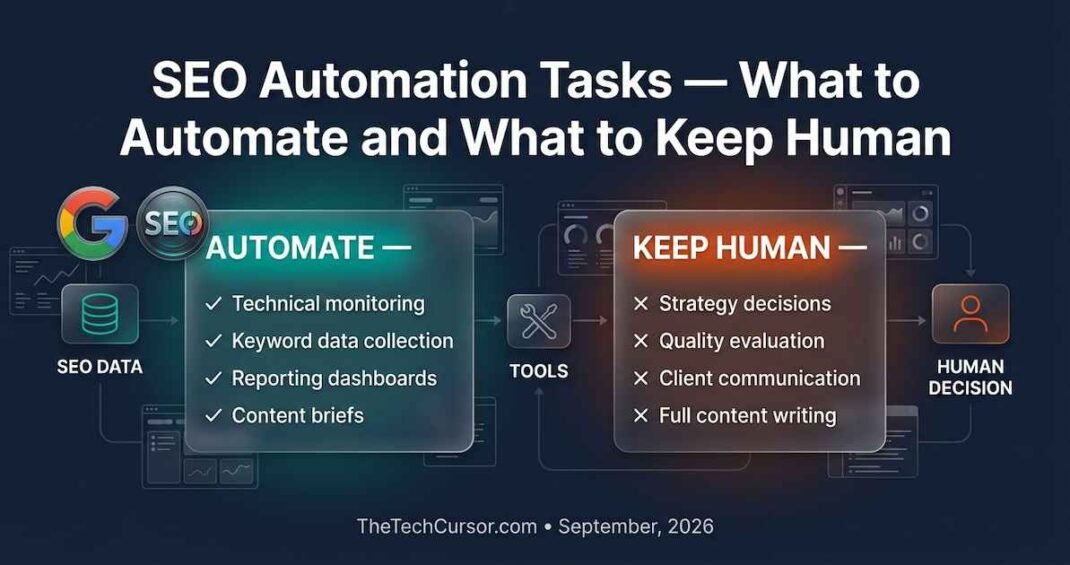
The brands winning in SEO right now are not the ones automating everything. They are the ones who have clearly identified which tasks benefit from automation and which tasks require human involvement. This guide covers both sides of that line — and gives you specific tools and approaches for each.
1. Why SEO Automation Has Changed in 2026
Two developments have fundamentally changed what SEO automation looks like in 2026.
First, AI writing and analysis tools are now widely available. Tasks that previously required a developer — clustering keywords, generating content briefs, analyzing SERP patterns — can now be completed by any marketer with access to Claude, ChatGPT, or Gemini. The technical barrier to automation has dropped significantly.
Second, Google’s quality systems have become more sophisticated. Automated content that might have ranked in 2022 is increasingly being filtered out, penalized, or simply ignored. As covered in the Google old low-value pages site recovery guide, sites that automated content production without quality controls are facing significant recovery challenges.
These two developments pull in opposite directions. Automation is easier than ever. However, the consequences of automating the wrong things are also more severe than ever. The automation decision framework below helps you navigate this tension.
2. The Automation Decision Framework
Before automating any SEO task, ask three questions.
Question 1: Does this task follow a consistent, repeatable pattern? Tasks with consistent inputs and predictable outputs are good automation candidates. Tasks where the right answer depends on context, judgment, or expertise are poor automation candidates.
Question 2: What is the cost of an automation error? Some errors are cheap — a slightly wrong keyword cluster is easy to fix. Other errors are expensive — automated content that violates Google’s quality guidelines can take months to recover from. Higher error costs require more human oversight, even in automated workflows.
Question 3: Does automation remove the value? Some tasks derive their value from human judgment. An automated link building outreach that removes personalization removes the thing that makes outreach work. An automated content brief that skips audience research produces a brief without the insight that makes content useful.
Tasks that pass all three tests are strong automation candidates. Tasks that fail any one of them should remain human-led — or be automated only with strong human review checkpoints.
3. Category 1: Technical Audits and Monitoring
Technical SEO is the highest-value automation category. Most technical checks follow consistent patterns. Errors are easy to catch and fix before they cause lasting damage. Furthermore, the volume of pages on most sites makes manual technical auditing impractical.
Automate these technical tasks:
Crawl scheduling — Schedule weekly crawls with Screaming Frog, Sitebulb, or similar tools. Configure automatic alerts for critical errors: 5xx server errors, broken internal links, missing canonical tags, and pages returning unexpected status codes.
Core Web Vitals monitoring — Connect your site to Google Search Console and set up automated email alerts for CWV regressions. Additionally, tools like PageSpeed Insights API can be scheduled to check key pages on a regular cadence.
Index monitoring — Set up automated checks for sudden drops in indexed page counts. A 20% drop in indexed pages overnight is a critical alert that should trigger immediate human investigation.
Redirect chain checking — Automate regular checks for redirect chains longer than two hops. Chains are easy to create accidentally and slow to notice without automated monitoring.
Broken link detection — Schedule automated broken link checks across your most important pages. Furthermore, monitor for new 404s that appear after site updates.
Do not automate these technical tasks:
Do not automate the interpretation of crawl findings. A crawler flags issues without context. Deciding which flagged issues actually matter — and which are intentional or low-priority — requires human judgment. As covered in the before hiring an SEO auditor guide, this interpretation gap is why audit quality varies so dramatically.
4. Category 2: Keyword Research and Clustering
Keyword research has a strong automation component — but also a judgment component that automation frequently misses.
Automate these keyword tasks:
Volume and difficulty data collection — Use SEO tool APIs (Semrush, Ahrefs, Moz) to pull keyword metrics in bulk. This is pure data retrieval and is ideal for automation.
Semantic clustering — AI tools can group large keyword lists by semantic similarity significantly faster than manual review. Tools like Keyword Insights and KeyClusters do this automatically. Furthermore, Claude and ChatGPT can cluster keyword lists when prompted with clear instructions.
SERP feature identification — Automate regular checks for which keywords in your tracking set are triggering AI Overviews, featured snippets, People Also Ask boxes, and shopping carousels. This data changes frequently and is impractical to monitor manually at scale.
Competitor keyword gap analysis — Automate regular competitor keyword comparison reports. Monthly or quarterly automated gap reports surface new opportunities without requiring manual analysis each time.
Do not automate these keyword tasks:
Do not automate keyword prioritization. Choosing which keywords to target requires understanding your business goals, your competitive position, your content capabilities, and your audience’s actual intent. As covered in the query templates and topical authority guide, the most valuable keyword strategy decisions require human understanding of query patterns and user intent that automated tools cannot replicate.
5. Category 3: Content Production and Optimization
Content automation is the most contested area in SEO — and the one where the automation decision framework matters most.
Automate these content tasks:
Content briefs — AI tools can generate structured content briefs from keyword research data, SERP analysis, and competitor content audits. The brief itself is not the final product — it is a starting point for human writers. Automating brief generation saves significant research time without removing human judgment from the writing process.
Meta title and description generation — For large sites with hundreds or thousands of pages, automated meta title and description generation — with human review of the outputs — is practical and effective. Templates with variable fields work well for ecommerce product pages, local pages, and other repeatable page types.
Content freshness checks — Automate regular scans of your content inventory for pages with statistics, dates, or product information that may have become outdated. Flag pages for human review rather than automatically updating them.
Internal link suggestions — AI tools can analyze your content library and suggest relevant internal links for new articles. Human writers should review and approve these suggestions — but the initial identification can be automated.
Do not automate these content tasks:
Do not automate full article production without substantial human involvement. As covered in the content marketing 12-year low article and the future of content idea economy guide, the brands seeing strong content results are investing more human expertise in their content — not less. AI assists. Humans decide, edit, and take responsibility for the final output.
6. Category 4: Reporting and Analytics
Reporting is one of the highest-value automation opportunities in SEO. Most reporting tasks are data aggregation and formatting — ideal for automation.
Automate these reporting tasks:
Weekly performance summaries — Connect Google Search Console and GA4 to Looker Studio. Build automated dashboards that update daily. Schedule weekly email digests with key metric summaries.
Ranking tracking — Schedule automated ranking checks for your priority keyword set. Most rank tracking tools support automated weekly or daily checks with email alerts for significant movements.
AI visibility tracking — As covered in the AI visibility dashboard guide, automate GA4 AI referral traffic segmentation and Search Console AI Performance Report exports. Prompt tracking is more manual — but even that can be semi-automated with tools like Profound and Otterly.ai.
Competitive monitoring — Set up automated alerts for competitor ranking changes, new content publication, and backlink acquisition. Tools like SEMrush Position Tracking and Ahrefs Alerts handle this automatically.
Do not automate these reporting tasks:
Do not automate insight generation. Data collection is automatable. Understanding what the data means for your specific business situation requires human analysis. Automated reports that present data without interpretation produce dashboards that nobody acts on.
7. Category 5: Link Building and Outreach
Link building has a strong data component that benefits from automation — and a relationship component that is actively harmed by it.
Automate these link building tasks:
Prospect identification — Use tools like Ahrefs, Semrush, and Moz to automatically identify sites linking to competitors but not to you. Link gap analysis at scale is practical only with automated data collection.
Broken link discovery — Automate checks for broken links on relevant external sites that might benefit from a replacement link to your content. Tools like Ahrefs Site Explorer can identify these opportunities automatically.
Backlink monitoring — Automate regular checks for new backlinks, lost backlinks, and changes in referring domain quality. These are pure data monitoring tasks.
Do not automate these link building tasks:
Do not automate outreach. As covered in the invisible PR guide and the traditional link building AI search guide, the value in link outreach is genuine relationship-building. Automated outreach removes exactly the thing that makes outreach work. Furthermore, Google’s spam detection systems specifically target patterns associated with automated mass outreach.
8. Category 6: Local SEO Tasks
Local SEO has several highly automatable tasks — particularly around monitoring and consistency checking.
Automate these local SEO tasks:
NAP consistency monitoring — Automate regular checks for Name, Address, and Phone inconsistencies across directories, review platforms, and citation sources. Tools like BrightLocal and Yext handle this automatically.
Review monitoring — Set up automated alerts for new reviews across Google Business Profile, Yelp, and relevant vertical platforms. Responding to reviews requires human judgment — but knowing they exist requires only automated monitoring.
Google Business Profile post scheduling — Automate regular GBP post scheduling with tools that support API access. Consistent posting signals activity without requiring daily manual updates.
Do not automate these local SEO tasks:
Do not automate review responses. Customers who leave reviews — positive or negative — deserve human responses. Automated review responses are easy to identify and damage brand perception. Furthermore, they miss the opportunity to demonstrate genuine customer care that builds the reputation signals AI systems value.
9. The Tasks You Should Never Automate
Some SEO tasks should remain entirely human-led regardless of what automation tools make possible.
Strategy and prioritization — Deciding which markets to target, which content investments to make, and how to allocate SEO budget against business goals requires human understanding of business context that no automation tool possesses.
Client and stakeholder communication — SEO reporting to clients, stakeholders, and leadership requires human interpretation, narrative construction, and relationship management. Automated reports are inputs to this process — not substitutes for it.
Quality evaluation — Deciding whether a piece of content meets your quality standards, whether a link opportunity is worth pursuing, or whether a technical fix is the right solution requires human judgment calibrated to your specific situation.
Crisis response — When rankings drop significantly, when a manual action is received, or when a major algorithm update hits, the response requires human strategic thinking that accounts for your specific site history, business context, and risk tolerance.
10. Building Your SEO Automation Stack
A practical SEO automation stack for 2026 combines four layers.
Layer 1: Data collection tools: Screaming Frog, Ahrefs, Semrush, or Moz for crawling and keyword data. Google Search Console and GA4 for performance data. Rank tracking tools for position monitoring.
Layer 2: AI analysis tools: Claude, ChatGPT, or Gemini for content briefs, keyword clustering, and analysis tasks. MCP server integrations connect AI tools directly to your SEO data sources, as covered in the MCP servers for SEO guide.
Layer 3: Reporting and dashboards: Looker Studio for automated performance dashboards. Google Sheets for custom data aggregation. Scheduled exports from SEO tools for regular reporting.
Layer 4: Monitoring and alerts: Uptime monitoring for server health. Search Console performance alerts. Rank tracking alerts for significant movements. Brand mention monitoring for reputation management.
The goal is not to eliminate human involvement. It is to remove humans from repetitive data collection and monitoring tasks so they can focus on strategy, interpretation, and judgment-dependent work.
11. Bottom Line
SEO automation in 2026 is about making humans more effective — not replacing them. The tasks that benefit most from automation are data collection, monitoring, and repetitive formatting work. The tasks that suffer most from automation are those that require judgment, expertise, relationship-building, and strategic thinking.
The automation decision framework is simple. Does the task follow a consistent pattern? Is the error cost manageable? Does automation preserve the value? Tasks that pass all three tests are automation candidates. Tasks that fail any one of them need human oversight.
Build Your Automation Incrementally
Start with technical monitoring — it delivers immediate value with minimal risk. Add keyword data automation next. Build reporting dashboards that update automatically. Layer in content assistance tools with strong human review processes. Add link-building prospecting tools with manual outreach.
Each layer frees up human time for the higher-value work that automation cannot do. That is the SEO automation dividend — not fewer humans, but better-focused humans doing the work that actually moves the needle.