
Read time: 5 min
Table of Contents
- What Google Just Announced
- Update 1: More Inline Links, Higher Up
- Update 2: Dedicated Source Links for Specific Tasks
- Update 3: Article Carousels Now Rolling Out Globally
- Update 4: Related Articles With Images
- Update 5: Clickable Creator Profiles in AI Mode
- Update 6: Preferred Sources Usage Up 7x
- The Honest Assessment — Will Searchers Actually Click?
- What Publishers Should Do
- Bottom Line
Google announced a series of updates to AI Mode and AI Overviews on October 15, 2026. The changes add more links, visual carousels, related articles, and creator profile connections to AI search responses. Google described the goal as making “exploring the web simpler, more visual, and more engaging.”
The updates are real and significant. Whether they will meaningfully restore publisher clicks lost to AI features is a separate question — and one Google has not answered with click data.
1. What Google Just Announced
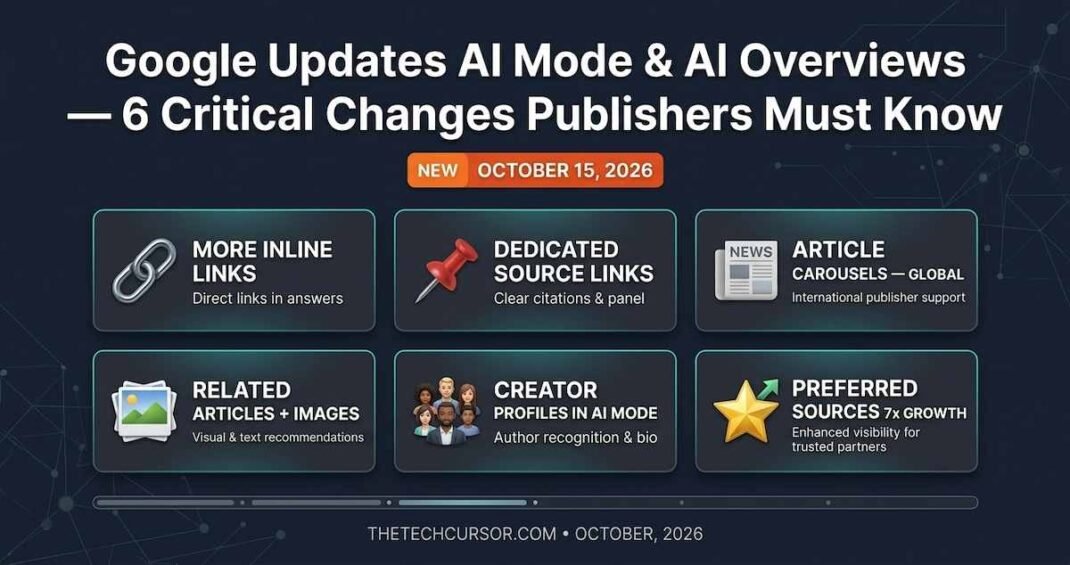
Six distinct updates rolled out or are rolling out for AI Mode and AI Overviews:
- More inline links, embedded in words or phrases within AI responses
- Dedicated source link sections for specific task-based queries
- Article carousels for timely queries, now expanding globally
- Related articles with images and thumbnails
- Clickable creator profile links in AI Mode video responses
- A reported 7x growth in Preferred Sources usage this year
Each update moves in the same direction: more visible, more clickable pathways from AI responses to external web content. The stated intent is clear. The actual click behaviour that results is unknown — because Google has not released click data from AI features in Search Console.
2. Update 1: More Inline Links, Higher Up
Inline links are hyperlinks embedded directly in words or phrases within the AI response — not just listed as citations at the bottom. Google confirmed it has “made continuous and substantial increases” to the presence of inline links in AI search responses.
Furthermore, these inline links are now appearing higher up in the AI response than before. Google’s stated purpose is to “ensure key sources are easily clickable.”
This is a meaningful structural change. Previously, many AI Overview citations appeared below the main text block — requiring the user to scroll past the full answer to find source links. Moving links inline and higher up makes them more visible and potentially more likely to receive clicks.
However, visibility is not the same as clicks. A user who reads an inline link and finds the AI response sufficient has no incentive to click. The question of whether higher link placement translates to meaningfully higher click-through rates is one Google has not answered publicly.
3. Update 2: Dedicated Source Links for Specific Tasks
For queries where there are only a small number of official sources capable of completing a specific task, Google will now display a dedicated section at the top of the AI response that surfaces those links directly.
The example Google provided is an airline refund query. When a user asks how to request a refund from a specific airline, the AI response now surfaces the airline’s official refund page in a prominent dedicated section — rather than burying the link in a list of citations below the AI answer.
This update is the most publisher-positive of the six. It specifically identifies task completion scenarios — situations where users need to take action on a specific website — and brings those links forward in a dedicated, high-visibility placement.
The practical implication is that pages designed for task completion — account pages, application forms, booking systems, official information pages — may see meaningful click increases from this placement. Informational content that answers questions without requiring task completion on the source site is less directly affected.
4. Update 3: Article Carousels Now Rolling Out Globally
Google first announced article carousels for AI responses earlier this year. The feature surfaces article cards — with headlines, thumbnails, and source attribution — within AI responses for timely, news-based queries.
Google confirmed these are now rolling out for “additional locations and languages globally.” Furthermore, the carousels are being offered for a “wider range of queries” than when first launched — expanding from a narrow set of breaking news queries toward a broader set of timely topics.
The carousels highlight Preferred Sources specifically — giving publishers who have been added as Preferred Sources by users a visual prominence advantage over non-preferred sources in the same carousel.
This is the update with the clearest benefit for publishers invested in timely content and Preferred Source growth. A publisher appearing in an article carousel has a thumbnail, a headline, and their brand name visible to the user — significantly more prominent than an inline text link.
5. Update 4: Related Articles With Images
Google is adding image thumbnails to some AI responses in a “related articles” format. The design goal is a “more clickable” appearance for publisher links that appear alongside or below the main AI response.
The practical effect is similar to the article carousel — making publisher links more visually prominent rather than plain text. Images and thumbnails give users more context about what they will find at the link before clicking.
This update benefits publishers who produce well-illustrated content with strong featured images. Furthermore, publishers who have optimized their Open Graph images — the images that appear when a page is shared or linked — will see those optimizations carry into this placement.
6. Update 5: Clickable Creator Profiles in AI Mode
For video results within AI Mode, Google is adding clickable creator profile links. When a creator or publisher’s video appears in an AI Mode response, users can click on the creator’s name to open their Google Search profile.
This is specifically about Google Search profiles — the publisher and creator profiles that Google has been expanding access to throughout 2026, most recently lowering the eligibility threshold to 10,000 followers.
One important caveat: clicking the creator profile link does not take the user directly to the creator’s own website. It takes them to a Google landing page for the creator’s Search profile — from which the user can then navigate to the creator’s external properties.
Consequently, this is a visibility benefit — users can learn more about a creator without leaving Google — but it is not a direct traffic driver in the same way that a link to the creator’s website would be.
7. Update 6: Preferred Sources Usage Up 7x
Google reported that Preferred Sources usage has grown by 7x this year — meaning seven times as many users are now actively selecting their preferred news and content sources compared to earlier in 2026.
This growth matters for publishers because Preferred Sources receive visibility advantages in AI responses, article carousels, and Discover. A publisher with a large Preferred Sources following is systematically more visible to their opted-in audience across Google’s AI features.
For publishers who have not yet invested in Preferred Sources growth — promoting the add-as-preferred-source option to their existing audience — the 7x growth signals that this audience segment is becoming more significant within Google’s ecosystem.
8. The Honest Assessment — Will Searchers Actually Click?
Google is clearly investing in making AI responses more link-rich and more visually engaging. The intent to maintain publisher relevance within AI search results is evident in every update announced today.
However, intent and outcome are different things.
The University of Pennsylvania and Northeastern research found that AI Mode reduces clicks to websites substantially. More links visible in an AI response does not automatically mean more clicks — it means more links that users can choose to click or ignore while reading a response that already answers their question.
Google’s refusal to provide click data in Search Console’s AI Performance reports — despite now reporting impressions — is relevant here. If inline links and carousels were producing meaningful click increases, click data would support the publisher-positive narrative Google is trying to establish. Without that data, publishers are asked to trust the intent without seeing the outcome.
The dedicated source links update — specifically designed for task completion queries — is the most credible of the six updates for driving actual clicks. The carousels and related articles with images improve visual prominence but do not fundamentally change the incentive structure that determines whether a user with a sufficient AI answer will click through to a source.
9. What Publishers Should Do
Each of today’s updates points toward a specific publisher action.
For inline link visibility: Structure content with clear, specific sections that can be referenced inline. Content where specific facts, statistics, or recommendations are tied to specific phrases is more likely to be cited inline than undifferentiated explanatory prose.
For dedicated source links: Identify your task-completion pages — pages where users need to take an action that can only be completed on your site. These are the pages most likely to receive the dedicated source link treatment. Ensure they are technically excellent and load quickly.
For article carousels: Invest in Preferred Sources growth. Promote the “Add as Preferred Source” option to your newsletter subscribers, social followers, and direct audience. Build and maintain your Google Search profile. Carousels specifically highlight Preferred Sources — that visibility advantage compounds with scale.
For related articles: Audit your featured images and Open Graph image tags. Ensure every article has a compelling, correctly sized thumbnail that represents the content accurately.
For creator profiles in AI Mode: If you are producing video content, optimize your YouTube presence and ensure your Search profile is current. The creator profile link appears on video results — not text articles — so video investment is the prerequisite.
Track everything separately. The AI visibility dashboard framework covers how to monitor AI impression trends in Search Console, AI referral traffic in GA4, and Preferred Sources growth separately. Today’s updates make that tracking more important, not less — because publishers need to evaluate whether the visual prominence improvements translate into actual traffic changes.
10. Bottom Line
Google’s October 15 AI Mode and AI Overview updates represent genuine effort to make AI search responses more publisher-friendly. More inline links, carousels, visual related articles, and creator profile connections all increase publisher visibility within AI responses.
The question of whether increased visibility translates to increased clicks remains unanswered — and will remain unanswered until Google releases click data alongside impression data in Search Console’s AI Performance reports.
For publishers, the most actionable update today is the article carousel expansion. Preferred Sources receive a visual prominence advantage in carousels. The 7x growth in Preferred Sources usage confirms that investing in this audience segment is increasingly worthwhile. Build your preferred source following, maintain your Search profile, and track carousel impressions in Search Console as one indicator of whether these updates are working for your specific content.