Read time: 5 min
Google’s Dive Deeper links have started appearing in AI Mode. Google announced the feature on October 15, 2026, along with other link changes. Observers noticed it live over the weekend of November 21 and 22.
The feature points searchers to articles after the AI answer. For publishers, that sounds helpful. However, the details suggest modest effects, at least for now.
What Went Live
SEO consultant Glenn Gabe spotted the new section first. He described blue links, thumbnails, and a short description. Other observers then confirmed they could see it too.
The feature appears to be rolling out gradually. Google has not posted a fresh announcement for this rollout. Instead, the company’s October post described the change in advance.
How Dive Deeper Works in AI Mode
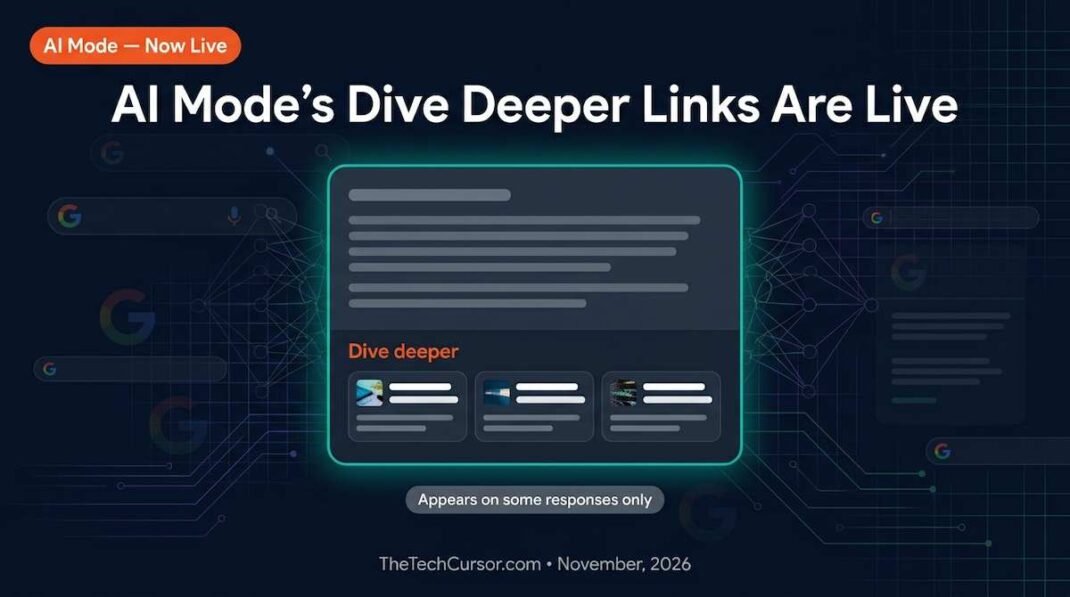
Dive Deeper shows links to articles at the end of some AI Mode responses. The links usually point to news publishers. They give more detail on the topic AI Mode just answered.
Google describes the goal in simple terms. Once a user understands the basics, they may want to dig into interesting angles. Therefore, Google is making the links at the end of some AI responses more engaging and prominent.
The design changes are specific. The links now carry image thumbnails and a more clickable layout. Importantly, the section appears only on some responses, not all.
Three Features, One Name
The name “Dive Deeper” now covers several different things. This causes confusion, so a quick map helps.
- Dive Deeper in Discover. This was a test of AI-generated topic summaries in the feed. The Discover Dive Deeper article explains it.
- Dive deeper from AI Overviews. A button at the bottom of an AI Overview has long let users continue in AI Mode.
- Dive Deeper in AI Mode. This is the new links section, which is the subject of this article.
Only the third feature shows article links after an AI answer. Consequently, do not assume that news about one applies to the others.
What We Do Not Know
Several questions remain open.
First, Google has not said how many responses show the section. Second, it has not shared any click data. Third, rollout timing by country and language is unclear.
Also, observers note a practical limit. Users must scroll past a lot of AI-generated content to reach the links. As a result, many people may never see them. One early assessment is that the feature may bring a few more clicks, not a surge.
What Publishers and SEOs Should Do
The steps below are analysis, not Google guidance.
- Optimize your images. Thumbnails are now part of the link design. Therefore, use clear, relevant lead images and correct Open Graph tags.
- Write clear headlines and descriptions. The section shows a title and short description. Specific wording helps users decide to click.
- Cover distinct angles. The feature is framed around interesting angles on a topic. Original reporting and analysis fit that frame better than rewrites.
- Grow Preferred Sources. Google has been highlighting articles from sources readers choose. The Preferred Sources guide explains how to prompt readers.
- Track referrals. Watch for changes in traffic from Google surfaces, and compare them with earlier baselines.
For context, the October AI Mode updates article lists the other link changes announced alongside this one. Meanwhile, the AI Mode clicks research showed that AI Mode reduces clicks overall. Furthermore, the Discover source click test shows that Google is also experimenting in the other direction.
6. Bottom Line
Google’s Dive Deeper links are rolling out in AI Mode. They add prominent, thumbnail-style article links at the end of some AI responses. However, Google has shared no click data, and the section sits far down the page.
The Takeaway
Treat this as a small positive for publishers, not a turnaround. Therefore, optimize your images and headlines, keep building direct audiences, and measure the results before drawing conclusions.