
Category: AI Search | Conversion Optimization | Digital Marketing
Read time: 7 min
Site: TheTechCursor
Table of Contents
- The Conversion Rate That Should Change Your Strategy
- Why LLM Traffic Behaves Fundamentally Differently
- The Trust Advantage of AI Citations
- PPC Landing Page vs LLM Landing Page — The Key Differences
- Four Actions to Convert LLM Traffic
- Action 1: Optimize for Information Gain to Earn the Citation
- Action 2: Wrap Your Brand Around the Citation Sources
- Action 3: Build Conversational Conversion Paths
- Action 4: Fix Your Attribution Before You Scale
- Bottom Line
Paid search has been performance marketing’s workhorse for two decades because the logic is clean: you pay for a click, you measure what happens next, you optimize.
AI-driven search is creating a fundamentally different kind of referral traffic — one that arrives after an AI system has already shaped the visitor’s decision. And the conversion data on that traffic is striking.
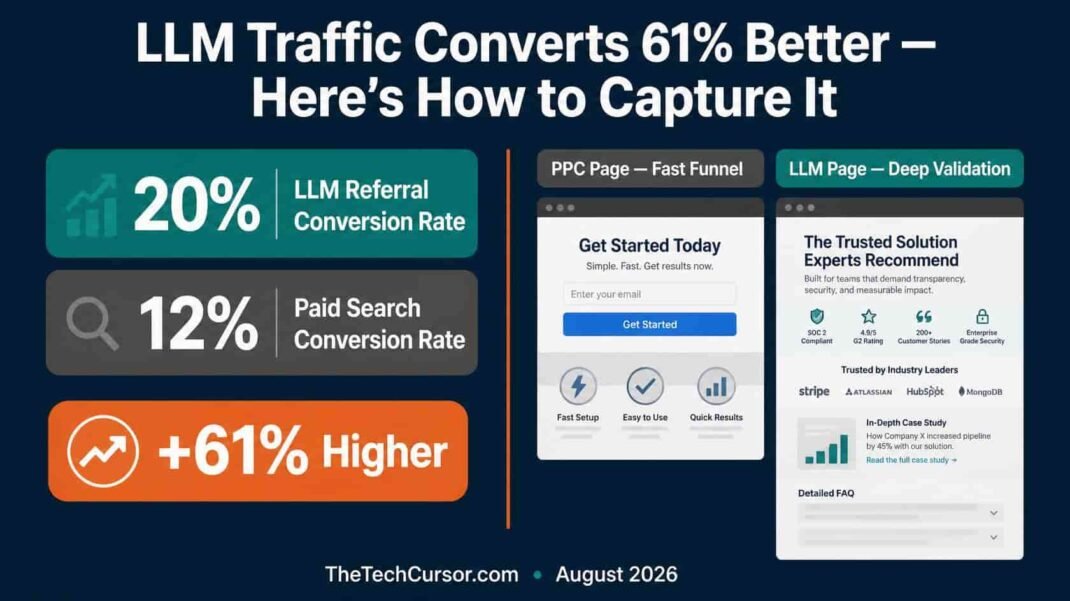
<cite index=”59-1″>Internal data from Jason Tabeling at Further shows LLM referral traffic converts at 20%, making it the highest-converting tactic in their dataset and 61% higher than paid search.</cite>
That is not a marginal improvement. It is a structural difference — and it demands a structural change in how brands build landing pages, measure attribution, and think about the relationship between AI visibility and conversion strategy.
1. The Conversion Rate That Should Change Your Strategy
<cite index=”59-1″>Our data shows LLM referral traffic converts at 20%, making it the highest-converting tactic in our dataset and 61% higher than paid search.</cite>
Before unpacking why, it is worth pausing on what this means practically. Most paid search teams treat conversion rate optimization as a function of landing page testing — headline variations, CTA placement, form length. Those optimizations matter. However, if LLM-referred visitors are converting at 20% and paid search visitors at roughly 12%, the most impactful “optimization” available to many teams is not changing a button colour. It is ensuring they appear in AI responses at all.
AI citation is now a conversion channel — not just a visibility metric. The brands that understand this will prioritize earning AI citations with the same urgency they apply to improving Quality Scores or landing page load times.
2. Why LLM Traffic Behaves Fundamentally Differently
The behavioural difference between LLM-referred visitors and paid search visitors starts before the click — like the query itself.
<cite index=”59-1″>Google has reported that the average search query in AI Mode is three times longer than a traditional search query. One in six AI Mode searches is also non-textual, using voice or image-based inputs.</cite>
A traditional paid search query might be “best CRM for small business.” An AI Mode query for the same purchase intent might be: “I run a 50-person consulting firm using Google Workspace. What CRM integrates best with it, costs less than $50 per user, and has strong email automation?”
The difference is not just length. It is the depth of context the user has already provided — and the depth of decision-making the AI has already done on their behalf.
<cite index=”59-1″>In PPC, you target intent based on an isolated search query. LLM users operate on context. By the time the LLM user clicks a link, the AI has already synthesized the options. The user is not looking for a generic landing page comparing 10 CRMs. They want validation of the AI’s specific recommendation.</cite>
The AI has done the top-of-funnel heavy lifting. The visitor arriving from an AI citation is further along in their decision journey than almost any paid search visitor — which is precisely why the conversion rate is higher.
3. The Trust Advantage of AI Citations
There is a second dynamic that amplifies conversion probability for LLM-referred visitors: perceived objectivity.
<cite index=”59-1″>When a user clicks a PPC ad, they know it is a paid placement, which creates a built-in level of skepticism. When an AI model cites your website as a source, the user may perceive it as an objective recommendation. The AI has evaluated information across the web and selected your content as a source for its answer.</cite>
This creates a fundamentally different baseline of trust. A visitor who arrived because an AI specifically cited your content as the authoritative source for their question arrives with an implicit endorsement that paid traffic cannot replicate.
However, that trust is contingent on alignment. <cite index=”59-1″>If you treat an LLM-driven visitor like a PPC visitor, you risk losing them.</cite> The trust the AI citation created can be eroded almost instantly if the landing page experience does not match what the AI told the visitor to expect.
4. PPC Landing Page vs LLM Landing Page — The Key Differences
The structural difference between what PPC visitors need and what LLM visitors need is significant enough to warrant distinct landing page approaches.
| PPC Landing Page | LLM Landing Page | |
|---|---|---|
| Focus | Immediate action — form fill, purchase, call | Depth, verification, transition to expertise |
| Design | Stripped down, minimal navigation, aggressive CTA | Navigable, resource-rich, clear pathways to depth |
| Content | Benefit-driven copy, bullet points, keyword-matched messaging | Comprehensive, authoritative — showing why the AI cited you |
| Trust mechanism | Social proof, testimonials, guarantees | Alignment with AI summary, expert depth, primary sources |
| User goal | Make a decision | Validate a decision already forming |
<cite index=”59-1″>When an LLM user lands on your site, they may be fact-checking the AI or looking for the next step. If they are greeted by a high-pressure, gated form without the nuanced information the AI promised, they may bounce immediately.</cite>
This does not mean abandoning conversion goals on pages that receive LLM traffic. It means sequencing them differently. Depth and validation come first. The conversion path follows naturally once trust is confirmed — rather than being forced before trust is established.
5. Four Actions to Convert LLM Traffic
Based on Jason Tabeling’s framework, four specific actions make the biggest difference in capturing LLM referral conversions.
6. Action 1: Optimize for Information Gain to Earn the Citation
You cannot convert LLM traffic you do not receive. The first action is ensuring your content earns citations in AI responses for the queries that matter to your business.
<cite index=”59-1″>AI models prioritize content that offers information gain — unique data, proprietary research, primary sources, and expert opinions that cannot be found elsewhere.</cite>
As covered in TheTechCursor’s earlier article on traditional link building and AI search, generic content that restates what is already available on Page 1 of Google gives an AI model no reason to cite you. The model already has access to all of that information. What gets cited is content that adds something the model cannot generate from its training data alone.
Practical audit questions:
- Does each of your core pages contain at least one piece of original data, expert insight, or proprietary framework?
- Are your key claims attributable — stated clearly enough to be extracted and cited individually?
- Does your content demonstrate genuine expertise that validates the AI’s citation of you as an authoritative source?
If the honest answer to any of these is no, that is your highest-leverage conversion optimization opportunity — not A/B testing a button colour.
7. Action 2: Wrap Your Brand Around the Citation Sources
Not every AI citation is yours to earn directly. However, you can influence the experience visitors have on the sites that are being cited — through targeted advertising.
<cite index=”59-1″>If you cannot influence the actual results of the LLM prompt, you can review which websites are cited and where traffic is directed. At these sites, you can buy display ads through a contextual strategy or pre-roll on YouTube. YouTube shows up in 16% of AI results according to a report by Bluefish.</cite>
The logic is straightforward. If a competitor’s page is consistently cited by AI for a query you care about, and visitors land on that page before clicking through to your site, you can ensure your brand is visible during that visit — through contextual display ads, YouTube pre-roll, or sponsored content on the citing publication.
This is not a replacement for earning citations directly. However, it is a practical competitive response that does not require waiting months for content strategy to compound. It also reinforces brand awareness at a moment when the visitor is actively researching your category — precisely the moment when brand impressions carry the most weight.
8. Action 3: Build Conversational Conversion Paths
<cite index=”59-1″>LLM users are incredibly specific. They have unique edge cases.</cite>
A static lead form asking for name, email, and company is optimized for the average visitor. However, an LLM visitor typically arrives with a highly specific context — they have already told an AI exactly what they need, and they have arrived at your site because the AI determined you might meet that need.
A generic form that ignores that context is a conversion opportunity lost.
<cite index=”59-1″>Instead of a static lead form, consider interactive elements. Use self-serve qualification tools, calculators, or even your own on-site AI chatbot that can pick up the conversation where the external LLM left off.</cite>
The conversational model — where the landing page experience continues the dialogue the AI started — aligns naturally with how LLM-referred visitors are already thinking. They have had a detailed, specific conversation about their need. A landing page experience that responds to that specificity converts more effectively than one that resets to zero.
Practically, this might mean:
- A configurator or calculator that adapts to stated constraints
- A chatbot that can answer the follow-up questions an AI response might have generated
- Dynamic content sections that surface the most relevant case studies, data points, or product details based on the referring query if it is available in the referral string
9. Action 4: Fix Your Attribution Before You Scale
<cite index=”59-1″>Tracking LLM traffic is a mess. Much of ChatGPT traffic shows up in analytics as “Direct” or “Referral” without granular query data.</cite>
This attribution problem has two consequences. First, it makes LLM traffic look smaller than it actually is — inflating direct traffic figures and obscuring the true contribution of AI referrals to conversion performance. Second, it prevents teams from making informed investment decisions about AI visibility — because they cannot see the ROI clearly enough to justify the spend.
As covered in TheTechCursor’s LLM prompt tracking guide, solving this requires a multi-signal approach:
Move away from last-click attribution for channels where AI referrals are likely contributing to conversions. A user who first encountered your brand in a ChatGPT response and later converted through a Google search is not a Google-attributed conversion in any meaningful sense.
Add “How did you hear about us?” fields to your highest-value forms — specifically including AI search options. “ChatGPT,” “AI Search,” “Perplexity,” “Google AI Mode” should all be listed explicitly. Self-reported attribution is imperfect — but it captures data that no analytics tool currently provides.
Monitor brand lift and direct traffic correlations alongside major AI feature rollouts and expansions of your AI visibility footprint. When your AI Overview citation rate increases for a category of queries, look for corresponding increases in branded search and direct traffic 4-8 weeks later. That correlation is directional evidence of LLM referral impact even when it is not directly tracked.
10. Bottom Line
<cite index=”59-1″>LLM traffic volumes may not rival traditional Google Search or PPC campaigns today, but the intent and trust level of an AI-referred user can be unusually high. By shifting your focus from aggressive, keyword-matched landing pages to authoritative, context-rich experiences, you can turn this emerging channel into your most powerful engine for high-quality conversions.</cite>
The 20% conversion rate and 61% advantage over paid search are not reasons to shift all budget away from paid search — they are reasons to take AI visibility as seriously as paid search budget. The two are increasingly connected, as covered in TheTechCursor’s analysis of the new search journey.
Furthermore, the landing page differences between PPC and LLM visitors are practical and implementable right now — without waiting for attribution tools to catch up. Build the depth. Provide the validation. Continue the conversation the AI started.
The visitors are arriving ready to convert. The question is whether your landing pages are ready to receive them.