
Category: Local SEO | Google Maps | Google Business Profile | Digital Marketing
Read time: 8 min
Table of Contents
- The Decline Nobody Warned Local Businesses About
- The Data — 179 Profiles, 2 Years, One Clear Pattern
- Why Calls Are Falling Faster Than Website Clicks
- The Two New Formats Replacing Traditional Local Packs
- Format 1: AI-Powered Local Packs — Fewer Businesses, More AI
- Format 2: Destination Cards — No Call Button
- The Zero-Click Local Search Problem
- What This Means for Your Local SEO Strategy
- 6 Actions to Adapt Right Now
- Bottom Line
If your Google Business Profile is ranking well but your calls are down — you are not imagining it. The data confirms it.
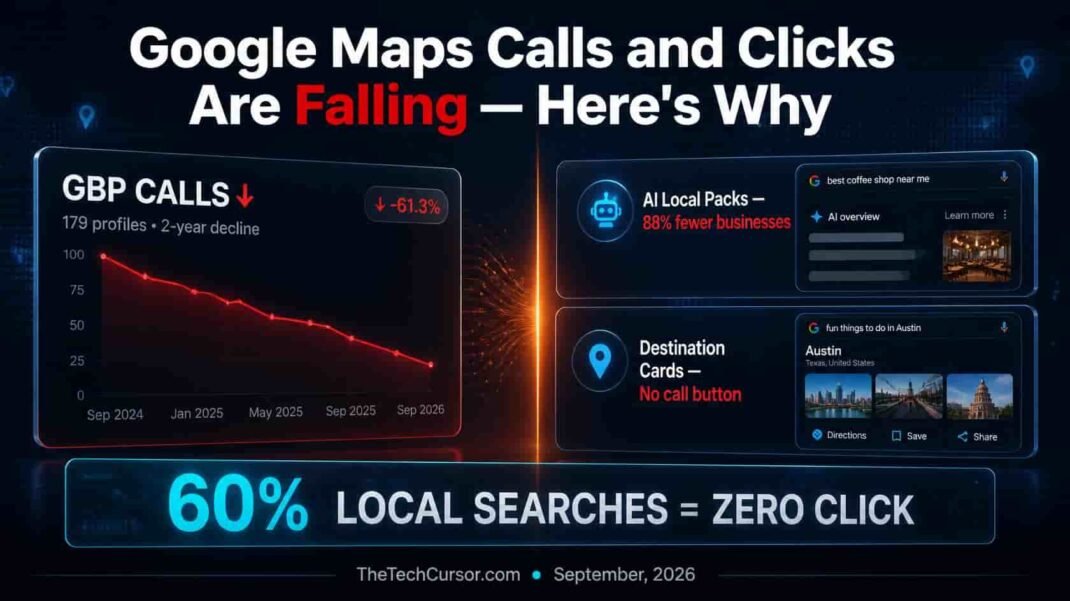
<cite index=”34-1″>Clicks-to-call are declining over the last two years across Google Business Profiles — even for businesses that have maintained or improved their local pack rankings.</cite> The problem is not your ranking. The problem is that Google is changing what happens after you rank — and the changes are systematically reducing the number of calls and clicks that local businesses receive from Maps and Search.
Here is what the data shows, why it is happening, and what to do about it.
1. The Decline Nobody Warned Local Businesses About
For years, local SEO success was measured simply: rank in the local pack, get calls and clicks. The relationship between ranking and revenue was relatively direct. A business that appeared in the top three Map Pack results could reliably expect calls, direction requests, and website visits proportional to its position.
That relationship is breaking down — not because rankings have become less valuable, but because Google is fundamentally changing what the local search results page looks like and what actions it makes available to users.
<cite index=”34-1″>Two specific formats are rolling out rapidly that explain most of the decline: AI-powered local packs that include fewer unique businesses, and destination cards that surface business information without prominent call buttons.</cite>
The result is a local search environment where visibility and actionability are increasingly decoupled. You can rank. You can appear. And users can still not call you — because the interface has changed.
2. The Data — 179 Profiles, 2 Years, One Clear Pattern
The clearest evidence of the decline comes from a dataset compiled by Dale at Jepto — analyzing <cite index=”34-1″>179 Google Business Profiles across 34 different law firms in the USA, tracking their clicks from Google Business Profiles over the last two years. The pattern is clear: clicks-to-call are declining consistently over that period.</cite>
Law firms are a particularly informative category to study because they are high-intent, high-value local businesses where phone calls are the primary conversion action. A decline in call clicks for law firms is not explained by changing user behavior around low-stakes purchases — it reflects a genuine structural change in how Google presents local business information.
<cite index=”34-1″>The decline does not apply equally to website clicks on business profiles. Website icons show up on local business profiles on desktop. This tells us that the traffic decline is more specific to mobile, where phone icons show up and clicks-to-call are the primary action.</cite>
This mobile specificity is the key insight. The call button — the primary conversion mechanism for most local service businesses on mobile — is becoming less prominent and less available across two specific new formats that Google is actively rolling out.
3. Why Calls Are Falling Faster Than Website Clicks
The asymmetry between declining calls and relatively stable website clicks points directly to Google’s interface changes on mobile.
On desktop, users see a website icon prominently displayed on local business profiles. That website click remains available and visible. On mobile, the primary action has historically been the phone call — a single tap that connects a user directly to the business. That action is what Google’s new formats are reducing.
<cite index=”39-1″>Over 60% of local searches now result in “zero clicks” — the user finds the phone number, address, or answer to their question directly on the search results page without ever visiting your website.</cite>
However, there is an important distinction between zero-click searches that convert — where the user sees your phone number and calls you directly from the SERP without clicking the call button — and zero-click searches that do not convert at all, where the AI-generated response resolves the query without prompting any user action.
<cite index=”40-1″>Behavioral signals carry 8% of the total local ranking weight. Click-through rate, mobile clicks-to-call, direction requests, and website visits from GBP all feed the Local Pack algorithm as proximity engagement signals.</cite>
This creates a compounding problem: fewer call button clicks means reduced behavioral signals, which over time can affect the ranking signals that determine local pack position — turning a visibility problem into a ranking problem.
4. The Two New Formats Replacing Traditional Local Packs
Understanding exactly what is replacing traditional local packs on mobile is essential for adapting your local SEO strategy.
5. Format 1: AI-Powered Local Packs — Fewer Businesses, More AI
The first format change is the emergence of AI-powered local packs — Google-generated summaries of local business options that replace the traditional three-business local pack with an AI-synthesized response.
<cite index=”34-1″>In 322 markets analyzed, 88% had fewer unique businesses in the AI local packs than traditional local packs.</cite>
This finding is striking. Traditional local packs typically show three businesses. AI local packs are showing fewer — meaning a smaller percentage of local businesses appear in the primary discovery surface for any given query.
Furthermore, AI local packs present business information differently than traditional packs. Rather than three parallel listings with clear call and direction buttons, the AI-generated format presents a synthesized overview that may emphasize different attributes — reviews, specific services, AI-generated descriptions — while de-emphasizing the direct action buttons that drove call conversions.
As covered in TheTechCursor’s article on local business Gemini citations, the factors that determine whether a business appears in AI-generated local responses are distinct from traditional local pack ranking factors — and many businesses that rank consistently in traditional packs are absent from AI-generated equivalents.
6. Format 2: Destination Cards — No Call Button
The second format change is the rollout of destination cards — a SERP format that displays comprehensive business information in a card-style layout without a prominent call button.
Destination cards surface the business name, address, hours, photos, and reviews — but route users toward directions rather than calls. For service businesses where the phone call is the primary conversion action, this format shift directly reduces call conversion probability even when the business appears prominently in results.
<cite index=”34-1″>Call buttons are becoming less and less frequent on mobile as these two formats roll out rapidly.</cite>
The combination of fewer businesses appearing in AI packs and reduced call button prominence in destination cards creates a structural headwind for local service businesses that depends on Google Maps and Search as a primary call driver.
7. The Zero-Click Local Search Problem
The zero-click problem covered in TheTechCursor’s earlier article on Google AI Overviews has a specific local search dimension that is worth understanding separately.
For informational local queries — “what time does [business] close,” “does [business] have parking,” “what is [business]’s address” — zero-click is not necessarily a problem. The user gets the information they need directly from the SERP. The business benefits from the visibility even without a click.
However, for high-intent local queries — “plumber near me,” “best divorce attorney [city],” “emergency HVAC repair” — the traditional expectation was that ranking in the local pack generated calls. The new formats are creating a layer between the query and the call that did not previously exist.
<cite index=”39-1″>If your only metric for success is website traffic, you are looking at the wrong data. You want to optimize for the conversion that happens on the search page itself — ensuring your phone number is prominently displayed and that booking or quote buttons are integrated directly into your GBP.</cite>
This reframe is critical for local businesses and their SEO teams: the primary optimization target is now the GBP experience itself — not just ranking in the pack, but ensuring that when users encounter your profile in any format, the path to conversion is as short as possible.
8. What This Means for Your Local SEO Strategy
The calls-and-clicks decline requires a strategic response across three dimensions.
Measurement must change first
<cite index=”40-1″>The Map Pack drives 70 to 80% of local leads, making behavioral interactions directly tied to revenue.</cite> If your current local SEO reporting tracks only rankings and website traffic, you are missing the most important data — what users do when they encounter your GBP across all formats.
Expand your measurement to include: GBP call clicks, direction requests, GBP website clicks, and direct phone calls tracked via call tracking numbers. Segment this data by device type — mobile versus desktop — to identify where the decline is sharpest for your specific business.
Attribution must account for zero-click conversions
Many users who see your phone number in a SERP feature or destination card will call you directly by dialing the number — without clicking a call button. These calls do not appear in GBP insights as “call clicks.” They appear in your call logs but not in your analytics.
Implementing call tracking with a GBP-specific tracking number allows you to capture these zero-click-to-dial conversions that standard GBP analytics miss. The gap between what GBP reports as call clicks and what your call tracking system records as inbound calls reveals the size of your zero-click conversion volume.
GBP optimization must target AI pack inclusion
As covered in TheTechCursor’s article on local business Gemini citations, the five factors that most influence AI local pack inclusion are: website content depth, structured data implementation, GBP completeness, third-party review presence, and topical authority. Traditional local pack ranking signals and AI pack inclusion signals overlap — but they are not identical.
9. Six Actions to Adapt Right Now
Action 1: Add a call tracking number to your GBP Replace your standard business phone number on your GBP with a call tracking number that routes to your main line. This captures direct dials that never register as GBP call clicks — giving you a more accurate picture of how many customers are finding and calling you from Google.
Action 2: Integrate booking and quote buttons directly into GBP <cite index=”39-1″>Ensure your “Book Online” or “Request a Quote” buttons are integrated directly into your GBP.</cite> Google supports direct booking links for many business categories — and booking integrations reduce the friction for users who encounter your profile in destination card or AI pack formats where the traditional call button is less prominent.
Action 3: Optimize for AI local pack inclusion Run the queries that matter most to your business in Google on mobile — both in standard Search and in AI Mode. Observe whether your business appears in AI-generated local responses. If not, review your GBP completeness, structured data implementation, and review platform presence against the five-factor framework covered in TheTechCursor’s Gemini citations article.
Action 4: Build your owned communication channels The structural shift in Google Maps call volume is a long-term trend — not a temporary fluctuation. Building owned customer communication channels that do not depend on Google Maps — email lists, SMS opt-ins, WhatsApp Business, direct website contact forms — reduces your exposure to continued Google interface changes.
Action 5: Monitor GBP Insights weekly — specifically call trends <cite index=”37-1″>A significant drop in direction requests might indicate your address information is showing incorrectly. A drop in website clicks might indicate a recent website change affected load time on mobile. The Insights data is diagnostic — review it monthly and act on what it tells you.</cite> For call-dependent businesses, weekly monitoring allows you to catch changes as they happen rather than discovering them at quarter-end.
Action 6: Diversify your local discovery channels <cite index=”34-1″>Success requires diversifying visibility across social platforms like YouTube or Reddit, and adopting a multi-location approach to offset shrinking organic visibility.</cite> Apple Maps, Bing Places, Yelp, and industry-specific directories provide alternative discovery surfaces that are not subject to Google’s format changes. As covered in TheTechCursor’s GBP Continuity Plan article, cross-platform redundancy is good practice regardless of GBP performance — and becomes more valuable as Google Maps call volume declines.
10. Bottom Line
<cite index=”34-1″>Clicks-to-call are declining from Google Business Profiles even for businesses maintaining strong local pack rankings.</cite> The cause is structural — two new SERP formats are rolling out rapidly that reduce call button prominence and limit the number of businesses appearing in AI-generated local responses.
The response requires changes across measurement, optimization, and channel strategy simultaneously. Measure what is actually happening to your call volume. Optimize for AI local pack inclusion alongside traditional local pack rankings. Build owned communication channels that reduce dependency on Google Maps as your primary call driver.
<cite index=”34-1″>A data-first strategy — prioritizing unique human content over AI-generated text, diversifying visibility across platforms, and tracking the right conversion metrics — is what separates local businesses that adapt from those that keep optimizing for a version of Google Maps that no longer exists.</cite>
The local search landscape is changing faster than most businesses have adapted. The data on falling calls and clicks is the clearest signal yet that the adaptation is no longer optional.
Pingback: Idea Economy: Why SEO Content Is Now About Thinking - The Tech Cursor
Pingback: AI Mode Follow-Up Questions Reveal Your Content Gaps - The Tech Cursor