
Read time: 7 min
Table of Contents
- Why SEO Reports Fail Executives
- The Metric Problem — Traffic Is Not a Business Outcome
- What Executives Actually Care About
- The One-Page Executive Summary Framework
- Connecting SEO to Revenue — Three Approaches
- How to Report AI Search Visibility
- Handling Difficult Conversations — Declines and Uncertainty
- The Cadence — Monthly, Quarterly, Annual
- Common Reporting Mistakes That Kill SEO Budgets
- Bottom Line
Most SEO reports are written for SEO professionals. They contain ranking tables, traffic graphs, keyword movements, and crawl error counts. They are accurate, detailed, and almost entirely useless for the executive audience that controls the budget.
Executives do not need to understand how SEO works. They need to understand whether the investment is producing business value — and whether it deserves continued funding. A report that cannot answer those two questions in the first 60 seconds has already failed.
1. Why SEO Reports Fail Executives
SEO reports fail executives for three consistent reasons.
They lead with channel metrics instead of business outcomes. Organic sessions, keyword rankings, and domain authority scores are meaningful to SEO practitioners. They are abstract to most executives. An executive who hears “we gained 340 organic keywords this month” has no frame of reference for whether that is good, bad, or relevant to anything they care about.
They do not connect to the numbers executives already track. Every executive tracks revenue, pipeline, leads, and costs. An SEO report that does not reference any of these numbers exists in a separate world from the conversations executives have every other day. Consequently, SEO becomes a cost center rather than a revenue driver in their mental model.
They bury the important information in too much detail. A 40-page report with every metric available from every tool is comprehensive. It is also exhausting to navigate. Executives who cannot find the key insight in two minutes will stop reading — and stop trusting the report as a useful input.
The fix for all three problems is the same: start with what the business cares about, connect SEO work to those outcomes, and make the most important information impossible to miss.
2. The Metric Problem — Traffic Is Not a Business Outcome
Traffic is the most commonly reported SEO metric. It is also the least useful metric for an executive audience — for a specific reason that has become more acute in 2026.
AI Overviews reduce clicks to publisher websites even when rankings hold. The University of Pennsylvania and Northeastern research confirmed that AI Mode reduces clicks substantially. Furthermore, the ecommerce search trends data showed that 39% of sites saw traffic decline or go flat while conversions held or improved.
This means traffic can decline while the business performs better from organic search. It also means traffic can hold while the business gets fewer qualified leads from the channel. In both cases, traffic alone tells you nothing useful.
Reporting traffic to an executive therefore creates one of two problems. If traffic is declining due to AI Overviews, the report looks bad when the business impact may be neutral or positive. If traffic is growing through low-intent queries, the report looks good when the business impact may be minimal.
Neither outcome serves the SEO program’s credibility. The solution is to report on what traffic does — not on traffic itself.
3. What Executives Actually Care About
Executives care about a short list of outcomes. Every SEO report should connect to at least one of them.
Revenue and pipeline. Did organic search generate deals, revenue, or pipeline this period? How does that compare to previous periods and to other channels?
Cost efficiency. What is the cost per lead or cost per acquisition from organic search compared to paid channels? Is SEO improving or worsening its cost efficiency over time?
Market position. Is the company more or less visible than competitors for the searches that matter? Is it gaining or losing ground on key competitive terms?
Risk. Are there threats to existing organic revenue — algorithm updates, competitor advances, technical issues — that require attention or investment to address?
These four questions cover everything an executive needs to evaluate an SEO investment. A report that answers all four clearly and briefly will get read. Furthermore, it will get referenced when budget conversations happen.
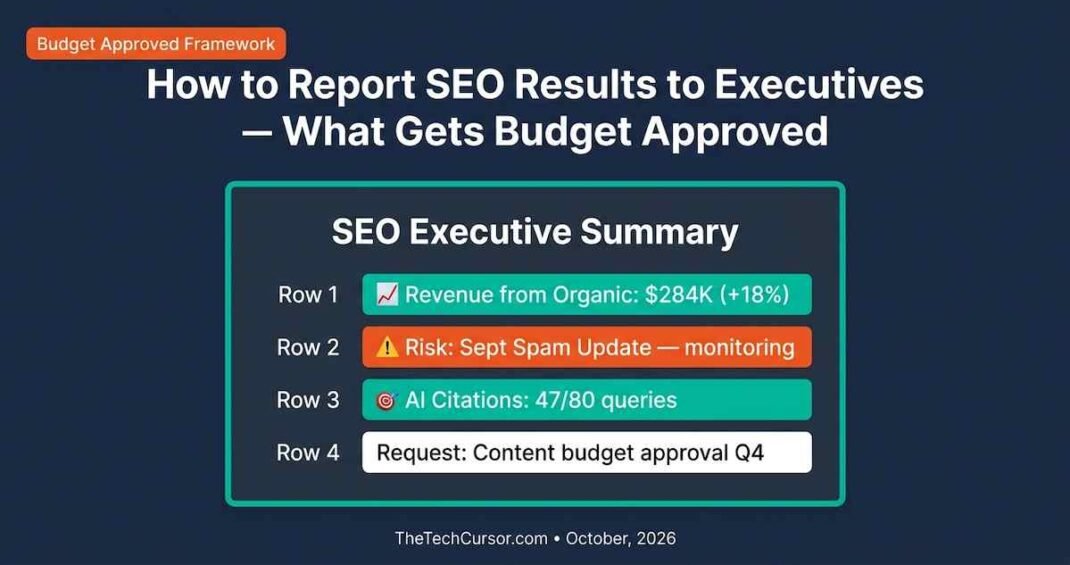
4. The One-Page Executive Summary Framework
Every SEO report — regardless of how much supporting detail it contains — should begin with a one-page executive summary that covers four elements.
This period’s headline number. One metric that represents the business impact of SEO this period. Leads generated, revenue attributed, pipeline influenced, or cost per acquisition — whichever connects most directly to what the executive team tracks. State the number and compare it to the previous period.
What drove it. Two or three sentences explaining the primary factors behind the headline number. Not technical explanations — business explanations. “The content we published in Q2 targeting enterprise buyers is now ranking for the searches those buyers make when they are evaluating vendors” is an executive explanation. “We improved our domain authority and gained positions for high-volume keywords” is not.
What we are watching. One current risk or opportunity. An algorithm update that landed this month, a competitor gaining ground on a key term, or a technical issue that could affect performance if left unaddressed. Executives appreciate knowing about risks before they become problems — it demonstrates strategic awareness rather than reactive reporting.
What we need. If anything is needed from the executive team — budget approval, a decision on a technical change, access to something the SEO team cannot access without sign-off — state it explicitly in the summary. Burying requests in supporting detail is how requests get missed.
5. Connecting SEO to Revenue — Three Approaches
Connecting SEO directly to revenue is the most credible thing an SEO report can do. The mechanism for that connection depends on the business model.
Approach 1: Direct attribution: For ecommerce businesses with clear transaction tracking, GA4 can attribute revenue directly to organic search sessions. This is the cleanest attribution and the most credible to executives. Report total organic revenue, organic revenue as a percentage of total online revenue, and organic revenue trend over time.
Approach 2: Lead and pipeline attribution: For B2B businesses where sales cycles span weeks or months, direct revenue attribution requires time. Instead, report organic-sourced leads, lead quality indicators (conversion rate from lead to opportunity), and pipeline value influenced by organic search. Most CRMs can be connected to GA4 to provide this data. The SEO budget justification framework covers how to present pipeline contribution in budget conversations.
Approach 3: Cost comparison: When direct revenue attribution is not yet possible, compare the cost of acquiring the same leads or traffic through paid channels. If organic search generates 500 leads per month at an organic cost basis of $40 per lead, and the same leads through paid search would cost $180 per lead, the organic channel is delivering $70,000 per month in cost efficiency relative to paid. That number resonates with executives even without direct revenue attribution.
6. How to Report AI Search Visibility
AI search visibility is the newest and most poorly understood dimension of SEO reporting. Most executives have heard about AI Overviews and AI Mode. Few have seen any reporting on what their company’s position in those surfaces looks like.
This is an opportunity to differentiate your reporting.
Report AI citation share: Track whether your brand appears in AI-generated responses for the searches that matter to your business. Use prompt tracking across ChatGPT, Gemini, Claude, and Perplexity for your priority queries. Report the percentage of tracked queries where your brand is cited — and whether that percentage is improving.
Report AI referral traffic: With Gemini UTM parameters now available, GA4 can show sessions arriving directly from AI platforms. Report these sessions separately from organic search traffic. Show their conversion rate and business contribution alongside traditional organic metrics.
Connect AI visibility to brand awareness: For executives who are skeptical about AI search metrics they cannot directly connect to revenue, frame AI citation share as a brand awareness metric. Being cited in AI responses for relevant queries builds brand recognition with potential buyers who may not click through immediately but will recognize the brand when they encounter it later.
The AI visibility dashboard guide covers the technical setup for each of these tracking approaches in detail.
7. Handling Difficult Conversations — Declines and Uncertainty
Two situations create the most friction in executive SEO reporting: unexplained declines and genuine uncertainty about AI search impact.
When traffic or conversions decline: Never bury a decline in the supporting detail of a report. Executives discover it anyway — and the credibility damage from appearing to hide bad news is worse than the bad news itself.
Instead, lead with the decline, explain its most likely cause, and present what is being done about it. “Organic traffic declined 18% in September. The September 2026 spam update affected approximately 15% of the sites in our category. We are auditing our content against Google’s current quality guidelines and expect to understand the full impact within four weeks” is an executive response. It is honest, it demonstrates competence, and it gives the executive what they need to understand the situation.
When AI search creates genuine uncertainty: The State of Search 2027 data found that only 9% of search professionals feel confident measuring AI visibility. Executives should know that this uncertainty exists across the industry — and that your team is building measurement capability while the tools catch up.
Being honest about what can and cannot be measured is more credible than presenting uncertain data with false confidence. “We can measure AI referral traffic precisely in GA4. We cannot yet attribute revenue directly to AI Overview citations — that measurement gap exists across the industry, and we are tracking it” is an honest and credible statement that sets appropriate expectations.
8. The Cadence — Monthly, Quarterly, Annual
Different reporting cadences serve different purposes. Each has a different audience and a different level of detail.
Monthly reporting: Monthly reports cover performance trends, significant changes, and operational updates. They are typically reviewed by marketing leadership rather than C-suite executives. Consequently, they can contain more SEO-specific detail than executive-level reports — while still leading with business outcomes.
Quarterly reporting: Quarterly reports go to executive teams and often inform budget decisions. They should be brief — the one-page executive summary plus supporting detail for anyone who wants to go deeper. They should cover the quarter’s performance against objectives set at the start of the quarter, explain significant changes, and set objectives for the next quarter.
Annual reporting: Annual reports inform next year’s budget request. They should show the full-year trend, compare performance against the plan agreed at the start of the year, and present the investment case for next year based on what this year demonstrated. The SEO budget justification framework is specifically designed for this conversation.
9. Common Reporting Mistakes That Kill SEO Budgets
Several reporting patterns consistently undermine executive confidence in SEO programs — even when the underlying work is strong.
Leading with rankings: Keyword rankings are the least credible metric in executive reporting. They fluctuate daily, they do not connect to revenue, and they are easy to game in ways that produce no business value. Leading a report with ranking tables signals that the SEO team does not understand what the business cares about.
Celebrating impressions without clicks: Reporting rising impressions without acknowledging declining click-through rates — a common pattern when AI Overviews absorb clicks — creates a false picture that collapses when executives ask why leads or revenue are not reflecting the impression growth.
Comparing to industry averages without context: “Our organic traffic grew 12% while the industry declined 8%” sounds positive. It tells an executive nothing about whether that performance is sufficient to meet the business’s objectives. Benchmarking against business targets is more credible than benchmarking against industry averages.
Reporting effort instead of outcomes: “We published 24 articles, fixed 340 technical errors, and built 45 backlinks” is an activity report. It describes what the team did. It does not explain what the business received. Effort reporting in executive contexts implies that the team is measuring inputs because it cannot measure outputs.
Never reporting risks: An SEO report that only contains positive news is either a good report from a performing program or a filtered report from a team that is avoiding difficult conversations. Executives cannot distinguish between the two. Including honest risk reporting — algorithm update exposure, competitor advances, technical debt — builds credibility even when the news is not uniformly positive.
10. Bottom Line
Effective SEO reporting for executives is not about simplifying the work. It is about translating the work into the language executives already use to make decisions.
Start with business outcomes. Connect SEO performance to revenue, pipeline, cost efficiency, and competitive position. Make the most important information available in 60 seconds. Report AI search visibility as a distinct and growing dimension of search performance. Handle declines and uncertainty honestly.
The Reporting Checklist
- One-page executive summary with headline number, explanation, risk, and request
- Business outcome metrics first — revenue, leads, pipeline, cost per acquisition
- Traffic reported in context of what it produced — not as a standalone metric
- AI citation share and AI referral traffic as separate reporting dimensions
- Declines acknowledged directly with explanation and action plan
- Risks flagged proactively — algorithm updates, competitor movements, technical issues
- Effort metrics removed or moved to supporting detail where executives rarely read
The report that gets budget approved is the one that makes the business case clear enough that a non-technical executive can defend the investment in a room full of other executives. Build every report with that person in mind.