
Read time: 8 min
Table of Contents
- The Research — 3,000 Listicles, 15 Variables, One Clear Answer
- Signal 1: Freshness — The Strongest Predictor of All
- Signal 2: Counted Listicles Beat Editorial Roundups
- Signal 3: Larger Numbers in Titles Rank Higher
- Signal 4: More Headings Actually Hurt Rankings
- Signal 5: Word Count and Images Help — But Inconsistently
- Are Self-Serving Listicles Still Worth It?
- Publishers Still Beat Brands — But the Gap Is Closing
- The AI Overviews Problem for Listicles
- What This Means for Your Listicle Strategy
- Bottom Line
Listicles have been a content marketing staple for over a decade. However, with AI Overviews covering 83.7% of queries on average — and 93.4% in B2B — and Reddit or YouTube appearing on 92% of listicle SERPs, the question of what actually makes a listicle perform well has never been more urgent.
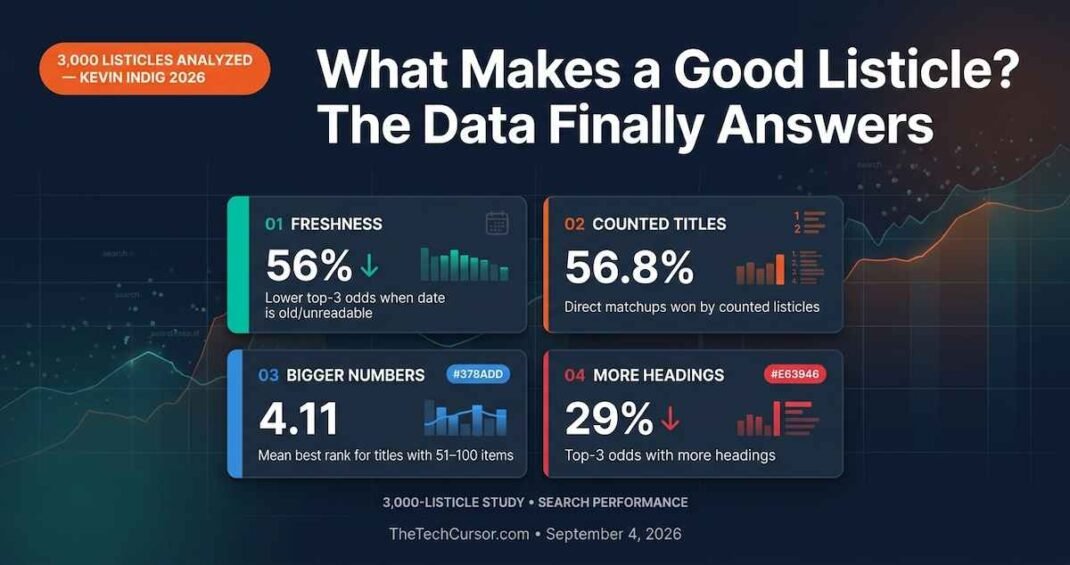
Kevin Indig, former Head of SEO at Shopify and G2, just published one of the most rigorous listicle ranking studies available — analyzing over 3,000 listicles across 15 variables to identify which signals are actually associated with higher rankings.
Here are the findings — and what they mean for your content strategy.
1. The Research — 3,000 Listicles, 15 Variables, One Clear Answer
(cite index=”16-1″>The methodology combined four analyses from the original study of 59,984 valid Google search results pages across 60,000 US English queries and 15 verticals. A balanced sample of 3,000 currently ranking listicles was crawled, containing 200 pages from each vertical, split evenly between counted listicles and editorial roundups.</cite>
The crawl recorded objective page signals — word count, headings, estimated list items, images, author information, dates, canonical URLs, and structured data — and compared pages with best positions in the top 3 against pages in positions 8-10.
Crucially, most of the 15 variables analyzed did not survive control checks. The findings below represent the signals that held after controlling for vertical, query wording, and listicle type — making them meaningfully more reliable than typical correlation studies.
2. Signal 1: Freshness — The Strongest Predictor of All
(cite index=”16-1″>The clearest signal was freshness. A date from the previous two years appeared on 66.6% of pages in the top 3, compared with 57.3% of pages in positions 8-10.</cite>
This is not a minor difference — it is a 9.3 percentage point gap that remained consistent after controlling for vertical and other variables.
The inverse finding is equally telling. (cite index=”16-1″>An old date, or a date the crawler could not interpret, appeared on 8.2% of top-3 pages and 15.1% of pages in positions 8-10. After controlling for vertical, query wording, and listicle type, an old or unreadable date was associated with 56% lower odds of ranking in the top 3.</cite>
The practical implication is significant: An outdated listicle — one with a stale publication date or no readable date — has roughly half the probability of reaching the top 3 compared to a recently dated equivalent. For content teams that publish listicles and then forget them, this is the single most impactful finding in the study.
Freshness matters for a simple reason: both traditional search algorithms and AI systems favour recently updated content for informational queries where the “best” answer changes over time. A listicle of project management tools that was last updated in 2023 is almost certainly out of date — and Google treats it that way.
Action: Implement a quarterly listicle review program. Update your highest-priority listicles with new entries, remove outdated ones, and add an updated publication date every 3-6 months. As the content pruning guide explains, consistently refreshing high-value existing content outperforms producing new content on already-covered topics.
3. Signal 2: Counted Listicles Beat Editorial Roundups
The study distinguishes between two listicle formats:
Counted listicle: Explicit item count or numbered-list evidence in the title or search snippet — “17 Best Project Management Tools.”
Editorial roundup: Recommends several options without an explicit number — “The Best Project Management Tools.”
(cite index=”16-1″>56.8% of direct matchups — covering 6,114 search results pages where both formats appeared in the organic top 10 — went to counted listicles. The best counted listicle averaged position 3.77, while the best editorial roundup averaged position 4.59. Counted listicles landed in the top 3 55.9% of the time when present in the top 10. Editorial roundups did so 41.4% of the time.</cite>
However, the finding has a notable exception: (cite index=”16-1″>Editorial roundups won the direct matchup in consumer technology, fitness and sports, and automotive, while counted listicles won in the other 12 verticals.</cite>
This exception suggests the counted advantage is not universal — in verticals where editorial authority and taste-making carry more weight, the explicit number may signal a mechanical approach that readers and algorithms discount.
The underlying mechanism: Explicit numbers in titles satisfy informational intent more directly. A user searching for “best CRM software” who sees “The 23 Best CRM Tools” has an immediate expectation-setting signal — they know what they will get. Explicit numbers also signal comprehensiveness, which correlates with the kind of content that earns the top positions.
4. Signal 3: Larger Numbers in Titles Rank Higher
This is perhaps the most counterintuitive finding — and the one with the clearest practical implication.
(cite index=”16-1″>The rank pattern strengthens as the leading number in the title rises. Among explicit list queries, counted listicles with 51 to 100 in the title had a mean best organic rank of 4.11. Titles with 2 to 5 averaged position 5.85.</cite>
A near-linear relationship emerges across the number ranges studied: the higher the number in the title, the better the average ranking position.
Kevin Indig offers an important clarification: (cite index=”16-1″>The leading title number is only a proxy for list length. A title can say “50 ideas” while the page contains fewer, more, or differently grouped items.</cite>
This matters because it suggests the mechanism is not simply “more items = better ranking.” Rather, a higher number signals comprehensiveness and effort to both users (who click on high-number titles more readily for comprehensive queries) and algorithms (which interpret high-number titles as signals of exhaustive coverage).
The click-through rate connection: A title promising 50 tools rather than 5 will generally earn higher click-through rates for queries where comprehensiveness is valued — and higher CTR contributes to the positive signals that reinforce rankings.
Practical guidance: For listicles targeting comprehensive informational queries, aim for genuine lists of 20+ items rather than curated lists of 5-7. This is not about padding — it is about matching user intent for queries where breadth of coverage is what the searcher actually wants.
5. Signal 4: More Headings Actually Hurt Rankings
This finding directly contradicts common content optimization advice — and it is one of the most important findings for how content teams structure listicles.
(cite index=”16-1″>More section headings did not predict a better position. A one-standard-deviation increase in heading count after adjusting for unusually large values was associated with 29% lower top-3 odds.</cite>
Kevin Indig offers a clear explanation: (cite index=”16-1″>While signalling depth through big numbers in the title earns higher rankings, over-structuring content with many headings is counterproductive. “50 best tools” may signal comprehensiveness, match explicit list intent, or attract clicks. But 50 products can also appear in cards without creating 50 headings.</cite>
This reveals an important distinction between comprehensiveness and fragmentation. A listicle with 50 items presented as cards, brief descriptions, or a well-organized table can signal comprehensiveness without creating 50 separate heading sections that fragment the content into a format more resembling a site map than a curated resource.
The structural recommendation: Present list items using visual formats — cards, tables, icon-plus-text layouts — rather than as individual heading-anchored sections. Use headings for major organizational categories within the list (if the list warrants it) rather than for individual items. Reserve H2 and H3 headings for structural navigation, not for each tool, tip, or item in the list.
6. Signal 5: Word Count and Images Help — But Inconsistently
(cite index=”16-1″>Top-3 pages had 21.5% more words and 38.9% more images at the median, but these differences did not remain consistent in every adjusted model. Median numbered-heading and ordered-list counts were zero in both groups.</span>
The inconsistency of the word count and image findings across adjusted models means these should be treated as directional signals — not reliable ranking factors in isolation.
The 21.5% word count advantage is consistent with the general principle that comprehensive content covering a topic exhaustively tends to rank better. However, it does not mean adding words improves rankings — it means top-ranking listicles happen to be longer, likely because genuine comprehensiveness requires more content.
The 38.9% image advantage is consistent with the finding that visual presentation of list items (product images, screenshots, icon illustrations) is a characteristic of high-ranking listicles — without being the cause of higher rankings.
7. Are Self-Serving Listicles Still Worth It?
The study examined vendor-owned listicles — those in which the brand publishing the list also appears on it, typically in first position.
The finding is nuanced and worth reading carefully.
(cite index=”16-1″>Self-serving listicles that were published toward the end of last year grew in traffic 3.5x more than the rest. However, vendors who put themselves first in their listicles are not responsible for their own growth. After accounting for starting traffic, industry, listicle type, current rank group, and repeated pages from the same publisher, self-promotion was associated with only 4% stronger growth, with a 95% interval ranging from 51% lower to 120% higher.</cite>
In other words: the growth in vendor-owned listicles reflects increased investment and effort — not a special ranking benefit from self-promotion. The listicles grew because brands put more work into them, not because placing themselves first helped rankings.
Kevin Indig’s recommendation is direct: (cite index=”16-1″>Use third-party data as a proof point for your listicle ranking. If you have G2 reviews that support you being “the best for x”, you can write about it with a clear conscience. If not, maybe listicles are not the best option. Maybe leaning on an affiliate partner or creator to do this is the better way.</cite>
As covered in an article on self-promotional listicles and AI Overviews, Google has explicitly stated that self-serving listicles that rank a brand’s own product first are not the type of content they want to feature prominently in AI Overviews. The traditional search ranking of these pages may be sustainable — their AI citation probability is more limited.
8. Publishers Still Beat Brands — But the Gap Is Closing
(cite index=”16-1″>Publishers supplied 46.8% of the highest-ranking listicles vs. 19.2% for brands and vendors, and won 54% of head-to-head matchups on the same SERP.</cite>
The publisher advantage reflects structural differences that are difficult for brands to replicate: perceived editorial independence, broader topical authority, and established credibility with both readers and algorithms.
However, the study also found that brand-owned listicles appeared on 46.2% of B2B software SERPs — reflecting how heavily the B2B category relies on this format for AI search visibility. The brand presence in B2B is substantially higher than in consumer categories, suggesting the publisher advantage is more pronounced in some verticals than others.
The strategic implication for brands: In verticals where publishers dominate, the most effective approach may be through the publisher ecosystem — sponsoring listicle coverage, partnering with affiliate publishers, or providing strong product review programs to G2 and Capterra that generate the third-party validation publishers draw on. As covered in the DTC AI search case study, building authority through third-party editorial coverage often outperforms attempting to build equivalent authority through owned content.
9. The AI Overviews Problem for Listicles
Kevin Indig identifies a structural tension in the listicle landscape that goes beyond individual ranking signals.
(cite index=”16-1″>Listicles are basically curations, and they avoid Google having to take a stance. Now, AI Overviews change that. In AI Overviews, you get a clear recommendation for brands. It is a philosophical shift in how Google takes a position on which brands to recommend. As a result, while listicles still rank well and might inform AI answers, Google’s shift to name brands in AI Overviews makes their value even more questionable.</cite>
Furthermore, (cite index=”16-1″>AI Overviews covered 83.7% of queries on average and 93.4% in B2B, while 92% of listicle SERPs carried Reddit or YouTube.</cite>
This creates a challenging competitive environment for listicles — they continue to rank, but they do so on SERPs that are increasingly crowded with AI-generated answers, community platforms, and video content competing for the same attention.
As covered in the analysis of zero-click search and the new search journey loop, the most important response to this environment is ensuring that your listicle content becomes the source AI Overviews draw on — not a result competing below an AI-generated answer that cites someone else’s listicle.
10. What This Means for Your Listicle Strategy
The research translates into a clear set of priorities:
Priority 1: Freshness program is non-negotiable. A quarterly review of your highest-priority listicles — with genuine updates to content and visible date changes — is the single highest-ROI listicle optimization available. A 56% reduction in top-3 probability for stale content is too large to ignore.
Priority 2: Use explicit counts in titles — but match the number to the content “The 25 Best CRM Tools for Small Businesses” outperforms “The Best CRM Tools for Small Businesses” in 12 of 15 verticals. Use explicit numbers in your listicle titles — and ensure the content genuinely delivers the number of high-quality items promised.
Priority 3: Aim for genuine comprehensiveness — not arbitrary number inflation. The higher-number advantage reflects user preference for comprehensive coverage on informational queries. Build genuinely comprehensive lists — 20+ items where the query warrants it — rather than artificially limiting to 5-7 “top picks” that feel curated but fail to satisfy users who want a complete picture.
Priority 4: Restructure heading architecture. Move list items out of individual H2/H3 headings and into card, table, or structured text formats. Use headings for major organizational categories — “AI-Powered Tools,” “Budget-Friendly Options” — not for individual items. This reduces heading count while maintaining organizational clarity.
Priority 5: Build third-party proof before self-promoting. If your brand belongs on your listicle, use external validation — G2 ratings, verified review data, independent test results — as the basis for your placement. Self-promotion without external corroboration does not meaningfully improve rankings — and reduces AI citation probability.
Priority 6: Optimize for AI citation, not just ranking. The most durable listicle strategy in a world of 83.7% AI Overview coverage is ensuring your list content becomes the source AI cites — not a result competing below the AI Overview. As covered in the five-phase AI citation framework, the content signals that earn AI citations — freshness, originality, structured data, topical authority — directly align with the ranking signals this research identifies.
11. Bottom Line
Kevin Indig’s 3,000-listicle study is one of the most methodologically rigorous pieces of listicle ranking research available — and its findings directly challenge several assumptions that content teams have built listicle strategies around.
The clearest takeaways:
- Freshness is the #1 signal — update your listicles quarterly or risk 56% lower top-3 odds
- Counted titles outperform editorial titles in 12 of 15 verticals — use explicit numbers
- Larger numbers rank higher — aim for genuine comprehensiveness, not arbitrary curation
- More headings hurt — use cards and tables for list items, not individual heading sections
- Self-promotion grows traffic — but through effort and investment, not placement gaming
- Publishers still lead — but brands can compete through genuine quality and third-party validation
(cite index=”16-1″>Query intent is the biggest lever. Google shows 5.3x more listicles when the query explicitly asks for a set of options.</cite>
The implication is that the highest-priority listicle investments are those targeting queries with explicit list intent — “best,” “top,” “list of” — where the format matches what Google is already surfacing. For those queries, the signals identified in this research determine who ranks. Apply them deliberately.