
Read time: 7 min
Table of Contents
- The Study — What Researchers Actually Found
- How the Researchers Measured It
- What Google Says — And Why Both Can Be Right
- The Wider Wikipedia Traffic Picture
- Machine Demand Is Growing While Human Visits Fall
- Why Wikipedia Is a Unique but Limited Test Case
- What This Means for Publishers Beyond Wikipedia
- The Strategic Implication — Citation Without Clicks
- Bottom Line
A University of Washington working paper published in September 2026 offers one of the most rigorous measurements yet of how Google AI Overviews affect web traffic — using Wikipedia as the test case.
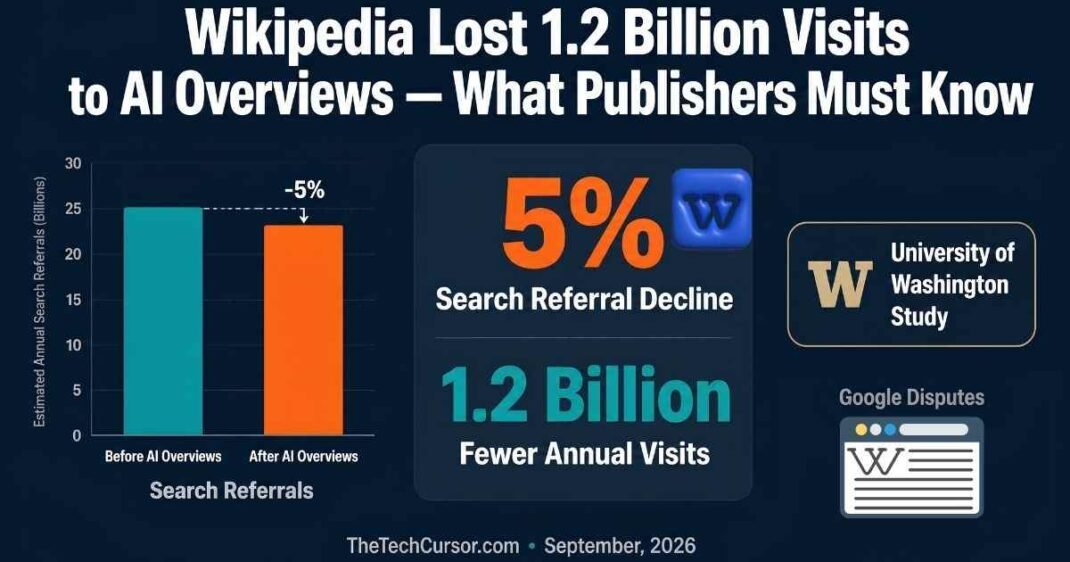
<cite index=”8-1″>The paper, by Mehrzad Khosravi and Hema Yoganarasimhan, estimates that Google’s AI Overviews reduced monthly search referrals to English Wikipedia by roughly 5% after the feature became the US default in May 2024.</cite> Extrapolated annually, that works out to approximately 1.2 billion fewer search referrals per year — a figure that is simultaneously precise and contested.
The findings matter beyond Wikipedia. The study offers the clearest causal estimate available for how AI Overviews affect click-through to cited sources — and the methodology reveals both what we can measure and what remains genuinely unknown.
1. The Study — What Researchers Actually Found
<cite index=”8-1″>The paper estimates that default AI Overview availability reduced monthly external-search referrals to English Wikipedia by 5.45% relative to German Wikipedia and 4.82% relative to French Wikipedia.</cite>
<cite index=”8-1″>For the English edition as a whole, the estimate works out to around 100.27 million fewer search referrals each month, totalling about 1.20 billion annually.</cite>
These numbers are estimates derived from a statistical model — not direct measurements of clicks diverted away from Wikipedia. That distinction matters for how they should be interpreted, as discussed below.
The study has been revised significantly since its first publication in February 2026. Earlier versions used daily pageviews and reported a decline of approximately 15% — a figure that generated significant attention in the SEO community at the time. <cite index=”8-1″>The paper then switched to monthly search referrals and added German and French controls in later versions, producing the current 5% estimate.</cite> The revision is itself an important story: the methodology improved, and the headline number changed substantially as a result.
2. How the Researchers Measured It
The methodology is worth understanding — because it explains both the strength of the finding and its limitations.
<cite index=”8-1″>Wikipedia releases monthly clickstream data at the article level for various Wikipedia language editions. Google switched AI Overviews on by default in the United States in May 2024 but hadn’t yet done so in Germany or France during the sample period.</cite>
The researchers used this timing difference as a natural experiment. <cite index=”8-1″>During the sample period, about 40% of traffic to English Wikipedia came from the United States. Meanwhile, traffic for German and French editions mostly came from countries without default AI Overviews. If, after May 2024, English referrals fell compared to German and French referrals for the same articles, that difference is the estimate.</cite>
<cite index=”8-1″>The data covers December 2023 to December 2024. The panel includes 499,927 matched English-German article pairs and 530,873 English-French pairs.</cite>
This is a difference-in-differences design — a standard causal inference approach that compares what changed in the treatment group (English Wikipedia, affected by AI Overviews) versus the control group (German and French Wikipedia, not yet affected) over the same time period. When done well, this design provides stronger causal evidence than simple before-after comparisons.
3. What Google Says — And Why Both Can Be Right
Google disputes the study’s conclusions — specifically on methodological grounds rather than the underlying finding.
<cite index=”8-1″>Google told a Brazilian outlet that Wikimedia’s public data lumps all external search engines together, which prevents the analysis from isolating Google’s specific contribution. However, the researchers responded that other engines handle only a small portion of traffic, and the analysis uses the timing break created by the AI Overviews rollout.</cite>
Both points are valid — and they are not mutually exclusive.
Google is correct that the data cannot perfectly isolate its contribution. The researchers are correct that Google dominates external search referrals to Wikipedia so thoroughly that the combined metric is a reasonable proxy.
Furthermore, Google’s own public statements on AI Overview traffic impact are not straightforwardly contradictory to this finding. Google’s SVP Nick Fox claimed AI features are sending billions of clicks weekly — a claim about absolute volume growth. This study measures relative referral share — what percentage of searches sent users to Wikipedia. These are different metrics, and both could be simultaneously accurate: more total clicks while Wikipedia specifically receives a smaller share of them.
4. The Wider Wikipedia Traffic Picture
The University of Washington study focuses specifically on search referrals — one component of Wikipedia’s total traffic. The broader picture from Wikimedia’s own data is more concerning.
<cite index=”8-1″>In October 2025, Wikimedia product director Marshall Miller shared that overall human pageviews across all Wikipedia languages had decreased by about 8% compared to the same period in 2024. Miller attributed the decline to generative AI and social media platforms.</cite>
<cite index=”8-1″>Wikimedia’s draft plan for the 2026-27 fiscal year highlighted that decreasing pageviews and fewer referrals from Google, along with unprecedented bot traffic, are expected to continue rather than be short-term issues. The plan notes that almost 90% of Wikipedia visitors have traditionally come from Google search.</cite>
That last figure is the most strategically important one for any publisher reading this. Wikipedia’s extraordinary dependency on Google Search — 90% of visitors arriving via Google — makes it uniquely vulnerable to changes in how Google presents search results. Most publishers have more diversified traffic sources. However, publishers heavily dependent on informational Google traffic face a structurally similar risk at a different scale.
5. Machine Demand Is Growing While Human Visits Fall
One of the most revealing aspects of the Wikipedia data is the divergence between human visits and machine access.
<cite index=”8-1″>In April 2025, Wikimedia engineers observed that bandwidth for downloading images and media files went up by 50% since January 2024. Most of this increase came from bots scraping Wikimedia Commons for AI training rather than from regular readers. They also noted that bots accounted for at least 65% of the most expensive traffic and about 35% of pageviews.</cite>
<cite index=”8-1″>A year later, the team reported they were blocking or limiting around 30% of automated requests from crawlers that ignore their policies, with blocked or throttled requests at about 1.5 billion a day.</cite>
This pattern — growing machine consumption alongside declining human visits — is the central tension in the relationship between AI companies and publishers in 2026. AI systems are training on publisher content, drawing on publisher knowledge bases for real-time retrieval, and citing publishers in generated responses. Whether those citations translate to meaningful human traffic is precisely what this study is trying to measure.
<cite index=”8-1″>In January 2026, Wikimedia Enterprise announced that Google is an existing customer, and for the first time Amazon, Meta, Microsoft, Mistral AI, and Perplexity were introduced as partners. Wikimedia Enterprise reported $8.3 million in revenue for the 2024-25 fiscal year from paid API access.</cite>
The Enterprise model — charging for high-volume API access rather than licensing content — is one proposed resolution to this tension. It does not restore the human visits that AI Overviews divert. However, it creates a revenue stream from the machine access that is growing to replace them.
6. Why Wikipedia Is a Unique but Limited Test Case
The features that make Wikipedia measurable are also what limit how broadly its findings apply.
Wikipedia is uniquely suited to this kind of research because Wikimedia publishes article-level traffic data across multiple language editions — enabling the cross-language comparison that powers the study’s methodology. Almost no other publisher makes this data available at the granularity required for this kind of analysis.
<cite index=”8-1″>The paper does not establish whether news sites, retailers, or other types of websites would experience similar effects. The sources don’t address whether other organizations could create a paid access service similar to Wikimedia Enterprise.</cite>
Furthermore, Wikipedia occupies a specific position in AI search ecosystems that most publishers do not. Wikipedia is among the most consistently cited sources across all major LLMs — because it covers an enormous range of topics with reasonably neutral, well-sourced information that AI training data heavily represents. Publishers heavily dependent on informational Google traffic face a structurally similar risk. Understanding how the new search journey works — AI answers shaping the shortlist before organic clicks happen — is essential context for any publisher strategy.
The 5% figure should be understood as a Wikipedia-specific finding — meaningful and directionally informative, but not a number that can be directly applied to other publishers’ situations.
7. What This Means for Publishers Beyond Wikipedia
The Wikipedia study cannot tell you what AI Overviews are doing to your specific site’s traffic. However, it illuminates three dynamics that apply broadly:
Informational content is most exposed. Wikipedia’s content is overwhelmingly informational — answering factual questions that AI Overviews are specifically designed to resolve. Publishers whose traffic is primarily driven by informational queries face the greatest exposure to AI Overview displacement. Publishers with content tied to transactions, local intent, or specialized professional needs face different dynamics.
Google dependency is a structural risk <cite index=”8-1″>Almost 90% of Wikipedia’s visitors have traditionally come from Google search.</cite> Any publisher with comparable dependency on a single traffic source faces exactly the kind of referral shift this study documents. Traffic diversification through Invisible PR — direct newsletter audiences, podcast mentions, community presence — reduces this structural risk.
Citation and visits are decoupling. The Pew Research finding cited in the study is particularly important for content strategy: <cite index=”8-1″>when visits included an AI summary, people clicked on traditional results 8% of the time, compared to 15% when no summary was there. Only 1% of visits to pages containing an AI summary led to a click on a source inside it.</cite>
Being cited in an AI Overview does not reliably translate to receiving the click. This confirms the zero-click AI search value pattern: citation builds brand awareness and entity authority, but direct traffic generation from AI citations remains low.
8. The Strategic Implication — Citation Without Clicks
The Wikipedia study reinforces a strategic conclusion that is becoming clearer across multiple data sources: AI search is restructuring the relationship between visibility and traffic.
In traditional search, visibility and traffic were tightly linked — ranking in position one meant receiving a predictable share of clicks. In AI search, a brand can be cited in an AI Overview — gaining visibility and entity authority — while receiving significantly fewer direct clicks than a comparable traditional ranking would have generated.
This decoupling has two practical implications for publishers and brands:
Measure citation separately from traffic. Citation in AI responses is a meaningful marketing outcome even when it does not generate a direct click. Brand recognition, aided recall in future searches, and downstream direct traffic are all influenced by AI citation — but none appear as organic sessions in standard analytics. Tracking AI citation share alongside traffic metrics gives a more complete picture of content’s actual reach across both traditional and AI search surfaces.
Invest in content that converts when clicked. Since AI Overviews are absorbing the lower-intent, quick-answer clicks, the human traffic that does arrive tends to be higher intent — users who wanted more than the AI Overview provided. Content designed to serve those users well — comprehensive, specific, transactional — converts more effectively than content optimized for volume: fewer clicks, but more valuable ones.
9. Bottom Line
The University of Washington study is the most methodologically rigorous estimate available of how AI Overviews affect publisher traffic — and Wikipedia is the only publisher whose data makes such an estimate possible.
The 5% search referral decline, translating to approximately 1.2 billion fewer annual referrals, is a significant finding. It is also a Wikipedia-specific finding, derived from a unique dataset, covering a specific time period, subject to the limitations the researchers themselves acknowledge.
What it confirms for the broader publishing ecosystem: AI Overviews are redirecting some portion of informational search traffic. The exact magnitude varies by publisher, content type, and query category. The trend is real and ongoing.
The strategic response is not to abandon informational content or to despair about AI Overview displacement. It is to understand that citation and traffic are increasingly separate outcomes — each with distinct value — and to build content and measurement strategies that account for both.
Pingback: Google's "Dive Deeper" Test in Discover: Publisher Risk - The Tech Cursor
Pingback: Google's AI Contribution Pilot: What Publishers Should Know - The Tech Cursor