
Read time: 8 min
Table of Contents
- Three Warnings in Five Days
- Warning 1: MIT Found a 32% Reduction in Mental Effort
- Warning 2: Anthropic’s Economic Model Shows 14% Job Losses
- Warning 3: Industry Leaders Called for a Slowdown
- The Pattern Underneath All Three
- Nicholas Carr Was Right in 2008
- The Diffusion Gap
- What Marketers Should Do Right Now
- Get Your Evidence House in Order
- Bottom Line
Three separate AI stories landed within five days this month. Each came from a credible source. Each described a different dimension of AI’s impact. However, they all describe the same underlying event from different angles.
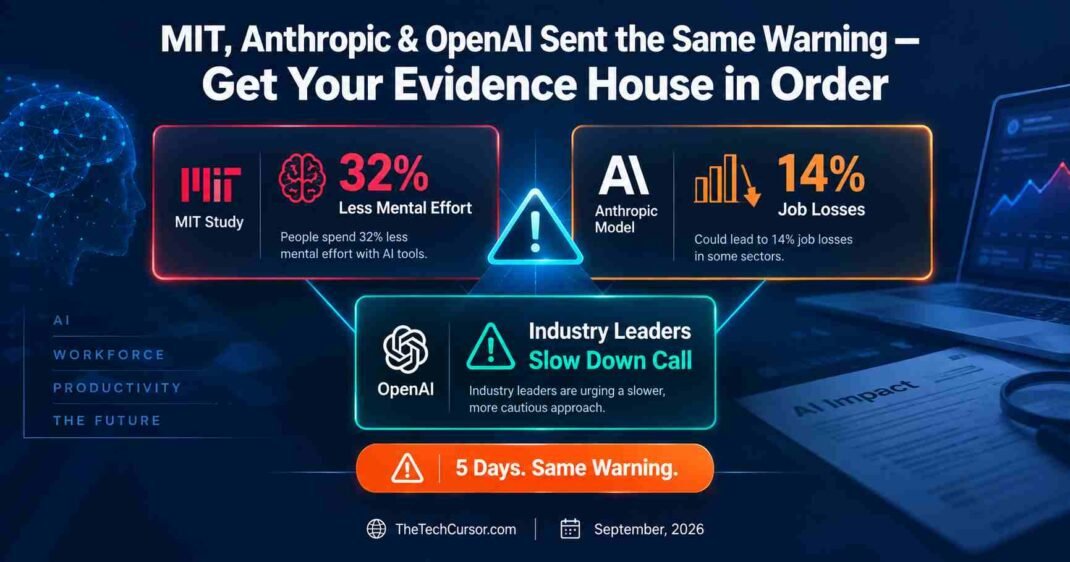
The marketers who read each story separately will miss the pattern. Those who find the pattern will have a meaningful strategic advantage. Here is the pattern — and what to do about it.
1. Three Warnings in Five Days
Three significant AI stories arrived between September 8 and 12, 2026.
First, on September 8, MediaPost reported on an MIT Media Lab study. Researchers used EEG caps to measure brain activity. They compared people writing with AI assistance versus writing alone.
Next, on September 9, NPR covered a new economic model from Anthropic. Anyone can use it to test assumptions about AI and the labour market. The results vary dramatically depending on your inputs.
Finally, on September 12, the New York Times reported on a major development. Anthropic CEO Dario Amodei published a 3,800-word essay. He called for the AI industry to slow down. OpenAI’s Sam Altman agreed. So did xAI’s Elon Musk. Google DeepMind’s Demis Hassabis also signed on within days.
Three stories. Three sources. Three angles. One signal.
2. Warning 1: MIT Found a 32% Reduction in Mental Effort
The MIT Media Lab study produced a striking number. Researchers found a 32% reduction in active mental effort among the AI-assisted group. They also measured a drop in brain connectivity.
The study has drawn pushback. MIT’s own researchers asked people to stop calling it “brain damage.” The sample size is limited. The methodology has been questioned. It would be wrong to treat these findings as settled science.
However, it would also be wrong to dismiss them entirely. The 32% reduction is a specific, measured finding. It is not about long-term damage. It is about what happens during AI-assisted work right now.
The practical question for content marketers is simple. If your team produces content with 32% less mental engagement, what does that content look like? Does it look the way you think it does?
For many teams, the answer is no. Reduced engagement produces grammatically correct content. It is structurally sound. But it is intellectually empty. It surfaces the obvious. It avoids the difficult. It reaches for safe synthesis rather than genuine insight.
This connects directly to the idea economy and the future of content. AI commoditizes production. Consequently, human thinking becomes more valuable than ever.
3. Warning 2: Anthropic’s Economic Model Shows 14% Job Losses
Anthropic built an interactive economic model. Anyone can use it. It shows how AI reshapes the labour market under different adoption scenarios.
At one extreme, the model shows a mild productivity bump. At the other extreme, GDP soars. However, nearly 14% of workers lose their jobs to AI. Less than half of them find new ones. Anthropic’s own economists decline to say which outcome is more likely.
That refusal is actually more honest than most AI economic forecasting. It acknowledges real uncertainty. The outcome depends on adoption speed, regulatory response, and wage dynamics. It also depends on which job functions prove easier to automate than expected.
What the model does establish is the range of outcomes. Labour disruption from AI is not zero. That is not a credible scenario. Furthermore, disruption is not uniform across all industries simultaneously.
The realistic question is not whether disruption happens. It is where and how fast it happens in your specific market.
For digital marketers, the vertical-specific curve matters more than the national average. Content production roles have a different automation risk profile than strategic planning. Entry-level SEO tasks are more exposed than client relationship management. Your own observation of which tasks AI is genuinely replacing will tell you more than any national model.
4. Warning 3: Industry Leaders Called for a Slowdown
Dario Amodei published a 3,800-word essay calling for the AI industry to slow down. He argued for slowing the pace of AI capability improvements. He called for independent audits. He also called for global rules.
Sam Altman agreed. Elon Musk agreed. Demis Hassabis agreed. All within days.
This is the most significant of the three stories. Not because the call to slow down will succeed. Rather, because of who is making it together. Anthropic, OpenAI, xAI, and Google DeepMind agree on almost nothing. They agree on this.
When the most capable AI companies call for external audits and global governance rules, that is a signal. It reflects their own uncertainty about where this leads. It is not reassurance. It is the opposite.
Furthermore, the call for independent audits has practical implications. If audits follow, brands built on verifiable human expertise will start with a significant advantage. Brands built on bulk AI generation will not. Brands built on bulk AI generation will face compliance requirements. They had years of warning to prepare for them.
5. The Pattern Underneath All Three
Strip away the individual details of each story. All three describe the same event from different perspectives.
The MIT study describes the cost at the individual level. It shows what happens to human cognitive engagement when AI handles the heavy lifting of production.
Furthermore, the Anthropic economic model describes the cost at the labour market level. It shows what happens to employment when AI automates tasks people were previously paid to do.
Finally, the Amodei essay describes the cost at the industry level. It shows what happens to trust and governance when the technology advances faster than oversight mechanisms.
Three levels. Same underlying dynamic. AI is advancing rapidly. The people closest to it are publicly uncertain about several important downstream consequences. Even the ones building it.
None of these stories tells you how fast any of this arrives in your specific market. That gap is the part nobody is measuring yet. It sits between the scale of the warning and the speed of real diffusion.
6. Nicholas Carr Was Right in 2008
In 2008, Nicholas Carr published an essay in The Atlantic. The title was “Is Google Making Us Stupid?” Carr argued that computing was becoming a utility. He compared it to the electrification of industry a century earlier. He said the shift from generating your own power to plugging into a shared grid rewired more than the economy. It rewired what work looked like. It rewired what people’s minds did on an ordinary afternoon.
Carr was widely dismissed at the time. The dominant reaction was that he was being dramatic. Tools make people more capable, not less. That was the consensus.
Eighteen years later, the MIT brain scan study describes what Carr warned about. Not brain damage. Rather, a measurable reduction in active mental effort. The kind that produces original thinking and genuine insight.
Anthropic co-founder Jack Clark made a similar point to NPR. He expects the technology itself to keep improving fast. However, its actual diffusion through the economy will be slower and messier than the AI industry assumes. That is Carr’s electrification argument restated. The grid did not reach everywhere at once in 1908. AI is not reaching everywhere at once in 2026.
The historical parallel matters for strategy. The electrification transition produced enormous disruption over 30 years. It did not happen overnight. Some industries were transformed almost immediately. Others took decades. The winners were not the ones who predicted the timeline most accurately. They were the ones who positioned themselves correctly before the transition arrived in their specific market.
7. The Diffusion Gap
The most actionable insight from all three stories is simple. The national AI adoption curve is not your adoption curve.
AI’s impact on content production is not uniform across all marketing verticals. A brand producing commodity informational content faces a different disruption profile than one producing specialized technical content. An agency doing templated deliverables faces a different profile than one doing bespoke strategic work.
The mistake is using industry-wide statistics to make decisions about your own program. Pull your own AI referral traffic monthly. Build your budget around your own measured slope. Not Anthropic’s national model. Not a competitor’s press release.
Your own GA4 data tells you where you actually are. Additionally, your Search Console AI Performance Report shows where AI is already affecting your traffic. Furthermore, your prompt tracking results reveal where your brand appears in AI responses. These are the inputs that matter.
Furthermore, measuring your own AI visibility is the only way to know whether these warnings have already arrived in your specific market. Or whether you still have time to prepare.
8. What Marketers Should Do Right Now
The practical response to three convergent warnings is not panic. It is not dismissal either. It is three specific actions.
Action 1: Audit your AI-assisted content for cognitive debt
Pull the last quarter of content your team produced with heavy AI assistance. Read it yourself. Not for grammar or structure. Look for the tells of reduced mental engagement. These include thin sourcing and claims without named experts. They also include safe synthesis that avoids anything controversial. Furthermore, watch for uniform paragraph rhythm that reads like a summary rather than an argument.
If you find those patterns, you have identified a content quality problem. It will compound over time. AI detection is becoming more sophisticated. Regulators are paying more attention to AI-generated claims. AI systems themselves are getting better at distinguishing original analysis from synthesized summaries.
Action 2: Measure your own diffusion curve
Build a monthly dashboard. Track your own AI referral traffic, AI citation share, branded search trend, and direct traffic. This is your actual curve — not the industry aggregate. The AI visibility dashboard guide covers exactly how to build this. These metrics reveal where AI is already affecting your traffic — and where it has not yet arrived.
Action 3: Build Verifiable Evidence
Action 3: Start building verifiable evidence now
The Amodei call for independent audits may or may not produce regulatory action. However, the direction of travel is clear. Brands with content programs built on verifiable human expertise will be better positioned. This is true regardless of whether formal regulation arrives.
Practically, this means named authors with verifiable credentials on every significant piece of content. It also means citing primary sources that readers can actually check. In addition, it means original research that produces data no AI system could generate without human input. Moreover, it means expert quotes from identified individuals who take responsibility for the claims attributed to them.
9. Get Your Evidence House in Order
“Evidence house” is a useful frame for what is needed right now. It describes the underlying quality standard that separates content worth trusting from content that merely looks trustworthy.
An evidence house, in order, means four things.
Named human authors with verifiable expertise. Not “editorial team.” Not “AI-assisted content.” A person who knows the subject. Someone who takes responsibility for what is published under their name.
Primary sources that readers can check. Cited studies, linked data, identified institutions. Not “research shows” or “studies suggest” without attribution.
Original contribution — something that would not exist if someone simply prompted an AI and accepted the output. An analysis, a case study, a proprietary data point. Something that required a human to create.
Consistent entity signals — the same author identity across multiple platforms. A consistent professional profile that connects a name to a specific area of expertise. As detailed in the 5 GEO pillars framework, credibility is built through consistent entity signals across the web. Named human expertise is one of the most powerful of those signals.
If Amodei’s call for outside audits gains any traction, regulators will look for verifiable human sourcing. Brands already showing checkable data will be trusted by default. Those running templated AI drafts full of unverifiable claims will scramble to catch up. They had years of warning to prepare.
10. Bottom Line
The three AI warnings that landed in five days are not a reason to stop using AI tools. They are a reason to use them more deliberately. Specifically, with more human oversight, more original contribution, and more attention to evidence quality.
Nicholas Carr was right in 2008. The grid did not reach everywhere at once. The transition from novelty to utility took decades. It rewired more than the economy. The same pattern is repeating now.
The brands that come out ahead will not be those that predicted the timeline most accurately. Instead, they will be the ones that built verifiable evidence into their content programs before it was required. Moreover, they will be the ones who measured their own diffusion curve carefully. They will know when the transition was arriving in their specific market.
Get your evidence house in order. The warnings are all pointing in the same direction.