
Read time: 6 min
Table of Contents
- What Google Just Launched: WeatherNext 3
- Why This Is a Search Story, Not Just a Weather Story
- Sundar Pichai’s Vision: Search as an Agent Manager
- The Pattern: Google Has Been Building This for Years
- What Task-Based Search Means for SEO
- Who Benefits and Who Loses in a Task-Based Search World
- Bottom Line
Google just integrated its most advanced AI weather model directly into Search, Maps, Gemini, and Cloud. WeatherNext 3 offers hourly updates, improved rain forecasting, real-time satellite data, and up to 50% greater accuracy than its predecessor.
Weather is interesting on its own, but the search story it reveals is more important.
The context of today’s announcement is not that Google is adding weather across its search surfaces. The big picture is that Search and AI is slowly transforming into a task-based experience that helps users accomplish things, not just find information.
This pattern is worth understanding clearly, because it changes what SEO optimizes for.
1. What Google Just Launched: WeatherNext 3
WeatherNext 3 is Google’s most advanced global-scale AI weather model. Here are the key improvements over previous weather integrations:
- Up to 50% more accurate than previous models
- Hourly updates, which are more frequent than most weather integrations have provided
- Local forecasts with more detail, offering neighborhood-level precision rather than city-level averages
- Real-time satellite data that updates continuously rather than at fixed intervals
- Better rain forecasts, one of the most practically requested improvements
Google is rolling it out globally across Search, Gemini, Maps, Google Maps Platform, Earth Engine and Cloud to improve weather information and decision-making.
The multi-surface rollout is significant. WeatherNext 3 is not a standalone weather product. Instead, it is infrastructure that Google has built into every surface where users make decisions that depend on environmental conditions.
2. Why This Is a Search Story, Not Just a Weather Story
Weather is one of the oldest and most consistent use cases in search. Users have queried weather in Google since the early 2000s. What has changed is what Google does with that query.
In traditional search, “weather this weekend” returned a mix of blue links alongside a featured weather widget. Those links came from sites like weather.com, local news sites, and The Weather Channel. The links were the primary deliverable, and the widget was a convenience.
In the WeatherNext 3 integration, however, the AI-powered weather experience is the primary deliverable. Google generates and presents the hourly forecast, rain probability charts, and satellite imagery directly. Users never need to click through to an external publisher.
Weather is more than just data. It’s data that users around the world depend on to make many of their most important decisions, for both business and personal needs. Google Search and many of its other search related surfaces are in a transition away from ten blue links to becoming a source of information that helps users plan and make decisions.
The shift is from search as discovery to search as resolution. Users once had to visit a weather service to plan their weekend. Now that planning capability sits directly inside search.
3. Sundar Pichai’s Vision: Search as an Agent Manager
The WeatherNext 3 launch is a product-level expression of a vision that Google’s CEO has been articulating at the strategic level.
Google’s CEO Sundar Pichai recently explained the changes inherent in the future of Search:
“I feel like in search, with every shift, you’re able to do more with it. If I fast forward, a lot of what are just information seeking queries will be agentic search. You will be completing tasks, you have many threads running. Search would be an agent manager, right, in which you’re doing a lot of things. And I can see search doing versions of those things, and you’re getting a bunch of stuff done.”
“Search as an agent manager” is a precise and meaningful framing. An agent manager does not deliver information for a human to act on. Instead, it coordinates tasks on the human’s behalf. In this vision, a user does not search for “what should I wear tomorrow” and then piece together an answer from a weather site, a fashion blog, and a local news site. Instead, they ask Google. Google then combines the weather data, the local context, and the relevant recommendations into a single response.
WeatherNext 3 is an early, relatively simple implementation of this vision. Weather data is well-structured, verifiable, and non-controversial. That makes it an ideal proving ground before Google extends task-based search to more complex decisions.
4. The Pattern: Google Has Been Building This for Years
The task-based search transition is not new. In fact, it accelerates a trajectory that has been visible in Google’s product decisions for years.
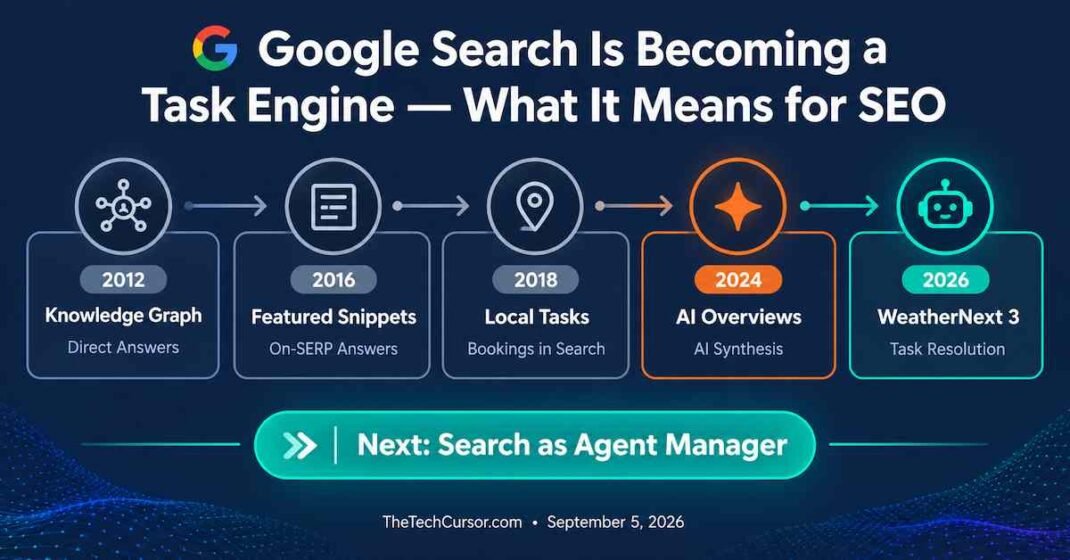
- 2012, Knowledge Graph: Google began giving direct answers to factual questions, such as “population of France.” Users no longer needed to click to a source page.
- 2016, Featured Snippets: Direct answers expanded to more complex informational queries. Google pulled content from publisher pages to answer questions on the results page.
- 2018, Local Experiences: Restaurant reservations, flight bookings, and appointment scheduling moved directly into search results, so users could complete tasks without leaving Google.
- 2024, AI Overviews: Google synthesized multi-source answers to complex research queries and resolved informational intent without requiring navigation to individual sources. As covered in our analysis of Google AI Overviews dynamically expanding, these responses now auto-expand for an increasing percentage of queries.
- 2026, WeatherNext 3: Google integrated AI-powered, task-specific data at the model level. It no longer just pulls external data, but generates high-accuracy outputs from its own AI infrastructure.
Each step moves Google further along one trajectory. It is shifting from a system that ranks pages to a system that resolves queries directly. WeatherNext 3 is the latest step, and Pichai’s “agent manager” framing suggests the trajectory does not end here.
5. What Task-Based Search Means for SEO
The task-based search transition has specific implications for SEO teams. It changes how they should think about their work and what they should optimize.
Informational queries increasingly resolve without clicks
As the analysis of zero-click search and AI value, the 68% zero-click rate reflects queries where Google’s task-based capabilities already resolve user intent. Weather queries have sat in this category for years. Now the transition is expanding the category to more complex informational queries. Eventually, based on Pichai’s vision, it will reach task-completion queries as well.
The practical implication is clear. Content that targets purely informational queries faces declining click-through rates as Google’s task-based capabilities expand. Examples include “what is the weather,” “how many calories in an apple,” and “what time does Target close?” This does not mean informational content has no value. It still has brand visibility value, AI citation value, and entity-building value. Its direct traffic-driving value, however, is decreasing.
Task-adjacent content earns more durable value
Task-based search does not fully resolve user intent for queries that involve the following:
- Personalization: These are decisions that depend on individual circumstances Google cannot fully know. For example, “should I buy an umbrella for my outdoor wedding?” requires context about the venue, the couple’s priorities, and the guest count. Generic weather data cannot capture any of that.
- Expertise evaluation: Here users want human judgment, not just data synthesis. “Is this symptom serious enough to see a doctor?” requires nuanced medical expertise that task-based data integration cannot reliably provide.
- Commercial evaluation: In purchase decisions, users want comparison, reviews, and specific product information. Task-based search summarizes these but does not replace them.
Content that serves these adjacent needs helps users make decisions with specific personal context rather than providing generic data. Consequently, this content category is the most insulated from task-based search displacement.
AI citation becomes more important than click-through
As task-based search resolves more queries directly, being cited within those task-based responses becomes more commercially significant than ranking below them. As covered in our five-phase AI citation framework, brands that earn AI citations for task-relevant content keep their visibility. This holds even as traditional click-through rates decline for the same queries.
6. Who Benefits and Who Loses in a Task-Based Search World
Who benefits:
- Brands with strong entity signals and AI citation presence: As Google’s task-based capabilities expand, brands that appear within task-based responses keep their visibility even without clicks. As part of our entity SEO framework, clear, consistent entity signals make a brand more likely to appear in AI-generated task responses.
- Businesses offering genuine personalization: Financial advisors, medical practices, and custom product manufacturers tailor decisions to individual circumstances, which task-based search cannot replicate. As generic information becomes freely available, their value proposition becomes more differentiated.
- Utility platforms with transactional intent: As part of an analysis of US website traffic winners and losers, USPS gained 12% in traffic last year. Transactional utility, such as tracking a package or finding a post office, requires direct platform access that task-based search can facilitate but not replace.
Who loses:
- Generic informational publishers: Their primary value is information that task-based search can now deliver more accurately and immediately. This group includes weather sites, simple fact repositories, and basic how-to content with no genuine expertise differentiation.
- Publishers dependent on weather, sports scores, and similar data queries: Google is integrating exactly these query categories at the AI model level. As the WeatherNext 3 rollout confirms, it resolves them without clicks to external publishers.
- Sites that have not invested in entity authority or AI citation: The task-based transition makes organic clicks from informational queries less reliable. Therefore, brands without AI search visibility have fewer fallback traffic sources.
7. Bottom Line
WeatherNext 3 is a weather product. Even so, its launch tells a story about Google Search that goes beyond meteorology.
Google Search and many of its other search related surfaces are in a transition away from ten blue links to becoming a source of information that helps users plan and make decisions.
That transition is not happening suddenly. It has unfolded gradually for a decade and accelerated with AI Overviews. Now it reaches specialized domains like weather forecasting, which previously sent consistent traffic to external publishers.
The strategic response is not to panic about lost informational traffic. Instead, work out which content categories are most and least exposed to task-based displacement. Then invest accordingly in the content, entity signals, and AI citation presence that maintain brand visibility as search continues to evolve.
Google’s vision is search as an agent manager, completing tasks rather than just returning links. WeatherNext 3 is one more step toward that vision. Brands that understand this trajectory and adapt will be better positioned for each next step. Those still optimizing for the old search experience will fall behind as Google replaces it.