
AI-Era Marketing Funnel: How TOFU, MOFU, BOFU Changed ?
Read time: 9 min
Table of Contents
- The Marketing Funnel Still Works, But AI Changed Every Stage
- What ToFu, MoFu, BoFu Mean: A Quick Refresh
- How AI Changed the Top of Funnel (ToFu)
- How AI Changed the Middle of Funnel (MoFu)
- How AI Changed the Bottom of Funnel (BoFu)
- The New Stage Nobody Had in 2023: AI-Mediated Discovery
- The Pirate Funnel in the AI Era: Which Metrics Still Matter
- Real Case Study: How the Swim University Funnel Works in 2026
- Building Your AI-Era Funnel: The 2026 Framework
- Bottom Line
The marketing funnel is one of the oldest frameworks in digital marketing. Top of funnel, middle of funnel, and bottom of funnel (ToFu, MoFu, BoFu) describe how prospects move from first awareness of your brand to becoming customers.
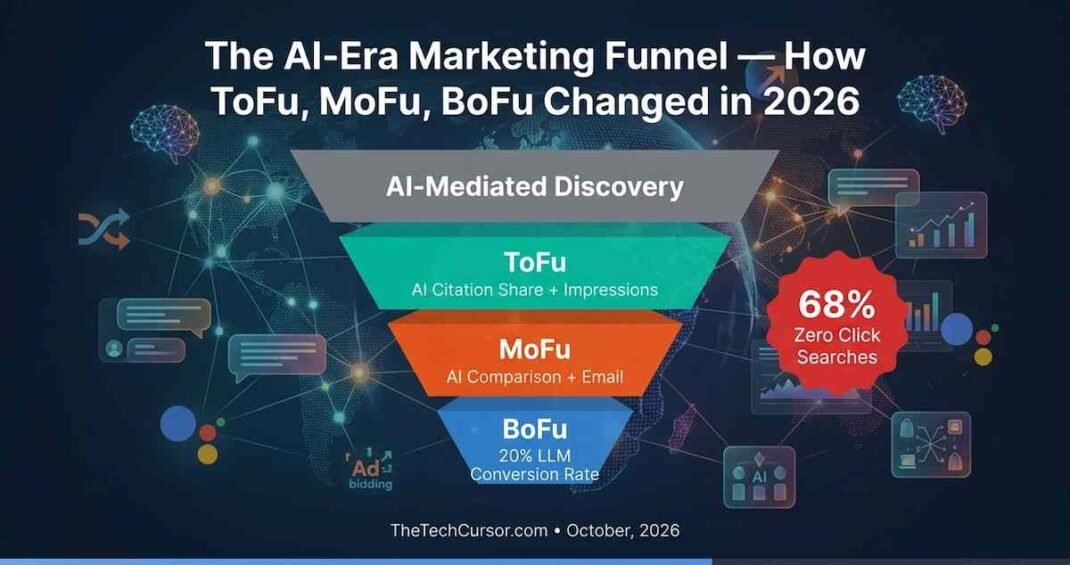
The framework itself has not changed. What happens at every stage has, because AI search now sits between the user and your content at every point in the journey.
In 2026, a ToFu blog post that ranks on page one may never get a click. An AI Overview can resolve the query before the user sees your result. Likewise, a MoFu comparison page may inform an AI recommendation, yet the user who converted never visited your site. Meanwhile, a BoFu landing page may receive AI-referred traffic that converts far better than paid search, according to one 2026 analysis. You cannot reliably attribute those visitors in GA4.
This is not the funnel breaking. It is the funnel evolving. Here is how every stage has changed, and what to do about it.
1. The Marketing Funnel Still Works, But AI Changed Every Stage
The fundamental logic of the funnel is unchanged. Prospects move through awareness, consideration, and decision. Some drop off at each stage, and the rest become customers. The better your content and experience at each stage, the more prospects reach the next one.
AI search has changed two things. It has changed how prospects encounter content at each stage, and it has changed how we attribute what moved them forward.
A well-designed funnel turns casual browsers into loyal customers while reducing your acquisition costs. The concept remains sound. But where the funnel intersects with search has changed fundamentally.
As covered in our analysis of the new search journey loop, search has shifted from a linear process to a loop. The old path was search, click, arrive, convert. Now AI Overviews, paid ads, organic results, and follow-up queries interact across multiple sessions before a conversion occurs.
Understanding how the funnel works inside this loop is the foundation of effective digital marketing in 2026.
2. What ToFu, MoFu, BoFu Mean: A Quick Refresh
Here is a quick refresher for readers new to the framework.
Top of Funnel (ToFu): Awareness. This is the widest part of the funnel. Prospects become aware of your brand, product, or service, and they are usually just recognizing a problem or need. ToFu content includes blog posts, videos, social content, and podcast appearances. It aims to be discoverable and useful to a broad audience. The goal is brand recognition and trust, not immediate conversion.
Middle of Funnel (MoFu): Consideration. Prospects now actively evaluate their options. They know their problem and compare solutions. MoFu content nurtures the relationship and shows why your solution is the right choice. Examples include comparison articles, case studies, product demos, email sequences, and webinars.
Bottom of Funnel (BoFu): Action. Prospects are ready to decide. They compare final options, look for proof, or respond to an incentive. BoFu content turns intent into action. Free trials, demos, discount offers, and transactional landing pages all belong here.
These three stages remain the organizing principle. What differs in 2026 is the set of challenges and opportunities at each one.
3. How AI Changed the Top of Funnel (ToFu)
The old ToFu problem: Create enough content to rank for enough informational queries and build awareness at scale.
The new ToFu problem: Create content that earns AI citations, not just rankings. AI Overviews now resolve a significant share of informational queries without a click.
As covered in our analysis of zero-click search and AI value, SparkToro’s study of Similarweb data found that 68% of U.S. Google searches ended without a click in the first four months of 2026. That is up from 60.45% in 2024. AI Overviews now appear on more than 20% of searches, and click-through rates fall by nearly 60% when they do. Informational queries are the main territory of ToFu content. For those queries, AI Overviews resolve the question before the user has a reason to click.
This creates two distinct ToFu realities in 2026:
- ToFu content that earns AI citations. Your brand appears in the AI Overview for informational queries, which builds recognition even without a click. As covered in our five-phase AI citation framework, citation in AI responses builds branded search lift. Users who meet your brand in an AI answer are more likely to search for it directly later.
- ToFu content that ranks below AI Overviews. Your content is technically on page one, but it sits below the fold of an AI-generated answer. Click-through rates for these positions are dramatically lower than they were before AI Overviews.
The 2026 ToFu adjustment
Stop measuring ToFu success only by organic traffic. Add AI citation share as a primary ToFu metric. This means how often your brand appears in AI responses for your target informational queries. As covered in our trending topics AI citations guide, tools like Otterly.ai, Goodie AI, and Semrush’s AI Visibility Overview track this directly.
The content that earns AI citations at ToFu also differs from the content that simply ranked. Generic informational articles that summarize widely known facts earn fewer citations. Content with original data, specific expertise, and genuine information gain earns more. Our idea economy article explains why. Our Google 14-point content quality checklist asks questions like “would you bookmark this?” and “does it provide insight beyond the obvious?” Those same questions should guide ToFu content decisions in 2026.
4. How AI Changed the Middle of Funnel (MoFu)
The old MoFu problem: Nurture prospects who found you through ToFu content but were not yet ready to buy.
The new MoFu problem: AI systems you do not control now nurture prospects partly on your behalf. They deliver AI-generated summaries, comparisons, and recommendations that may or may not include your brand.
MoFu is where AI search has its most complex impact. Comparison and consideration queries dominate this stage, and AI Overviews cover exactly those queries most thoroughly. As covered in our analysis of the new search journey loop, comparison queries trigger AI Overviews 95.4% of the time.
Imagine a prospect who searches “best [product category] for [use case]” and receives a comprehensive AI-generated comparison. They may reach a shortlist, or even a single recommendation, before visiting any brand’s website. Traditional MoFu touchpoints include comparison articles, competitor pages, and case studies. AI systems now mediate them by synthesizing those assets instead of sending traffic to them.
The 2026 MoFu adjustment
Be the source AI synthesizes from. Suppose AI responses to consideration-stage queries do not cite your comparison content, case studies, or product documentation. In that case, your brand is missing from AI-mediated MoFu conversations. As covered in our entity SEO framework, three things earn citations in these responses: clear entity signals, credible third-party validation, and content structured for AI extraction.
Invest in MoFu email and owned channels. AI cannot mediate a conversation that happens in your email list or community. MoFu content delivered through email reaches prospects without AI intermediation, and you can measure it fully. Sequences, newsletters, and direct nurture all work here. As covered in our analysis of the new US web traffic data, LinkedIn’s entry into the top 20 most-visited sites reflects the growing role of platform-native content in MoFu. That content bypasses search entirely.
Build the social proof AI cites. As covered in our DTC AI search case study, AI systems draw heavily on third-party review platforms, editorial coverage, and community discussions when they build product comparisons. Strong G2 reviews, editorial presence in category-relevant publications, and authentic community mentions are all MoFu investments. Invisible PR is one way to earn the mentions that AI trusts. Each one influences what AI tells prospects about you.
5. How AI Changed the Bottom of Funnel (BoFu)
The old BoFu problem: Convert high-intent visitors who arrived from transactional queries.
The new BoFu problem: AI-referred visitors convert at unprecedented rates, yet attributing them in GA4 is nearly impossible.
As covered in our analysis of LLM traffic and conversion strategy, Search Engine Land’s August 2026 analysis by Jason Tabeling put LLM referral traffic at a 20% conversion rate. That is 61% higher than paid search. The likely reason is simple. The AI has already done the consideration-stage work. Visitors have received a specific recommendation from ChatGPT, Perplexity, or Google AI Mode, and they arrive to validate it and complete the purchase.
Treat that headline figure as directional, though. The analysis does not disclose its sample size or how it defines a conversion. Other data points are in the same direction but are less dramatic. A 2024-2025 study in Marketing Science found ChatGPT traffic converted 13% below organic search. By March 2026, however, reports showed AI assistant visitors converting 42% better than non-AI traffic. Shopify merchant data from May 2026 showed AI-referred sessions converting almost 50% higher than organic search on product pages. Volume also remains small. One report estimates Google sends about 190 visitors for every visitor from ChatGPT. Even so, the direction is clear.
This is the BoFu opportunity of 2026. AI-mediated consideration pre-qualifies the prospects who reach your BoFu content. They are further along in their decision than almost any paid search visitor.
There is a catch, however. As covered in our analysis of the GA4 attribution crisis in US traffic data, most AI-referred BoFu traffic shows up as “Direct” in GA4. Teams that rely on default attribution cannot see it. Many analytics teams have noticed a direct traffic surge, and AI referrals that cannot be attributed drive much of it.
The 2026 BoFu adjustment
Build BoFu landing pages for AI-referred visitors. As covered in our LLM traffic conversion guide, AI-referred visitors need different landing pages than paid search visitors. They arrive after an AI recommendation, so they want validation and depth rather than a stripped-down conversion page. The page should confirm what the AI told them and provide the evidence behind the recommendation. It should also offer a frictionless path to conversion.
Fix attribution before scaling. Add “How did you hear about us?” form fields that list AI search options explicitly. Use UTM parameters on any links within AI-accessible content. Monitor branded search trends as a proxy for AI visibility impact. Without better attribution, BoFu investment decisions based on GA4 data will systematically undervalue the AI search channel.
6. The New Stage Nobody Had in 2023: AI-Mediated Discovery
The traditional model has three stages. In 2026, a fourth stage effectively sits before ToFu. Most funnel frameworks have not yet incorporated it.
AI-Mediated Discovery is the stage where a prospect first meaningfully encounters your brand category, and possibly your brand itself, inside a ChatGPT conversation, a Google AI Overview, or a Perplexity response.
This stage does not appear in your analytics. It generates no session, no click, and no referral. Even so, it shapes the prospect’s awareness and consideration set before they ever engage with your ToFu content.
As AI search changes how people research and evaluate products and services, it’s also important to understand the questions buyers ask at each stage of the funnel and where your brand appears in those conversations.
Brands that appear in AI-Mediated Discovery enter the traditional funnel with a significant advantage. AI cites them by name, describes them accurately, and recommends them for specific use cases. Brands that are absent must work harder at every later stage to overcome the trust gap.
For this reason, AI citation monitoring is not an optional AI search metric. It is a funnel measurement. The percentage of your target queries for which AI systems cite your brand sets your market presence before your funnel even begins.
7. The Pirate Funnel in the AI Era: Which Metrics Still Matter
Another useful diagnostic framework is the Pirate Funnel. Its stages are Awareness, Acquisition, Activation, Retention, Revenue, and Referral (AAARRR). Even so, several of its metrics need AI-era interpretation.
- Awareness: Measure it across both search impressions and AI citation share. A brand that ranks for 500 keywords but appears in zero AI responses for relevant queries has weaker awareness reach than its ranking data suggests.
- Acquisition: The attribution gap makes this increasingly complex. As covered in our US traffic analysis, the “Direct” channel now contains substantial AI-referred traffic that GA4 cannot attribute. Acquisition measurement therefore needs multiple signals, such as HDYHAU surveys, branded search trends, and UTM parameters.
- Activation: AI search has largely left this unchanged. Once a user is on your platform or in your product, product and UX determine activation behaviours, not search.
- Retention: AI recall increasingly influences it. Users who remember your brand from AI search recommendations are more likely to return directly. Few teams use branded search growth as a retention metric, but they should.
- Revenue: It requires AI-assisted revenue attribution alongside last-click and multi-touch models. The reported 20% AI-referred BoFu conversion rate makes AI-channel revenue attribution a priority for any team that has invested in AI search visibility.
- Referral: It now includes AI referral alongside word-of-mouth and affiliate referral. A brand that AI cites consistently for category queries generates a form of scaled referral that the original metric never anticipated.
8. Real Case Study: How the Swim University Funnel Works in 2026
Matt Giovanisci built the Swim University funnel. It generated over $12,000 per month from 400,000 monthly visitors. It offers a useful baseline for seeing how the AI era changes a real funnel.
The original funnel:
- ToFu: SEO blog posts and YouTube brought 400,000 monthly organic visitors.
- MoFu: A free cheat sheet led to an email opt-in, followed by a newsletter with pool maintenance content.
- BoFu: A one-time offer (OTO) at 50% off converted at 2.93% and produced $12,000+ per month.
How this funnel needs to adapt in 2026:
ToFu adjustment. Pool maintenance queries are exactly the informational queries AI Overviews cover comprehensively. A “how to clean a pool filter” query in 2026 likely triggers a full AI Overview, which reduces click-through to Matt’s informational blog posts. The ToFu investment therefore needs AI citation optimization. Structure those blog posts so AI responses can cite them, and the brand earns exposure even when no click happens.
MoFu adjustment. Email remains fully viable and fully measurable, and AI does not mediate it. In fact, the MoFu stage of this funnel is more valuable in 2026 than in 2023. It is an owned communication channel that bypasses AI intermediation entirely. Matt captures the list through the free cheat sheet, so he should accelerate its growth.
BoFu adjustment. The conversion page itself is largely unchanged, but attribution needs updating. AI-referred visitors who reach the OTO page via ChatGPT or Perplexity show up as “Direct” in GA4. As a result, the OTO conversion rate may be understated for AI-referred traffic specifically. A HDYHAU survey in the post-purchase flow would reveal how large the AI referral component is.
9. Building Your AI-Era Funnel: The 2026 Framework
Building or rebuilding a funnel for 2026 requires four adjustments beyond the traditional nine-step process.
Adjustment 1: Add AI-Mediated Discovery as a pre-funnel stage. Before you map ToFu, MoFu, and BoFu content, audit your AI search presence for your category’s most important queries. What does ChatGPT say about your brand? What does Google AI Mode recommend? Which sources do Perplexity responses cite? This audit reveals the pre-funnel stage that shapes every later interaction.
Adjustment 2: Separate AI citation metrics from traffic metrics at every stage. For every funnel stage, run two measurement tracks. Our AI visibility dashboard guide shows how to build the second one.
- Traditional: impressions, clicks, sessions, conversions
- AI: citation share, AI referral traffic, branded search trends, HDYHAU attribution
These tracks will diverge as AI search grows. Brands that maintain both will make better investment decisions than those relying on GA4 alone.
Adjustment 3: Build content specifically for AI extraction at each stage. ToFu content should include key takeaways sections, definition blocks, and original data, which are the formats AI systems extract most efficiently. MoFu comparison content should include tables, structured comparisons, and explicit use-case framing. BoFu content should include specific, verifiable proof points. Good examples are case studies with numbers, review summaries with ratings, and clearly stated guarantees.
As covered in our schema markup for AI citations, structured data at every funnel stage improves how accurately and confidently AI systems represent your content.
Adjustment 4: Invest in owned channels at every stage. Email, community, and direct subscription channels bypass AI mediation entirely. AI intermediation is growing at every stage of search-mediated discovery. Owned audience channels therefore become more valuable over time, as a hedge against continued growth in zero-click and AI-resolved queries.
10. Bottom Line
The ToFu, MoFu, BoFu funnel remains one of the most useful frameworks in digital marketing. What changed in 2026 is not the framework but the mechanisms that drive each stage.
At ToFu, AI Overviews resolve queries without clicks. AI citation share is now as important as organic ranking for brand awareness. At MoFu, AI-generated comparisons mediate consideration, so citation in AI responses is a prerequisite for inclusion in the prospect’s evaluation. At BoFu, AI referral traffic converts at a reported 20%, yet it shows up as “Direct” in GA4.
The 2026 funnel practitioner adds four things to the traditional framework:
- AI-Mediated Discovery as a pre-funnel stage to audit and optimize
- AI citation metrics alongside traditional traffic metrics at every stage
- Content structured for AI extraction alongside content structured for human reading
- Owned channels alongside search-dependent channels at every stage
The funnel still works. It just works differently now, and teams that understand how will build advantages that compound as AI search continues to grow.