
AI and Local Search: New Rules of Visibility & ROI (2026)
Read time: 9 min
Table of Contents
- Local Search Is No Longer Just About Maps
- The Three Phases: From Local 1.0 to Local 3.0
- Why AI Is the Driving Force Behind Local 3.0
- Pillar 1: Discovery: Consistency, Accuracy, Real-Time
- Pillar 2: Experience: Beyond Core Web Vitals
- Pillar 3: Relevance and Authority
- Pillar 4: Conversions: Speed, CRO, and Agentic Journeys
- Pillar 5: Performance: The Metrics That Matter in 2026
- What Changed From 2025 to 2026
- Bottom Line
Local search has never been more commercially important, and it has never looked more different from two years ago. It began with citation consistency and map optimization. Today it is a multi-channel, AI-powered ecosystem. Discovery, experience, and purchasing decisions now happen across a growing number of surfaces at the same time.
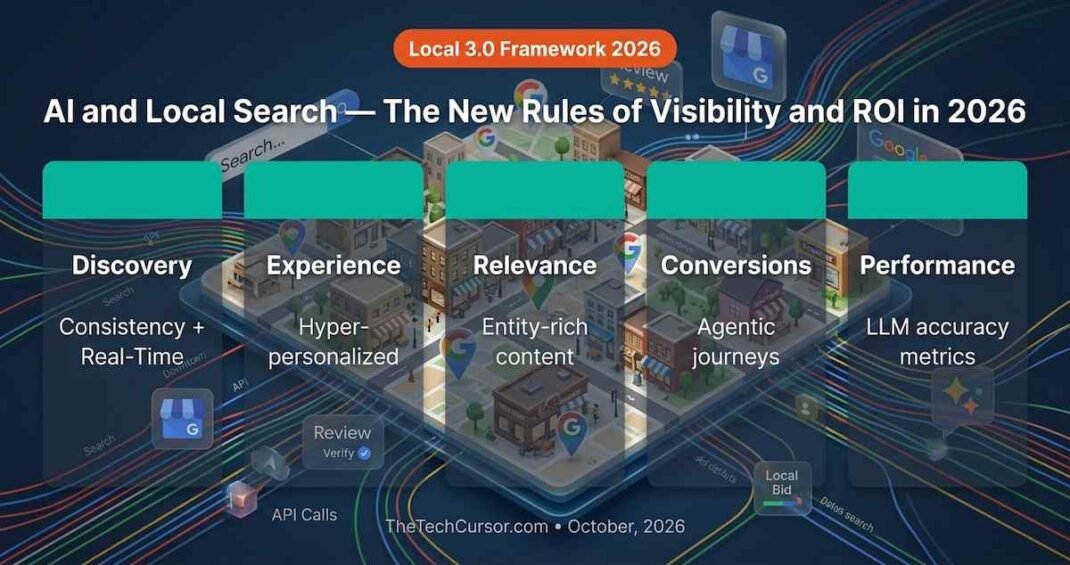
The shift is not incremental. AI has fundamentally changed how people discover local businesses, how they evaluate them, and increasingly, how they buy from them. Some brands still optimize for Local 2.0, relying on map rankings, review volume, and citation consistency alone. Those brands are missing the capabilities that determine visibility in 2026.
1. Local Search Is No Longer Just About Maps
The traditional local search funnel assumed a simple model. A user searched for a local service, and Google returned a map pack and organic results. The business with the best GBP listing, strongest reviews, and most consistent citations won the click.
That model still exists. However, it now sits alongside several other discovery surfaces. Each one runs on different signals and serves a different stage of the customer journey.
AI Overviews appear above local results for many local queries. ChatGPT, Gemini, and Perplexity answer local intent questions conversationally, often without showing a traditional map pack at all. Voice search delivers single-answer responses that name one local business rather than three. Google’s Universal Cart, launched October 15, 2026, even lets users buy from local-adjacent product queries without visiting the retailer’s site.
Consequently, you cannot measure local search ROI in 2026 by map pack position alone. It requires tracking visibility and performance across multiple surfaces. Each surface has its own ranking signals and its own user behaviours.
2. The Three Phases: From Local 1.0 to Local 3.0
Local search has evolved through three interconnected phases. Each phase built on the previous one, and each reflected the dominant technology of its era.
Local 1.0: Data accuracy and citation consistency. The first phase focused on keeping business information accurate and consistent across directories, citations, and the early map products. As a result, citation management services emerged to maintain correct listings at scale. The primary job was to be findable, with the right address, phone number, and business category on every relevant platform.
Local 2.0: Discovery, relevancy, authority, and experience. The second phase went beyond data accuracy. It emphasized content quality, engagement signals, and customer experience. In practice, it covered four areas:
- Discovery through comprehensive listings and rich content
- Relevancy through authoritative, localized content
- Customer experience through seamless, consistent personalization
- Engagement and conversions through optimization and paid strategies
This phase required a rock-solid platform foundation, topical and entity-rich content, and optimized digital assets. It rewarded businesses that treated their GBP as a content channel, not just a directory listing.
Local 3.0: AI-powered personalization and agentic discovery. The current phase applies AI across every dimension of the local search journey. The Local 2.0 framework remains: discovery, experience, relevance, conversions, and performance. AI, however, now plays a pivotal role in modernizing how each of them works.
AI-driven search is more personalized and context-aware than anything before it. Users now benefit from extended context windows, memory across sessions, and hyper-personalized responses. These responses reflect their specific needs and goals. Our local SEO services 2026 guide covers the GBP and citation tactics that underpin this new environment.
3. Why AI Is the Driving Force Behind Local 3.0
At the heart of Local 3.0 is AI’s ability to understand and match user intent with unprecedented depth and context. Several specific capabilities are transforming how local businesses get discovered and evaluated.
Hyper-personalization at scale. AI tailors experiences to individual users based on their history, preferences, and stated goals, not just the query they typed. Imagine a user who has searched for Italian restaurants with outdoor seating before. That user will see different local results than someone who has never made that kind of search, even when both submit the same query.
Memory across sessions. Some AI tools now keep context across multiple interactions. For example, a user who told ChatGPT their preferred airline in one conversation will see that preference reflected in future travel-related local queries. Businesses that earn loyal customers benefit increasingly, because that loyalty becomes part of the AI’s understanding of the user.
Multi-agent workflows. AI agents can now gather information from multiple local sources at once. They check availability, compare prices, read reviews, and make recommendations before showing the user a single answer. As a result, the traditional research phase shrinks to seconds. It also concentrates decision-making influence in the AI system rather than in the individual sources it draws from.
Real-time information and dynamic responses. AI search responses increasingly include real-time data, such as current hours, live availability, recent reviews, and pricing. A business with stale, inconsistent, or unavailable data is at a structural disadvantage. Competitors with current, machine-readable information will beat it.
4. Pillar 1: Discovery: Consistency, Accuracy, Real-Time
The discovery pillar in Local 3.0 requires three qualities that reinforce each other: consistency, accuracy, and real-time availability.
Consistency across LLMs. As large language models spread, the accuracy of business information inside them has become a foundational requirement. When ChatGPT, Gemini, or Perplexity generate a local recommendation, they draw on whatever they know about the business. Inconsistent NAP data, outdated hours, or conflicting category information creates ambiguity. That ambiguity lowers AI confidence in citing the business.
Disambiguation through context is critical. AI systems build maps of entity relationships, so consistency matters significantly. A business described differently across sources creates entity signal conflicts. These conflicts reduce citation confidence on every AI platform. Our guide on global vs local E-E-A-T shows how to build trust without confusing AI search.
Schema depth and real-time discovery. Deep nested schema markup goes beyond basic LocalBusiness schema. It adds specific service types, operating hours, geographic service areas, staff credentials, and product offerings. This structured data makes business information machine-readable, so AI retrieval systems can extract it with confidence.
In addition, deploying IndexNow through your CMS or CDN improves real-time discovery. It signals content updates to search engines immediately instead of waiting for scheduled crawls. In a competitive local market, a competitor’s updated hours or new service could tip a recommendation. Real-time content signals therefore matter.
Visual content and multi-modal signals. The role of images and videos in local search is evolving with multi-modal AI. These models understand connections across media types, so topical relevance now extends beyond text to visual and audio content.
One important 2026 development deserves attention, though. AI-generated images no longer perform well in local search. Google introduced a quality filter that significantly reduced the visibility of AI-created visuals. If you added AI photos to GBP listings or location pages, check your image traffic in Search Console for drops. Consider reverting to authentic photography.
5. Pillar 2: Experience: Beyond Core Web Vitals
Organic search traffic to websites is declining as AI-influenced search experiences become more common. Focusing only on load times and Core Web Vitals is no longer enough.
User expectations have shifted. AI-powered search has conditioned users to expect hyper-personalized, context-aware responses. A generic local service page that looks the same for every visitor creates a noticeable quality gap. It ignores the visitor’s location, device, prior behaviour, and stated intent.
Hyper-local and hyper-personalized landing pages. Location-specific landing pages perform significantly better than generic city-level pages. They reference neighbourhood context, local landmarks, and market-specific service details. This is not just an SEO consideration. It also reflects how local buyers judge trust and relevance when they evaluate providers.
Customer loyalty as AI training input. As AI assistants become more agentic, customer loyalty data becomes a competitive asset in a new way. Users will tell their assistants which vendors they prefer, and those preferences will shape the agent’s knowledge. A business with a strong loyalty relationship gains a systematic visibility advantage whenever that customer’s assistant handles a related query.
Agentic interactions. AI-powered search is creating hyper-personalized, agentic interactions built around customer intent. Unlike traditional searches, these interactions use extended context windows and memory. They enable deep, focused conversations that incorporate the user’s specific needs and goals.
Relevance and user intent have always been central to local search. In Local 3.0, AI transforms the customer journey through real-time intent matching. Content that is highly topical and entity-rich, with strong topical authority and expertise, performs best.
Topical and entity-rich content. Content that establishes clear entity associations performs best in both traditional local search and AI recommendation systems. Those associations cover what the business is, where it operates, what it specializes in, and which local context it belongs to. Thin, generic service pages that could apply to any business in any city perform poorly. By contrast, locally specific content that shows genuine local knowledge beats them.
Brand mentions across social and reviews. Brand mentions on social media and review platforms strengthen relevance and authority signals. This is especially true for AI systems that draw on conversational and social content. A business mentioned positively in local Facebook groups, Reddit threads, and neighborhood forums builds entity associations in AI systems. Formal directory citations cannot replicate those associations. Invisible PR covers how to earn mentions like these without chasing links.
Content audits for local performance. Regular audits identify underperforming location pages, outdated service descriptions, and content that no longer matches the business’s current offerings or service area. Audits should also check for freshness problems. Outdated statistics, superseded service information, and old pricing are common examples. AI systems may cite them as accurate even after the business has moved on.
7. Pillar 4: Conversions: Speed, CRO, and Agentic Journeys
Speed and Core Web Vitals directly affect conversion rates for local businesses. Many visitors who land on a local service page are already primed to act. They have researched through AI recommendations or review platforms, so they arrive with higher-than-average purchase intent.
Reducing friction at every touchpoint. The conversion goal in Local 3.0 is to minimize the steps between AI recommendation and completed action. For service businesses, this means click-to-call that works immediately without redirects. Product businesses, on the other hand, need availability and pricing visible without a trip to a separate page. Appointment-based businesses need booking systems that load quickly and run without errors.
AI-assisted CRO and A/B testing. AI tools can now accelerate conversion rate optimization. They analyze visitor behaviour patterns, identify friction points, and suggest test variations faster than manual processes. Likewise, businesses that apply AI to their own optimization capture an efficiency advantage that compounds over time.
The agentic commerce dimension. Google Universal Cart and the expansion of agentic checkout, covered in our Google Universal Cart guide, change where purchases happen. Some local-adjacent purchases now complete inside Google’s surfaces rather than on the business’s own site. Businesses that have integrated with the Universal Commerce Protocol capture these conversions. Those that have not are absent from an increasingly active purchase channel.
8. Pillar 5: Performance: The Metrics That Matter in 2026
Many factors influence local search results, so real-time, actionable insights based on current engagement are crucial. The performance metrics that matter in Local 3.0 extend beyond traditional local reporting into AI visibility measurement.
Traditional local performance metrics. GBP impressions, phone calls, website clicks, and driving directions remain foundational. Location page views, engagement rates, and conversion events show whether local search investment produces commercial outcomes.
LLM accuracy and consistency metrics. The LLM performance layer is new to Local 3.0. It measures how accurately and consistently AI systems represent the business. This requires prompt tracking across ChatGPT, Gemini, Claude, and Perplexity for the queries that matter most to local buyers in your category.
Our multilingual AI prompt tracking guide covers how to extend this tracking across languages for businesses that serve multilingual communities. Our AI visibility dashboard guide also covers the complete measurement infrastructure for tracking AI visibility alongside traditional local search performance.
Zero-click appearances. A local business that appears in an AI Overview or a conversational AI response generates brand impressions even when no click occurs. Tracking these appearances requires the AI prompt monitoring approach described above. Search Console’s standard performance report does not capture them.
9. What Changed From 2025 to 2026
The five-pillar Local 3.0 framework applies across both years. Several specific developments in 2026, however, have shifted the emphasis within it.
- AI Overviews expanded to 43% of local packs, up from minimal presence in mid-2025. Earning citation in AI Overviews for local queries is therefore now a primary visibility objective, not a secondary one.
- Agentic commerce is real, not hypothetical. Google Universal Cart launched in October 2026. Businesses that dismissed agentic checkout as a future concern now need a present-tense response.
- AI-generated images lost ground. Google’s quality filter reversed gains from AI photography on GBP listings and location pages. Authentic visual content matters more in 2026 than it did in 2025.
- Preferred Sources grew 7x, as reported in Google’s October 15 AI Mode update announcement. Building a Preferred Sources following is now a meaningful local visibility lever for publishers and local content creators who serve specific communities.
- LLM accuracy became measurable. Prompt tracking tools matured significantly in 2026, so monitoring AI representation of local businesses at scale is now practical. This capability did not exist in a usable form in mid-2025.
10. Bottom Line
Local 3.0 does not replace Local 1.0 and 2.0. Instead, it is a layer built on top of them. Citation consistency still matters, and so do GBP optimization and reviews. In a search environment where AI systems recommend local businesses based on a much broader set of signals, however, none of those foundations is sufficient alone.
The businesses that win in local search over the next two years will keep strong Local 1.0 and 2.0 foundations. On top of that, they will add the Local 3.0 capabilities that AI search requires:
- LLM accuracy monitoring
- Entity-rich content
- Hyper-local landing pages
- Agentic commerce readiness
- AI citation tracking alongside traditional performance metrics
The Local 3.0 Priority Checklist
- Audit LLM presence. Run prompt tracking across ChatGPT, Gemini, Claude, and Perplexity for your top local queries.
- Deep nested schema. Implement LocalBusiness schema with service types, staff credentials, and service area specifics.
- GBP freshness. Post weekly, update hours immediately when they change, and respond to every review within 48 hours.
- Authentic photography. Remove or replace AI-generated images on GBP and location pages.
- Hyper-local landing pages. Build dedicated pages for each service area with genuine local context.
- UCP readiness. Evaluate Universal Commerce Protocol integration if you sell products.
- AI visibility measurement. Add LLM accuracy and consistency metrics alongside traditional local KPIs.