
Is It Safe to Link to Competitors? Outbound Links & SEO
Read time: 6 min
Many SEO teams follow an unwritten rule. Never link to a competitor. Some extend it further and avoid external links altogether. The reasoning feels sensible. A link sends visitors away, and it may hand ranking strength to a rival.
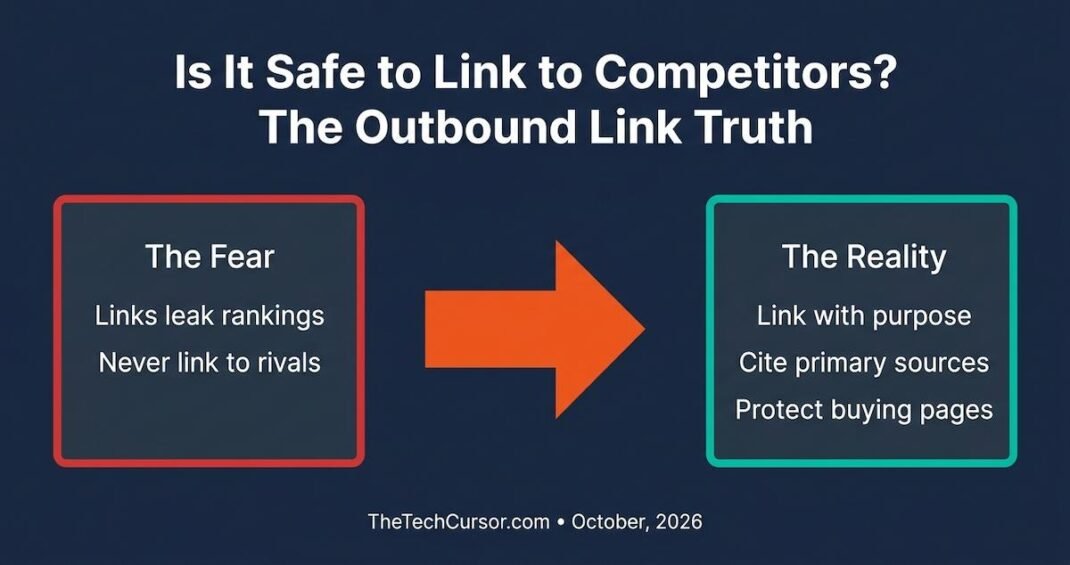
However, that rule mixes three separate worries. One is about losing visitors. Another is about losing ranking power. The third is about helping a business that sells against you. Each deserves its own answer.
1. The Fear Behind the Rule
The fear has a long history. Years ago, tools began reporting outbound link counts as if they were a ranking factor. Consequently, many site owners treated external links as a cost to minimize.
Google’s crackdown on link spam made things worse. Sites worried that any external link might look manipulative. As a result, linking out became something to avoid rather than something to do well.
The worry is understandable. Still, it rests on a few assumptions that do not hold up well under scrutiny.
2. The Hose Myth — Why Links Do Not Drain Rankings
The most common assumption treats a page like a bucket of ranking strength. Each outbound link, in this view, is a hole that lets some of it leak out.
Some SEO educators call this the hose myth. Links are not pipes that drain a fixed supply. Ranking depends on many signals, and relevance and quality of content sit at the center of them.
A page that cites credible sources is not weaker for doing so. Instead, citations show that the author did the research. Moreover, they help readers and search systems understand the topic the page covers.
3. What the Evidence Actually Shows
Direct proof on this question is limited, and caution is needed. Several practitioners agree on a few points.
Outbound links to authoritative sources, used in moderation, are generally considered harmless. Many experts also note that outbound links are not a direct ranking boost. Linking out will not lift a weak page on its own.
One vendor analysis examined roughly 38,000 data points and found that pages with many external links often earned strong impression counts. That result is correlation, not proof. Comprehensive pages tend to cite more sources, so the links may simply mark thorough content. Treat it as a hint rather than a rule.
The honest summary is simple. Outbound links do not appear to hurt well-made pages. They also do not work as a shortcut.
4. Where Outbound Links Do Cause Problems
Outbound links are not risk-free. Certain habits create real trouble.
Broken links. Dead external links frustrate readers and signal a neglected page. Regular audits catch them.
Undisclosed paid links. Google’s guidance asks sites to qualify paid links with the sponsored attribute. User-generated links call for the ugc attribute. Ignoring this invites link spam problems.
Irrelevant or low-quality destinations. Linking to poor sites can weaken trust in your own page.
Excessive links that distract. If every paragraph pushes readers elsewhere, your own internal links get fewer clicks. Furthermore, the page loses focus.
None of these problems come from linking out itself. They come from linking carelessly.
5. The Competitor Question — A Decision Framework
Linking to a competitor is a business question as much as an SEO question. Therefore, a simple test works better than a blanket ban.
Do not link when the reader is deciding what to buy. On product pages, pricing pages, and comparison pages built to convert, a competitor link can send a ready buyer away. The risk is commercial, not algorithmic.
Consider linking when the competitor is the primary source. Suppose a rival publishes original research that you want to discuss. Citing it is honest and useful. It also shows readers that you are not hiding from the facts.
Link to the information, not the sales page. Suppose a competitor owns the best explanation of a concept; link to that explanation. Avoid pointing at their product pages.
Consider the alternative. Often a neutral source, such as a standards body, a study, or official documentation, serves the reader equally well. In that case, you can avoid the question entirely.
One concern remains for some teams. A followed link to a rival might pass them some benefit. That worry is not baseless, though the effect is hard to measure. If it bothers you, a nofollow attribute is a reasonable option for competitor links you include for completeness.
6. Why Outbound Links Matter More in AI Search
AI search systems favour content that can be verified. A page that names its sources gives those systems something to check against.
This connects to a broader pattern. The Google 14-point content quality checklist stresses accuracy and sourcing. Similarly, the GEO pillars framework treats credibility as a foundation for AI visibility.
Citing sources is one visible way to show credibility. A page that makes claims with no attribution looks thin beside one that points readers to the evidence.
Furthermore, the future of content idea economy article explains why original, well-supported thinking is the scarce asset. Honest citation supports that standard.
7. How to Link Out Safely
Follow a few habits and the fear loses most of its force.
- Link for a reason. Each external link should support a claim or add context.
- Prefer primary sources. Link to the original study, not a blog summarizing it.
- Use accurate anchor text. Describe the destination clearly.
- Qualify paid and user-generated links. Apply sponsored and ugc attributes as Google advises.
- Audit regularly. Fix or remove broken external links.
- Keep internal links strong. External links should support your own pages, not replace the paths you want readers to take. The topic clusters guide shows how to build that internal structure.
Outbound linking also supports relationship building. The Invisible PR guide explains how mentions and citations across the web build visibility. Generous, honest linking is part of the same ecosystem.
8. Bottom Line
The blanket rule against linking to competitors is too crude. Linking out to credible sources is generally safe and often helpful. Linking to a competitor on a page meant to convert buyers is a real business risk. Everything in between depends on purpose.
A Simple Rule of Thumb
Link when it helps the reader and supports your credibility. Hold back when the link would pull a ready-to-buy visitor toward a rival. When in doubt, cite a neutral primary source.
The traditional link-building guide shows that links still matter in an AI-driven environment. Treating them as an honest part of good content, rather than a leak to prevent, is the healthier way to think about them.