
Read time: 6 min
A new study suggests that Google’s AI Mode keeps much of its shopping traffic inside Google. Shoppers can discover products there without ever visiting the brand’s own website.
The finding matters for every ecommerce team that measures success by referral traffic. It also connects to the wider shift toward agentic commerce. Therefore, here is what the study reports, what it does not tell us, and how to respond.
1. What the Study Found
The study, from a company called Findrix, analyzed 55,198 AI-generated answers in AI Mode. It focused on product-related answers in the United States.
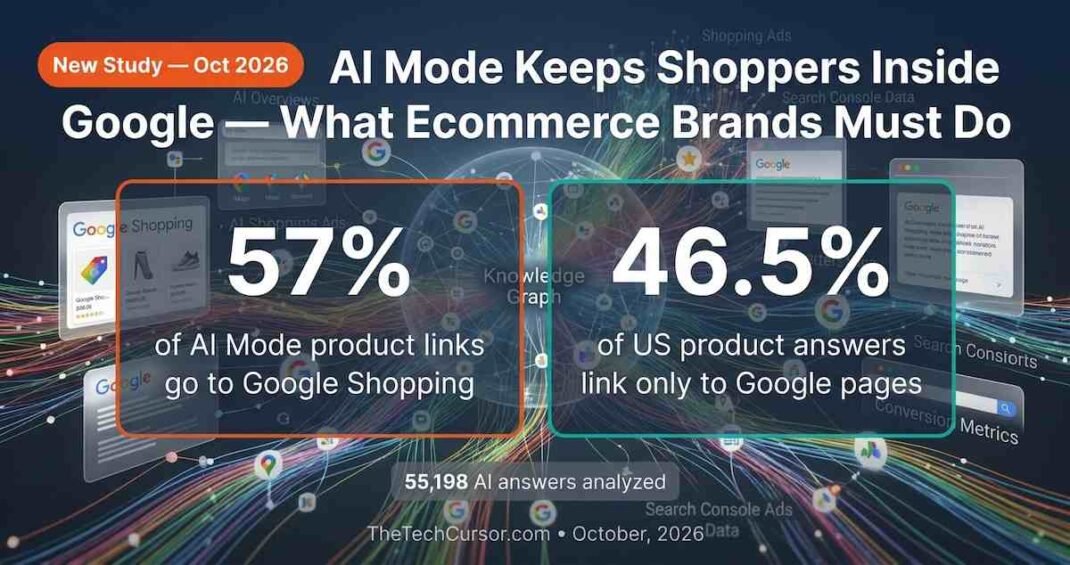
Two headline figures came out of it. First, about 57% of all links in AI Mode product answers led to Google Shopping product pages. Second, in 46.5% of US product answers, AI Mode linked only to Google’s own pages.
The study also found that fashion and beauty products had the highest rates of Google-only linking. The full category breakdown was not available to me, so this article does not go beyond those two categories.
2. Two Numbers, Two Different Meanings
These two figures are easy to confuse. They measure different things.
First, the 57% figure counts links. Of every link shown across all product answers, more than half pointed to Google Shopping product pages.
Second, the 46.5% figure counts answers. In nearly half of the product answers, every link pointed to Google. The shopper saw no merchant or publisher link at all.
Consequently, the second number is the more serious one for brands. An answer with no external link offers no path to a retailer’s site. Even so, a shopper could still click through from inside the Shopping page.
3. Fashion and Beauty Lead — Why That Matters
The study does not explain why fashion and beauty rank highest. A plausible reason is that these categories are visual, heavily browsed, and well covered in Google’s product data. That is an inference, not a finding.
However, whatever the cause, the practical point stands. Brands in visually driven categories are most exposed to discovery that never reaches their website. They also have the most to gain from strong product data inside Google’s own systems.
4. What Other Studies Add
Other research gives context, though each study has limits.
A separate vendor study from Productrise examined more than 100,000 identical shopping searches in the US and UK in July 2026. It reported that AI Mode returned at least one product on about 23% of shopping queries. Standard search did so on about 88%.
A follow-up Productrise study reported that AI Mode overlapped with the standard Popular products carousel on only about 1.28% of matched products. The same company also reported that products appearing in both places were priced about 21.6% higher in AI Mode on average.
Treat these results carefully. They come from a vendor, and coverage of the pricing study noted that Google had not verified it. Google also pointed out that all its shopping results draw on the same Shopping Graph data. Still, the studies point in a consistent direction. AI Mode shopping behaves differently from classic Shopping, and it keeps users close to Google.
5. Why Referral Traffic Will Understate Your Visibility
The core lesson is simple. A product can be visible in AI Mode and still produce no sessions in your analytics.
When a shopper sees your product inside a Google Shopping panel, the exposure is real. However, any resulting purchase may happen through Google’s checkout flow. The Google Universal Cart launch makes this more likely, because carts and checkout can now run across Search and Gemini.
Furthermore, the AI Mode click research showed that AI Mode reduces clicks to websites. Together, these findings mean referral traffic alone will undercount how often shoppers meet your brand.
6. What Ecommerce Brands Should Do Now
Consequently, several actions follow from the evidence.
Treat your product feed as a visibility asset. If AI Mode pulls product answers from Google’s Shopping data, the quality of your Merchant Center feed matters directly. Complete titles, accurate prices, clear availability, and good images all help.
Keep structured data accurate. Product and Offer schema helps AI systems read your product information correctly. The schema and AI citations guide explains which markup AI retrieval values most.
Review your Universal Commerce Protocol options. If checkout is moving into Google’s surfaces, retailers outside the protocol may lose conversions they never see. Check your Merchant Center account for onboarding steps.
Do not abandon organic product pages. Own-site pages still carry brand, trust, and conversion value. The ecommerce search trends data showed that organic Shopping and AI-referred traffic can convert well.
7. How to Measure Visibility Without Clicks
Standard reporting will miss a growing share of shopping exposure. Therefore, add a few measurements.
First, track your product impressions in Merchant Center and Search Console where available. Next, run regular prompt checks for your key product queries in AI Mode and other AI platforms. Note whether your products appear, and whether links point to your site or only to Google.
The AI visibility dashboard guide shows how to set up this tracking. Also watch branded search volume. If shoppers meet your brand in AI Mode, some will search for it directly later.
8. Bottom Line
The Findrix study suggests that AI Mode sends more than half of its product links to Google Shopping. In nearly half of US product answers, it linked only to Google pages. This is a single study, and its full methodology was not available for this article. However, it fits other evidence that AI shopping keeps users inside Google.
What to Take Away
Overall, visibility and referral traffic are drifting apart in ecommerce. Brands that measure only sessions will undercount their reach. Brands that invest in clean product data and track AI exposure directly will see the fuller picture.
The practical response is not panic. Strengthen your feed, keep your schema accurate, review your commerce protocol options, and measure exposure beyond clicks.
Pingback: Your Product Feed Is Your AI Resume — How to Get Your Products Recommended in ChatGPT and Google AI Shopping - TheTechCursor