
Category: Google Ads | AI Search | PPC Strategy | Digital Marketing
Read time: 8 min
Table of Contents
- The AI Overviews Paid Search Problem
- The Three Strategic Responses
- Strategy 1: Fight — Compete for Remaining Click Inventory
- Strategy 2: Influence — Earn AI Overview Citations
- Strategy 3: Generate — Create Demand AI Cannot Satisfy
- Which Strategy Is Right for Your Brand?
- The Combined Approach — How the Best Campaigns Use All Three
- Measuring Performance Across All Three Strategies
- Bottom Line
AI Overviews have fundamentally changed the paid search landscape — and most PPC strategies have not caught up.
The traditional paid search model assumed a simple dynamic: user searches, results page appears, ads compete for clicks. AI Overviews disrupt every step of that model. They appear before paid ads. They answer the query directly. Furthermore, they reduce the incentive to click on anything — including ads.
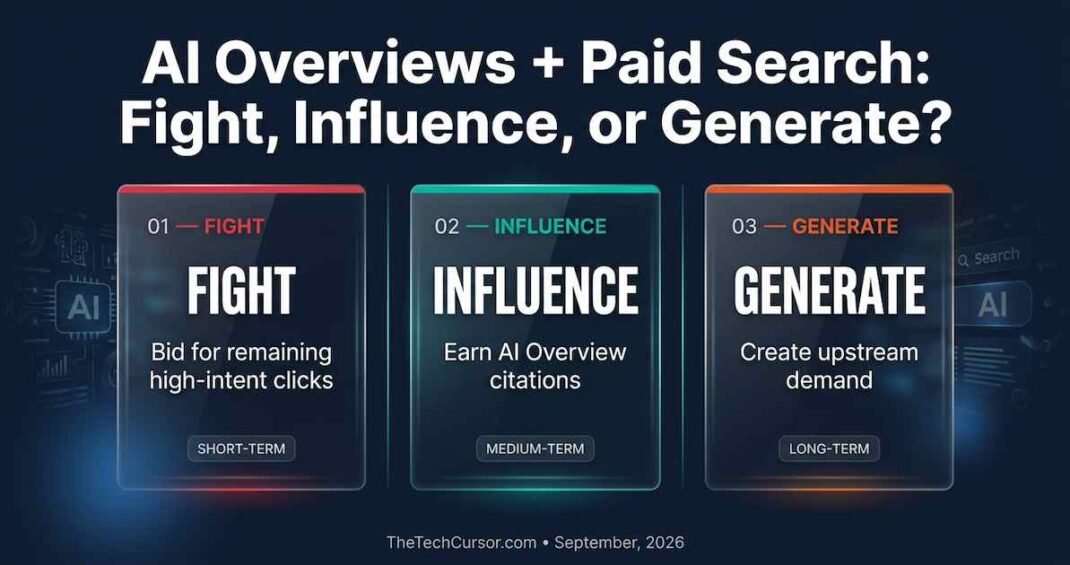
The response most PPC teams default to is fighting harder for the clicks that remain. That instinct is understandable — but it is only one of three viable strategic responses to AI Overviews, and for many brands, it is not the most effective one.
The three strategies are Fight, Influence, and Generate. Here is what each one means, when each one works, and how to decide which your brand should prioritize.
1. The AI Overviews Paid Search Problem
The data on how AI Overviews affect paid search performance is now well established —and it is not uniformly negative, which is itself an important strategic insight.
When an AI Overview appears for a query, paid click-through rates actually rise for the ads that appear below it. Users who engage with the AI answer and then decide they want more tend to be higher-intent. They have already done the quick research and are moving toward a decision.
However, fewer users reach that decision point. AI Overviews absorb the early-stage, informational clicks that previously drove top-of-funnel paid traffic. The remaining ad inventory is smaller but higher-intent.
For brands whose paid strategy depended on high volumes of informational traffic, this shift is painful. Conversely, brands whose paid strategy focuses on high-intent, decision-stage traffic find it less disruptive and sometimes advantageous.
The strategic question is not “how do we get our clicks back?” It is “what is the right paid search posture given how the search results page actually works now?” That question has three different answers depending on your brand’s position, objectives, and competitive landscape.
2. The Three Strategic Responses
Fight: Maintain or increase paid bidding on queries where AI Overviews appear, competing for the reduced but higher-intent click inventory that remains after the AI answer absorbs early-stage users.
Influence: Invest in the content and authority signals that earn AI Overview citations, using organic credibility to reduce paid spend dependency while building brand trust that improves paid performance on the same queries.
Generate: Use paid search to create demand for categories and solutions that users are not yet searching for — targeting the awareness stage before queries exist, rather than competing for existing query volume that AI Overviews are absorbing.
Each strategy is appropriate for a different set of conditions. Most brands need elements of all three — but the relative emphasis should reflect their specific market position, competitive dynamics, and business objectives.
3. Strategy 1: Fight — Compete for Remaining Click Inventory
Fighting for remaining click inventory is the most direct response to AI Overviews — and the most expensive if executed without strategic discipline.
When fighting makes sense:
The Fight strategy is appropriate when your product category generates high-intent queries that users need to act on regardless of what an AI Overview says. Compliance deadlines, urgent needs, local services, and time-sensitive purchases all fall into this category. Users who need a local emergency plumber or a product in stock by tomorrow are not satisfied by an AI Overview explaining their options. They need to take action immediately.
For these categories, the AI Overview filters out early-stage researchers while leaving the high-intent, action-ready users who are worth paying more to reach. The Fight strategy in this context means maintaining strong bids on high-intent queries and focusing ad creative on the conversion moment rather than the awareness stage.
How to fight effectively:
Bid on the queries that survive AI Overview filtering with the highest conversion probability. These are typically queries with strong commercial intent signals — brand names, product-specific terms, location modifiers, and action-oriented phrases. Avoid bidding on informational queries where AI Overviews will absorb most of the traffic before it reaches the ad inventory.
Furthermore, as covered in Google’s AI Max out-of-beta announcement, intent-based matching through AI Max captures the conversational, high-intent queries that traditional keyword targeting misses. The Fight strategy is most effective when combined with AI Max’s ability to match ads to the specific intent signals that survive AI Overview filtering.
The Fight strategy’s limits:
Fighting purely for remaining click inventory is an increasingly expensive strategy as AI Overviews expand. The impression base that generates clicks is shrinking for informational queries — meaning the same spend reaches fewer users even when individual click quality improves. Brands that rely entirely on Fight without complementing it with Influence or Generate are operating in a market that is structurally shrinking for their existing approach.
4. Strategy 2: Influence — Earn AI Overview Citations
The Influence strategy recognizes that appearing in an AI Overview is itself a valuable marketing outcome. Specifically, it improves paid performance on the same queries through the trust signal of being a cited source.
Research from Seer Interactive confirms the compounding benefit: brands cited in AI Overviews earn significantly more organic clicks and more paid clicks on the same queries than uncited brands. The AI citation acts as an endorsement that lifts the performance of every other touchpoint on the same results page.
When influence makes sense:
The Influence strategy is appropriate for brands in categories where comparison and research queries are common before purchase. This includes software, professional services, financial products, healthcare, and B2B solutions. These are the categories where AI Overviews appear most frequently. Moreover, the consideration-stage clicks they absorb are most valuable here.
For these brands, being cited in an AI Overview for a comparison query is not just organic visibility — it is a trust signal that makes the paid ad appearing below the overview more likely to convert. The user who saw your brand cited in the AI answer and then clicks your ad is already partially convinced.
How to earn influence:
AI Overview citations come from the same signals that drive organic rankings — with additional weight on original research, authoritative sourcing, and content that addresses the specific question being asked. As covered in the Freshpet GEO playbook, the four pillars of AI visibility — relevance, authority, structure, and engagement — directly predict citation probability.
For paid search teams, the Influence strategy requires coordination with SEO and content teams. The content investments that earn AI Overview citations are not paid search decisions — but they directly affect paid search performance. Paid and organic teams need shared visibility into which queries are generating AI Overviews and which content changes are affecting citation status.
The Influence strategy’s limits:
Influence cannot be bought directly. You cannot pay Google to appear in an AI Overview citation. The investment is in content quality, topical authority, and the third-party credibility signals that AI systems evaluate. Consequently, Influence is a slower strategy than Fight. However, its returns are more durable, and its benefits extend beyond the paid channel.
5. Strategy 3: Generate — Create Demand AI Cannot Satisfy
The Generate strategy is the most counterintuitive of the three — and the most overlooked by teams focused on competing for existing query volume.
The core insight is that AI Overviews can only absorb demand that already exists as search queries. They cannot satisfy demand that does not yet exist. Therefore, brands that use paid search to create demand — introducing new categories, new solutions, and new ways of framing problems — operate in territory where AI Overviews are not yet a significant competitive factor.
When generation makes sense:
The Generate strategy is appropriate for brands introducing genuinely new solutions. It also works for brands repositioning into new market segments. Furthermore, it suits brands whose most valuable customers are not yet actively searching for what they sell.
It is particularly relevant for B2B brands whose best-fit customers are solving problems in ways they do not yet associate with the brand’s solution category. For example, a company selling AI-powered inventory management software may have prospects searching for “reduce inventory costs.” They have not yet made the connection between their problem and the solution category.
How to generate demand:
Demand generation through paid search targets problem-aware rather than solution-aware queries. Instead of bidding on category keywords where AI Overviews appear, bid on the problem vocabulary that precedes category awareness. Additionally, use paid social alongside paid search to reach audiences by profile rather than by query. This builds the awareness that eventually creates the searches you want to win.
The new search journey — AI answer shaping the shortlist, paid ads capturing filtered demand, organic reinforcing decisions — only begins when a user makes a relevant search. The Generate strategy is about investing upstream of that journey, building the brand recognition and category association that makes your brand part of the AI-generated shortlist when the search eventually happens.
The Generate strategy’s limits:
Demand generation is the highest-risk and longest-payoff of the three strategies. It requires budget patience — spending to create future demand rather than capturing current demand. It also requires measurement sophistication — tracking how awareness investments eventually manifest as searches, clicks, and conversions weeks or months later. Moreover, it requires creative excellence — demand generation content must be genuinely interesting enough to create awareness in users who were not looking for it.
6. Which Strategy Is Right for Your Brand?
The right strategic emphasis depends on three factors: your competitive position in AI search, your category’s AI Overview exposure, and your growth objective.
High AI citation rate + high commercial intent queries → Emphasize Influence. If your brand is already being cited in AI Overviews for high-value comparison queries, double down. The citation is improving your paid performance on those queries — invest in maintaining and expanding it. Reduce bidding on informational queries where citation is doing the work.
Low AI citation rate + high AI Overview exposure → Balance Fight and Influence. If AI Overviews appear frequently for your category’s key queries but your brand is rarely cited, you face a choice: pay more for the reduced click inventory (Fight) or invest in earning citation status (Influence). The right balance depends on your content investment capacity and competitive landscape.
New category or repositioning → Emphasize Generate. If your brand is introducing a new category or repositioning significantly, the queries that matter most for your growth may not yet exist at scale. Invest in demand generation before competing for existing query volume that AI Overviews are reshaping.
Mature category with stable demand → Fight is most efficient. For brands in categories with stable, high-intent query volume and limited AI Overview exposure — local services, compliance-driven purchases, urgent needs — the Fight strategy remains the most direct path to paid performance.
7. The Combined Approach — How the Best Campaigns Use All Three
The brands consistently outperforming in paid search post-AI Overviews are not choosing one strategy — they are deploying all three with different budget allocations and different measurement timelines.
Short-term revenue protection → Fight: Maintain efficient bidding on high-intent, high-conversion queries. Use AI Max’s intent-based matching to capture conversational queries that traditional keywords miss. Accept that click volume on informational queries will decline and shift budget toward queries where intent-to-convert is demonstrably higher.
Medium-term competitive advantage → Influence: Invest in content and authority signals that earn AI Overview citations for your highest-value comparison and consideration queries. Track citation status through prompt monitoring. Build reporting that shows the paid performance lift from citation. This is a 3-6 month investment horizon with compounding returns.
Long-term market expansion → Generate: Allocate a portion of budget to demand generation campaigns targeting problem-aware audiences who are not yet searching for your category. Use brand awareness metrics and pipeline influence measurement rather than direct conversion attribution. This is a 6-18 month investment horizon with the highest ceiling for growth.
The combined approach requires three separate measurement frameworks, three separate budget pools, and three separate optimization rhythms. Most teams find this complexity challenging. Nevertheless, the brands that navigate it consistently outperform those optimizing a single strategy against a changing market.
8. Measuring Performance Across All Three Strategies
Each strategy requires different success metrics. Mixing them produces the illusion of underperformance where genuine performance actually exists.
Fight metrics:
- Conversion rate on AI Overview queries vs non-AI Overview queries
- CPA trend on high-intent keyword clusters
- Revenue per click on queries where AI Overviews appear
- Impression share on commercially-oriented terms
Influence metrics:
- AI Overview citation rate for target queries (from prompt tracking)
- Organic CTR lift on queries where citations are active
- Paid CTR lift on queries where organic citation exists
- Brand mention volume in category-relevant publications
Generate metrics:
- Branded search volume trend (as generated demand manifests as brand searches)
- Pipeline influence (sourcing assist attribution for awareness touchpoints)
- Category query volume trend (are the searches you are generating actually growing?)
- Direct traffic trend (demand generation builds direct navigation intent)
Building these metrics into a unified reporting view — alongside traditional paid and organic metrics — gives leadership a complete picture of search investment performance that neither channel reports alone.
9. Bottom Line
AI Overviews have not destroyed paid search — they have restructured it. Consequently, brands treating this as a problem to fight through higher bids are missing two-thirds of the strategic opportunity.
Fight is necessary. Influence is powerful. Generate is where the next category leaders will emerge.
The right emphasis depends on where your brand sits in relation to AI search. Specifically, consider whether you are already cited in AI Overviews, whether your category is heavily exposed to them, and whether your growth objective is protecting current revenue or expanding into new demand.
Map your category against the three strategies. Allocate budget with a different horizon for each. Build measurement that captures the full return from all three rather than attributing everything to last-click conversion. The paid search teams that figure this out in 2026 will have a significant advantage over those still optimizing for a results page that no longer exists.
Pingback: Google's AI Publisher Payments: Just 0.1% of Ad Revenue - The Tech Cursor
Pingback: Google Admits Search Console's AI Reporting Is Inadequate - The Tech Cursor
Pingback: Cloudflare: Disallow AI Training Without Blocking Google - The Tech Cursor