
Read time: 8 min
Table of Contents
- The Dirty Secret of SEO Audits
- Why SEO Audits Matter Even More for AI Search
- The Crawler Export Problem
- Three Contract Clauses to Add Before You Sign
- Run Your Own Crawler First
- Why LLM Audits Are Not Enough — And Where They Help
- What a Real SEO Audit Actually Delivers
- Get the Deliverable Expectations in Writing
- Red Flags to Watch For When Hiring
- Bottom Line
SEO audits can range from $2,500 to $20,000 or more — and a significant portion of what gets delivered at any price point amounts to little more than a crawler export with minimal human review attached.
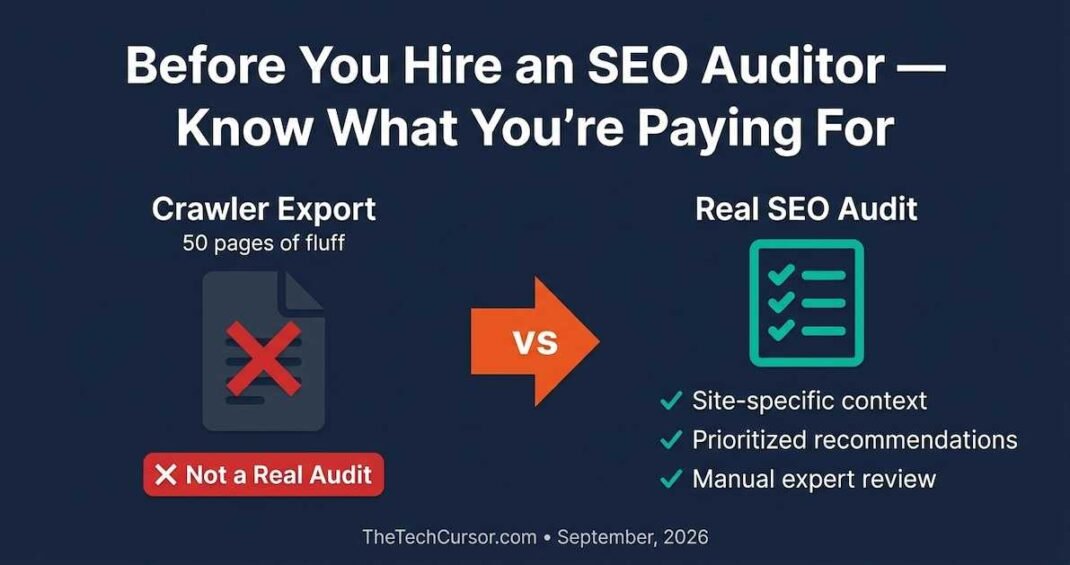
The problem is not that auditors are universally dishonest. It is that buyers rarely know enough about what a genuine audit looks like to distinguish it from an automated report with a professional cover page. This guide gives you that knowledge — before you sign and pay.
1. The Dirty Secret of SEO Audits
The most common SEO audit delivered in 2026 follows a simple pattern: run a site through Screaming Frog or a similar crawler, export the findings, apply some light commentary, and package it as a professional deliverable. The report may be 30, 50, or even 80 pages long. It may include charts, graphs, and technical terminology. It may still be fundamentally a crawler export.
This is a problem for two reasons. First, you could run the same crawler yourself for a fraction of the audit cost — Screaming Frog costs around $259 per year. Second, a crawler export without expert interpretation can actively mislead you. Crawlers flag issues without context. They cannot tell you which issues matter for your specific site, which were intentional, and which fixes would cause more damage than they solve.
A crawler identifies 4xx errors. An experienced SEO tells you which ones matter, which were deliberate, and what to do about the ones that genuinely need fixing. For a full breakdown of which technical SEO tasks are actually worth your time, the distinction matters enormously.
2. Why SEO Audits Matter Even More for AI Search
SEO audits have taken on new importance in the era of AI search — specifically because of how large language models retrieve and verify information.
Most major LLMs do not maintain their own web indexes. Instead, they rely on search engines using retrieval-augmented generation (RAG) to ground their outputs. This means AI search visibility and traditional search visibility share the same technical foundation — making a genuine audit valuable for both. When an LLM generates a response about your brand or category, it often verifies that information against search results before presenting it.
This means the same factors that determine whether your site ranks in traditional search — crawlability, indexability, content quality, technical health — also determine whether AI systems can reliably retrieve and verify information about your brand. A site with crawlability issues or thin content does not just underperform in traditional search. It is also harder for AI systems to fact-check against, reducing your probability of appearing accurately in AI-generated responses.
A genuine SEO audit in 2026 therefore serves both traditional search and AI search simultaneously — making it more commercially important than ever.
3. The Crawler Export Problem
Understanding what a crawler can and cannot do helps you evaluate what you are getting in an audit.
What crawlers do well:
- Identify broken links, redirect chains, and 4xx/5xx errors
- Flag missing or duplicate title tags and meta descriptions
- Surface pages blocked in robots.txt
- Identify thin content by word count
- Map internal link structure
What crawlers cannot do:
- Understand why something was done intentionally
- Know your business goals or audience
- Distinguish between a problem and a deliberate technical decision
- Evaluate content quality beyond word count
- Know which issues will actually move the needle for your specific site
- Account for technical debt — historical decisions that exist for reasons the crawler cannot see
The last point is particularly important. Many sites have pages with thin content that were deliberately kept thin — checkout pages, thank-you pages, internal search results pages — that should never be touched. A crawler flags them. An experienced SEO recognizes they are intentional and ignores them. An inexperienced auditor adds them to the to-do list, creating work that could actively harm your site.
4. Three Contract Clauses to Add Before You Sign
Before paying for any SEO audit, add the following clauses to your agreement. These protect you from receiving a crawler export disguised as professional work — and signal to the auditor that you know what genuine audit work looks like.
Clause 1: Refund for crawler-only deliverables: “A full refund is provided if the audit deliverable consists solely of crawler output with no manual review, discovery, or expert interpretation beyond what the crawler tool itself generates.”
Clause 2: Refund for LLM-only output: “A full refund is provided if the deliverable is substantively identical to what a standard LLM would produce from a basic audit prompt, with no findings that require human expertise, site-specific knowledge, or manual investigation to identify.”
Clause 3: Early notification of limited findings: “If the audit reveals that the site is in strong health and the deliverable will be limited in scope, the auditor will notify the client as soon as possible and offer the option to adjust scope or receive a partial refund reflecting the reduced work required.”
The third clause is important because a genuinely healthy site may only need a 10-page audit — and paying for a 50-page report on a healthy site means paying for filler. An honest auditor will tell you this. These clauses create the contractual expectation that honest assessment is the deliverable, not page count.
5. Run Your Own Crawler First
Before hiring an auditor, run your own site through a crawler tool. This serves two purposes: it familiarizes you with what crawler output looks like, and it gives you a baseline against which to evaluate what the auditor delivers.
Recommended tools:
- Screaming Frog SEO Spider — industry standard, free up to 500 URLs, approximately $259/year for unlimited
- Sitebulb — strong visualization and prioritization features, offers a free trial
Both tools provide explanations for their findings. Reading those explanations gives you a working understanding of what automated audit output looks like. When you receive a professional audit, you can then identify whether the report’s findings and explanations are substantively different from what the tool itself generated — or whether they are essentially the same content repackaged.
If the auditor’s explanation of a finding is nearly identical to the crawler tool’s own documentation, that is a signal that the finding was not independently analyzed. A genuine audit tailors findings and recommendations to your specific site, audience, and business goals — not to the generic guidance in tool documentation.
6. Why LLM Audits Are Not Enough — And Where They Help
AI tools including ChatGPT, Claude, and Gemini can generate SEO audit outputs from basic prompts. Some are surprisingly comprehensive. None of them is sufficient as standalone audits — but understanding why helps you evaluate both AI-assisted audits and traditional audits more clearly.
Where LLM audits fall short:
LLMs are trained on published SEO guidance — much of which is generic, occasionally outdated, or applicable to sites different from yours. An LLM audit prompt will surface common SEO issues. It will not know that your robots.txt blocks a specific folder intentionally, that your thin category pages exist because of a platform constraint, or that your redirect structure reflects a domain migration decision made three years ago.
More importantly, LLMs cannot verify what they find against actual crawl data from your site. They work from what you tell them — and from whatever the tool can access — not from a comprehensive technical picture of your specific infrastructure.
Where LLMs genuinely help:
Used as a second opinion alongside manual review, LLM audit prompts are valuable for surfacing issues a human reviewer might miss. For a proven framework on using Claude AI for structured audits, the same prompt principles apply to SEO auditing. A useful starting prompt structure:
“Audit this website for SEO. Evaluate site structure, crawlability issues, schema markup, thin or competing content, and content gaps. My site is [describe type — ecommerce/lead gen/publisher]. The blog is located at [folder path]. Please prioritize findings by impact and explain why each matters.”
The output gives you a checklist to work through manually — not a finished audit. Use it to supplement human expertise, not replace it.
7. What a Real SEO Audit Actually Delivers
A genuine SEO audit delivers findings and recommendations that could not be produced by running a crawler or prompting an LLM. Specifically, it delivers:
Site-specific context: A real audit asks about your business goals, audience, technical history, and intentional decisions before making recommendations. Findings are filtered through that context — so intentional thin pages are recognized as such, and recommendations are matched to what will actually move the needle for your specific situation.
Prioritized, actionable recommendations. Not every SEO issue is worth fixing. A genuine audit tells you which issues matter most for your site’s specific goals — and in what order to address them. The prioritization should reflect your business context, not a generic severity score from a crawler tool.
Explanations that go beyond tool documentation: Every finding in a real audit should be explained in terms of your specific site — why this issue exists, how it affects performance, and what fixing it would achieve. This directly supports reporting SEO results that executives actually care about — tying technical work to business outcomes.
Honest scope assessment: If your site is in good health, a real audit says so — and adjusts scope accordingly. Padding a report to justify a fee, or inventing issues to fill page count, is a sign of an auditor optimizing for billable hours rather than client outcomes.
8. Get the Deliverable Expectations in Writing
Before the audit begins, ask the auditor to specify in writing what the deliverable will include. Specifically, ask them to clarify what percentage of the deliverable will be crawler output versus manual analysis.
A direct question to ask: “Can you mark in the deliverable which findings came from your crawler and which came from manual review? I want to understand the breakdown.”
An auditor confident in their work will have no problem with this request. An auditor whose deliverable is primarily a crawler export may push back — which tells you something important before you pay.
Also ask about the follow-up call. A genuine audit includes a review session where the auditor walks through findings, answers questions about your specific situation, and explains their reasoning. An audit delivered as a document with no follow-up discussion is an audit that was not designed to be questioned.
9. Red Flags to Watch For When Hiring
Before signing, watch for these signals that an auditor may not deliver genuine value:
Red flag 1: Page count as a selling point: “Our audits are 50+ pages” tells you nothing about the quality of analysis. A 10-page audit of a healthy site from a skilled auditor is worth more than a 60-page crawler export.
Red flag 2: No questions about your business. A genuine auditor asks about your goals, audience, platform, technical history, and intentional decisions before auditing. An auditor who immediately starts crawling without understanding your context is optimizing for speed, not insight.
Red flag 3: Turnaround time that seems too fast. A comprehensive manual audit of a medium-to-large site takes days of focused work. An audit delivered in 24-48 hours was not manually reviewed.
Red flag 4: No mention of technical debt or intentional decisions. Every site has decisions made for reasons the crawler cannot see. An auditor who does not ask about these will either flag intentional decisions as problems or miss important context that changes what the right recommendation is.
Red flag 5: Generic recommendations. Recommendations that could apply to any website — “add more content,” “improve page speed,” “build more backlinks” — without specific application to your site are signs of a template-based audit rather than genuine analysis.
10. Bottom Line
The SEO audit market has a quality problem — and it has gotten worse as AI tools have made it easier to produce convincing-looking deliverables without doing the actual work. The three steps that protect you before hiring are simple:
Run your own crawler so you know what automated output looks like. Prompt an LLM to run a basic audit, so you know what AI-generated findings look like. Then add contract clauses that require the auditor to deliver something their tools cannot produce on their own.
The SEO expertise you are paying for is the judgment that comes from experience: knowing which findings matter for your specific site, which are intentional, which will move the needle, and which are safe to ignore. That judgment cannot be automated. If the deliverable you receive could have been produced without it, you did not get what you paid for.
Pingback: SEO Automation 2026: What to Automate vs. Keep Human - The Tech Cursor
Pingback: The Business Case for SEO Is Changing: Justify Your Budget - The Tech Cursor