
Read time: 7 min
Two developments landed this week that together define where SEO stands heading into Q4 2026.
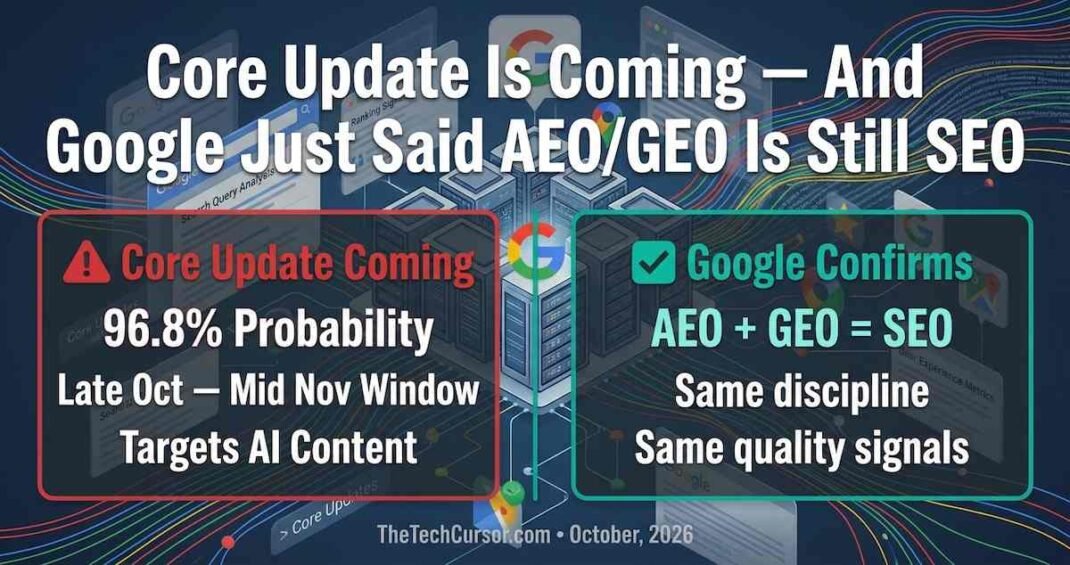
First, a prediction model trained on 25 years of Google updates is forecasting a 96.8% probability of a broad core update in the next 30 days — targeting scaled, low-value AI content in a pattern that echoes Panda.
Second, Google published an official documentation page confirming that AEO and GEO are not separate disciplines from SEO. <cite index=”97-1″>” From Google Search’s perspective, optimizing for generative AI search is optimizing for the search experience, and thus still SEO.”</cite>
Read together, these two developments tell the same story. The next Google update will evaluate AI-era content quality. And the framework for evaluating that quality is the same framework that has always governed SEO — expanded to include generative AI surfaces.
1. Two Stories That Define SEO Right Now
The core update forecast and the AEO/GEO confirmation arrived in the same week. That timing is not coincidental.
Google has been signaling throughout 2026 that its quality evaluation systems are evolving to assess content in AI-powered surfaces — not just traditional search results. The SAFE AI spam detector, deployed earlier this year, evaluates content against the spirit of policies rather than specific rules. The September 2026 spam update — the fourth spam update this year — reflected accelerating enforcement.
A broad core update arriving in late October or early November would represent the next phase of that enforcement. Core updates affect rankings across all content types and do not require a specific trigger. They reflect Google’s periodic recalibration of how it weighs quality signals across its index.
The combination of an imminent core update and Google’s official confirmation that GEO optimization is SEO optimization means that brands investing in AI search visibility are not building a separate capability. They are strengthening the same signals that determine traditional search performance.
2. The Core Update Forecast — 96.8% Probability
<cite index=”92-1″>A prediction model puts the chance of a Google update in the next 30 days at 96.8%. Dan Taylor’s model, trained on 25 years of Google updates and live volatility signals, points to late October to mid-November as the most likely window.</cite>
The model uses historical update patterns alongside current SERP volatility signals to forecast update probability. A 96.8% reading is extremely high — indicating that multiple signals are aligning simultaneously in ways that have historically preceded major algorithmic changes.
<cite index=”92-1″>Google hasn’t confirmed any update, so treat this as a forecast.</cite> Prediction models based on volatility signals are useful leading indicators but not certainties. Google has declined major updates in windows where similar conditions existed before. However, the combination of high model probability, a five-month gap since the last core update, and the specific content signals the forecast is picking up makes this forecast worth acting on.
3. Why Late October to Mid-November Is the Window
<cite index=”92-1″>Google hasn’t run a broad core update since May, and Taylor expects the next one to work as Panda and target scaled, low-value AI content.</cite>
The five-month gap since May is significant. Google typically runs three to four broad core updates per year. With May as the last confirmed update and Q4 beginning, October or November is the statistically likely window for the next one.
Furthermore, the timing aligns with a broader pattern of 2026 enforcement activity. Four spam updates, the deployment of SAFE AI detection, and expanding AI Mode coverage have all occurred this year. A broad core update — which affects the full index rather than specific spam patterns — would be a logical complement to the targeted enforcement that has already happened.
The pre-holiday timing also matters for ecommerce brands. A core update landing in late October or early November affects rankings during the highest-value commercial period of the year. Brands that wait until after the update to respond will lose ground during Q4 that may take months to recover.
4. The Panda Parallel — What Kind of Update This Will Be
The Panda parallel in Dan Taylor’s forecast is the most strategically significant detail in the prediction.
Panda, launched in 2011, targeted thin content, duplicate content, and content farms — sites that produced large volumes of low-quality pages primarily to occupy search rankings rather than serve users. It was not a penalty in the traditional sense. It was a quality classifier that assessed site-level content quality and downranked sites whose content fell below a quality threshold.
An update that “works like Panda” for AI content would follow the same logic. It would not target specific spam signals or individual pages. Instead, it would assess site-level content quality — specifically looking for sites that have published large volumes of AI-generated content without sufficient human expertise, editorial oversight, or genuine added value.
This framing has specific implications. A site with 50 high-quality human-authored articles and 500 low-value AI-generated pages would be more vulnerable to this type of update than a site with 50 high-quality AI-assisted articles that demonstrate genuine expertise and original insight.
<cite index=”94-1″>AI can help with research and structure, but publishing large volumes of pages that add little value can break Google’s scaled content abuse policy. Fact-check AI-assisted copy, add first-hand expertise, and review titles, descriptions, and image alt text before anything goes live.</cite>
5. Google Officially Confirms: AEO and GEO Are Still SEO
The second major development of the week is arguably more strategically significant than the core update forecast — because it settles a question that has been generating confusion and budget debates across the industry.
<cite index=”97-1″>In a new documentation page, Google addresses the elephant in the room: AEO, GEO, and SEO. To make a long story short, “From Google Search’s perspective, optimizing for generative AI search is optimizing for the search experience, and thus still SEO.”</cite>
AEO — Answer Engine Optimization — refers to optimizing content for conversational AI answers. GEO — Generative Engine Optimization — refers to optimizing for AI-generated search responses more broadly. Both have been positioned by some vendors and consultants as distinct disciplines requiring separate budgets, separate teams, and separate strategies from traditional SEO.
Google’s documentation page directly contradicts that framing. Optimizing for AI search and optimizing for traditional search are not separate activities — they are the same activity evaluated against the same underlying quality principles.
6. What Google’s Documentation Actually Says
The documentation Google published does not simply assert that AEO and GEO are SEO. It explains the logic behind that assertion.
Google’s AI-powered search features — AI Overviews, AI Mode, and related surfaces — are not separate ranking systems running on different principles from organic search. They draw on the same fundamental quality evaluation that determines traditional search rankings. Content that genuinely serves users, demonstrates real expertise, and provides accurate information performs well across both traditional search and AI search for the same underlying reason: it satisfies Google’s quality criteria.
Consequently, the best practices for AI search visibility and the best practices for traditional SEO are not two separate lists. They are the same list. E-E-A-T signals — Experience, Expertise, Authoritativeness, Trustworthiness — matter in AI Overviews for the same reason they matter in traditional search results. Technical accessibility matters for AI crawlers for the same reason it matters for Googlebot. Entity clarity matters for AI citation for the same reason it matters for Knowledge Panel eligibility.
The 5 GEO pillars framework covers this in detail. Credibility, Relevance, Structure, Freshness, and Reach are not GEO-specific pillars. They are SEO pillars that apply with equal force to AI search surfaces.
7. Why This Confirmation Matters Strategically
Google’s AEO/GEO = SEO confirmation has direct implications for three practical situations that many organizations are navigating right now.
Budget allocation: Some organizations have been debating whether to add a separate GEO budget alongside their SEO budget — treating AI search optimization as an entirely distinct investment. Google’s confirmation eliminates the theoretical justification for that separation. GEO work and SEO work that addresses the same quality signals should share the same budget pool — organized by economic purpose as covered in the SEO budget justification framework, not by channel label.
Team structure: Organizations that have been building or hiring separate “AI search” teams may need to reconsider whether separate teams are appropriate when the underlying optimization work is the same. Specialist knowledge of prompt tracking, AI citation monitoring, and AI-specific content structure is genuinely valuable — but it sits alongside, not separate from, core SEO knowledge.
Vendor evaluation: Vendors selling standalone GEO services as distinct from SEO services should now be evaluated against Google’s own statement. If a vendor’s GEO offering addresses quality signals that genuinely differ from SEO signals, the offering may have merit. If the GEO offering is primarily relabeled SEO work with AI branding, Google has now made it clear that the relabeling is not substantively meaningful.
8. What to Do Before the Core Update Hits
With a high-probability core update forecast for late October to mid-November, the next two to three weeks are the most valuable window for preparation.
Audit your AI-assisted content volume: If your site has published significant volumes of AI-assisted content in 2026, conduct an honest quality audit now. Identify pages where human expertise, editorial review, and genuine added value are absent. Prioritize the highest-traffic and highest-commercial-value pages for immediate improvement — or consider removing or noindexing pages that add no genuine value.
Check for fabricated author profiles: <cite index=”96-1″>Google’s guidance on creating helpful content tells site owners to avoid deceptive authorship information, naming made-up names, false credentials and AI-generated headshots. Accuracy matters, and so does honesty about who is behind the page.</cite>
Review your author attribution across all content. Named authors should be real people with verifiable credentials. AI-generated headshots paired with fictional expert names are a direct violation of Google’s guidance — and a likely signal that a Panda-style quality classifier would flag.
Establish your content baseline: Record your current Search Console performance data, ranking positions for priority keywords, and AI citation share across your key prompts. This baseline allows you to measure the update’s actual impact accurately — distinguishing genuine penalty from normal volatility during the rollout.
Do not make major site changes during the rollout: Once the update begins rolling out, stop making large-scale content changes until the rollout is complete. Changes made mid-rollout are difficult to evaluate and can compound the volatility rather than resolve it.
9. What to Do After the Core Update Hits
If the core update produces a significant ranking or traffic change, the response framework follows the same logic that applies to any quality-based algorithm update.
Wait for the rollout to complete: Core updates typically take one to three weeks to complete. Assessing impact before rollout completion produces unreliable conclusions. Monitor trends but avoid reactive changes until the data stabilizes.
Diagnose before fixing: Identify which pages and which content categories were most affected. If the impact is concentrated in AI-generated content, thin content, or content without credible authorship, the diagnosis points directly to what needs to be fixed.
Improve quality, not signals: Core update recoveries require genuine quality improvement — not technical optimizations designed to game quality signals. The Google 14-point content quality checklist provides a structured framework for assessing what genuine improvement looks like for each affected page.
Track AI citation share alongside traditional metrics: Given Google’s confirmation that AI search and traditional search optimization are the same discipline, recovery should be measured across both surfaces. The AI visibility dashboard framework covers how to track both traditional search performance and AI citation share in a unified view.
10. Bottom Line
Two developments this week converge on a single strategic message: the rules of SEO have expanded to include AI search surfaces, and Google is preparing to enforce those rules at core update scale.
The 96.8% core update probability is a forecast, not a certainty. However, the five-month gap since May, the specific AI content signals the model is picking up, and the Panda parallel make it a forecast worth preparing for — now, before the update window opens.
Google’s AEO/GEO = SEO confirmation is not a forecast. It is an official statement that settles a strategic debate. Brands that have been treating AI search optimization and traditional SEO as separate budgets, separate teams, and separate strategies are working against Google’s own stated framework.
The Three Actions to Take This Week
First: Audit your AI-assisted content against genuine quality standards — expertise, accuracy, named authorship, and real added value. Improve or remove pages that fail this audit before the update window opens.
Second: Consolidate your AI search and SEO strategies under a unified quality framework. Google has confirmed they are the same discipline. Your planning and reporting should reflect that.
Third: Establish your pre-update baseline in Search Console and your AI visibility dashboard so you can measure the update’s impact accurately when it arrives.
Pingback: Google November 2026 Core Update: What We Know So Far - The Tech Cursor
Pingback: 8 SEO Priorities to Rethink for AI Search — 4 to Emphasize More, 4 to Drop - TheTechCursor